
Prichard “Digget” Colón Passes Age 33,
Nearly 11 Years After Boxing Injury Changed His Life!
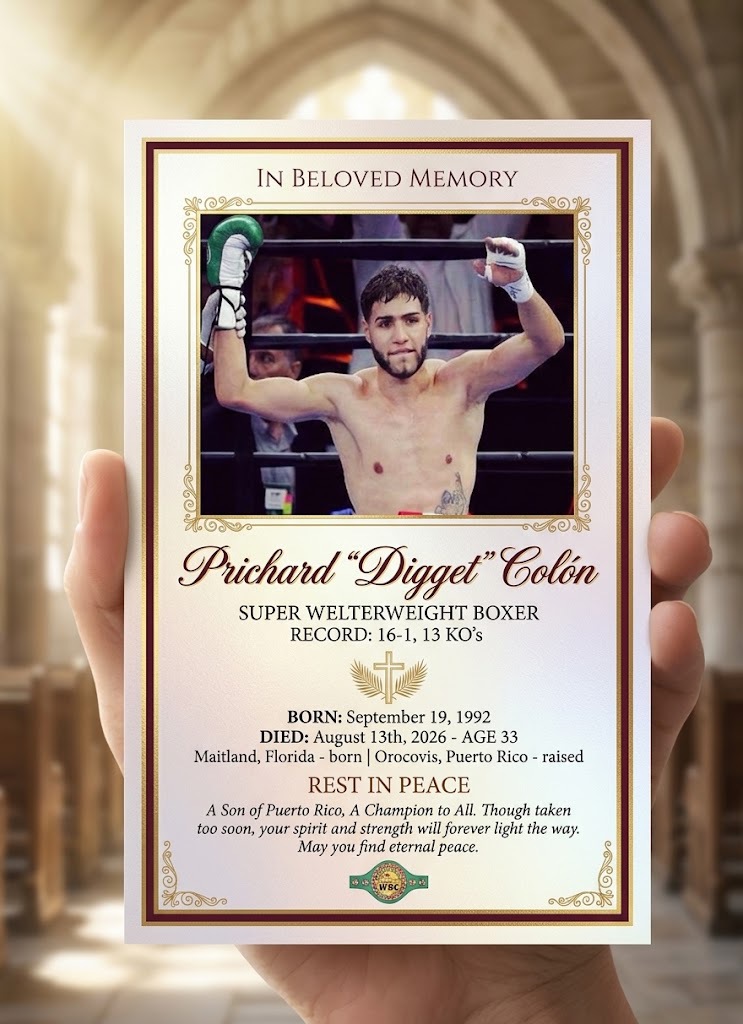
(August 13th) Prichard “Digget” Colón, the gifted Puerto Rican boxing prospect whose promising career was abruptly ended by a devastating brain injury in 2015, passed today, Thursday, August 13th, 2026. He was 33. Colón died at home in Florida, surrounded by the family that had cared for him throughout the nearly 11 years since the fight that changed his life. His father, Richard Colón, confirmed his death and expressed gratitude to the many people who had supported the family through years of love, prayers and unwavering support. No specific medical cause of death has been made public.
Details regarding a wake, funeral or private memorial had not been released at the time of publication. Separately, Puerto Rico Governor Jenniffer González announced that a day of mourning would be decreed in Colón’s honor, calling him a source of pride for Puerto Rico. She also extended her condolences to Colón’s parents, Richard and Nieves, who cared for their son for so many years, describing them as “two gladiators.”
Colón was born September 19th, 1992, in Maitland, Florida, and raised in Orocovis, Puerto Rico. Boxing was part of his family life from an early age. His father, Richard, had served in the military, boxed himself and later helped train his son. Colón developed as both a student and an athlete at the Albergue Olímpico in Salinas, Puerto Rico, where he continued his boxing and academic development and earned the nickname “Digget.” He later studied Business Administration at the Universidad del Sagrado Corazón in San Juan.
His amateur career quickly established him as one of Puerto Rico’s standout young boxers. Colón won five national championships in the 141- and 152-pound divisions and captured gold at the 2010 Pan American Youth Championship in the 64-kilogram division. He also competed in the qualification tournament for the 2012 London Olympics, where his run ended against Venezuela’s Gabriel Maestre. His amateur record has been reported as 170–15.
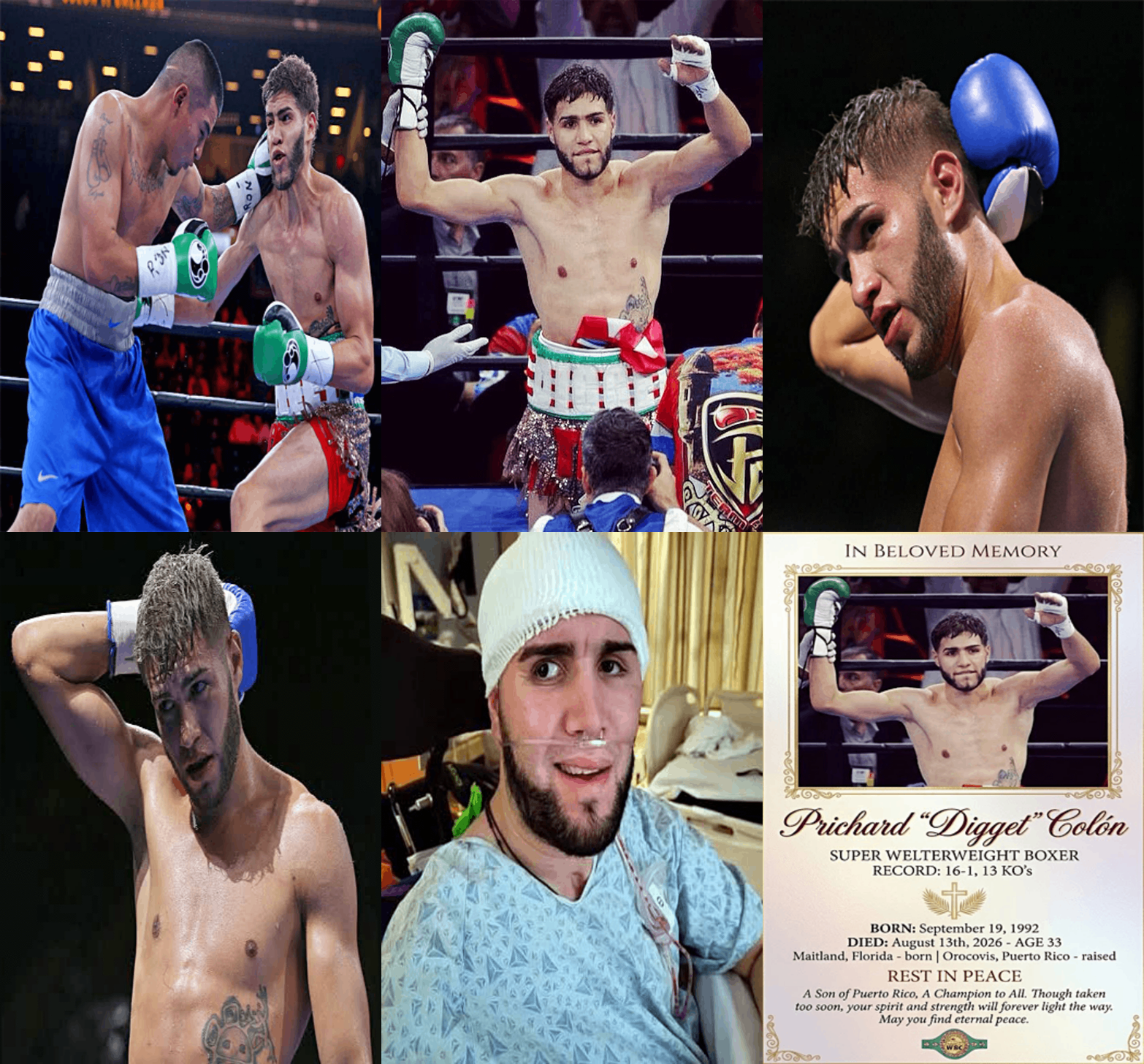
Colón turned professional at age 20 and made his pro-debut on February 23, 2013, in Cataño, Puerto Rico, stopping Xavier LaSalle in the first round. He fought five times in 2013 and seven times in 2014, winning every bout. His combination of size, speed, technique and punching power quickly attracted attention, and he emerged as one of the most closely watched prospects from Puerto Rico.
By 2015, the momentum was unmistakable. On September 11 of that year, Colón faced former world champion Vivian Harris in Toronto. He stopped Harris in the fourth round, improving his record to 16–0 with 13 knockouts. At 23, Colón appeared to be approaching the biggest opportunities of his career. Thirty-six days later, everything changed.
On October 17, 2015, Colón entered EagleBank Arena in Fairfax, Virginia, to face unbeaten Terrel Williams in a scheduled 10-round bout. Colón was 16–0, while Williams was also undefeated. During the fight, Colón repeatedly complained about punches landing to the back of his head, illegal blows commonly known as “rabbit punches.” The complaints became a recurring feature of the contest.
There were fouls on both sides. In the fifth round, Colón landed a low blow that referee Joe Cooper ruled intentional, resulting in a two-point deduction. In the seventh, Williams was penalized one point for a rabbit punch. The distinction remains important when describing what ultimately happened to Colón. Although the fight included repeated illegal blows to the back of the head and Colón suffered a devastating brain injury, a subsequent Virginia investigation did not identify a single action sufficiently apparent or egregious to assign responsibility to one person. What is not in dispute is what followed.
The fight reached the ninth round, when Williams knocked Colón down twice—the first professional knockdowns of Colón’s career. At the end of the round, members of Colón’s corner began removing his gloves, apparently believing the scheduled 10-round contest had ended. When they realized that one round remained, they attempted to prepare him to continue, but Colón could not answer the bell. Referee Joe Cooper disqualified him, giving Colón the first defeat of his professional career. The official result was a ninth-round disqualification loss, leaving him with a final professional record of 16–1 with 13 knockouts.
The result on the scorecard, however, was almost meaningless compared with what was happening to the young fighter. After returning to the dressing room, Colón became dizzy and nauseated, vomited and collapsed. He was taken to Inova Fairfax Hospital, where doctors discovered a severe brain injury and performed emergency surgery to relieve pressure and address the bleeding. The injury ended Colón’s boxing career at 23.
Colón spent 221 days in a coma. When he emerged, he had profound neurological impairment and required extensive rehabilitation and around-the-clock care. Contemporary reporting described the severity of his condition, while later accounts documented the extraordinary challenges faced by his family as they cared for him. The young boxer who had once dreamed of championship belts now needed assistance with the most basic aspects of everyday life.
For nearly 11 years, Richard and Nieves Colón and their family remained committed to Prichard’s care. There were therapies, rehabilitation efforts, medical challenges and periods of hope, but also countless ordinary moments that never made headlines: caring for him, supporting him and simply being present. The fighter who once walked into arenas under bright lights became a young man whose world was largely defined by the people who refused to leave his side.
The tragedy also led to a lengthy legal battle. In 2017, Colón’s parents filed a lawsuit seeking more than $50 million against ringside physician Richard Ashby and promoters associated with the event. The lawsuit alleged failures in the handling of Colón during and after the fight. Those claims were allegations made in civil litigation and should not be characterized as established findings of legal responsibility. The Virginia investigation likewise stopped short of assigning responsibility to a particular individual.
Colón’s name nevertheless became permanently linked to one of boxing’s most dangerous fouls: punches to the back of the head. In 2016, the World Boxing Council introduced what became known as the “Prichard Colón Rule,” calling for a zero-tolerance approach to rabbit punches and emphasizing strict enforcement of existing rules designed to protect fighters from such blows. In 2021, the WBC honored Colón as an Honorary World Champion, recognizing his courage and the perseverance of his family.
It is impossible to discuss Prichard Colón without acknowledging the career that never happened. His professional record ended at 16–1 with 13 knockouts. There would be no title fights, no world championship and no opportunity to see how far his talent might have taken him. There would be no chance to discover whether the young fighter from Puerto Rico could become one of the sport’s stars. Those questions remain unanswered.
But the career he did have was significant. He was a five-time national amateur champion, a Pan American Youth gold medalist and an Olympic hopeful. He turned professional at 20 and won his first 16 fights. He stopped a former world champion in Vivian Harris. At 23, he was 16–0 with 13 knockouts and appeared to be on the doorstep of something special.
Instead, October 17, 2015, became the final night of his boxing career and the beginning of an extraordinarily difficult chapter for his family. His professional career lasted less than three years. His fight outside the ring lasted nearly 11.
Prichard “Digget” Colón died on August 13, 2026, at the age of 33. He died at home in Florida, surrounded by the people who had cared for him since the worst night of his life. His death closes a chapter that began with extraordinary promise and ended in tragedy, but it does not erase what came before—or what followed.
The boxing world will remember the knockouts, the unbeaten record, the fight with Terrel Williams and the “Prichard Colón Rule.” But perhaps most of all, it should remember the young man behind the headlines—and the family who never stopped fighting for him.
Prichard “Digget” Colón was 33 years old.
 Print
Print