
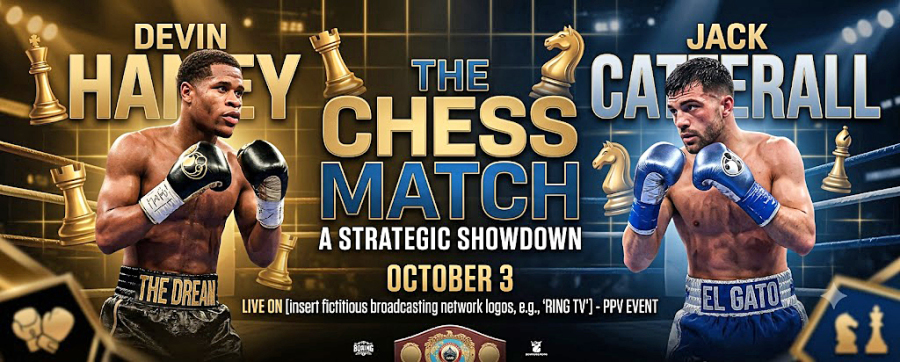
Paro Out, Devin Haney vs. Jack Catterall
“Chess Match” In The Works For October 3!
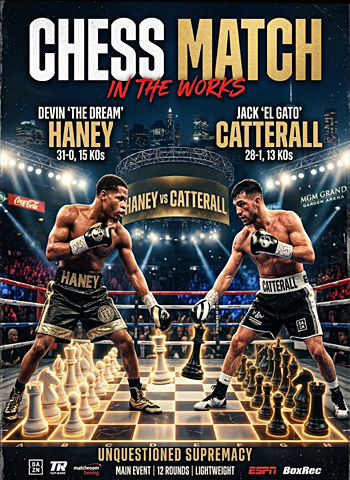
(August 8th) Advanced negotiations are reportedly underway for a high-stakes 147-pound showdown between WBO Champion Devin Haney and newly crowned WBA World champion Jack Catterall.
The search for Devin “The Dream” Haney’s next opponent appears to be narrowing toward a familiar name.
Multiple boxing outlets report that Haney and Catterall are in advanced negotiations for an October 3, 2026, showdown, with Haney’s WBO welterweight championship expected to be on the line. The fight has not yet been officially announced, and key event details, including the venue, broadcaster and finalized contractual terms, remain unconfirmed.
Catterall’s emergence as a potential opponent represents a significant development in a welterweight division increasingly complicated by mandatory challengers, purse-bid disputes and competing championship obligations.
For Haney, the proposed fight would be the first defense of the WBO welterweight championship he captured in November 2025, when he moved up to 147 pounds and defeated previously unbeaten Brian Norman Jr. by unanimous decision in Riyadh, Saudi Arabia. Haney dropped Norman in the second round with a left hook-right hand sequence and went on to win on scorecards of 114-113, 116-111 and 117-110. The victory made Haney a three-division world champion and established him as the WBO’s reigning welterweight titleholder.
The Norman victory also demonstrated why Haney’s skill set has translated effectively to the 147-pound division. Rather than relying on one-punch power, the former undisputed lightweight champion used distance, timing, defensive positioning and controlled combinations to neutralize Norman’s physical strength and punching threat. The performance was not without criticism—Haney’s safety-first approach remains a recurring point of debate—but strategically it confirmed that his boxing fundamentals could function against naturally larger opposition.
Now, however, the champion is facing a substantially different proposition.
Haney’s path to his first WBO title defense has been anything but straightforward. The WBO formally ordered Haney to face Keyshawn Davis, who was positioned as the mandatory challenger. When negotiations failed to produce a deal, the WBO ordered a purse bid, with the sanctioning body formally documenting the Haney-Davis mandatory championship contest in July.
Top Rank ultimately won the purse bid with an $8.55 million offer, leaving Davis entitled to 25 percent under the applicable split. That translated to approximately $2.14 million for Davis, while Haney's share was approximately $6.41 million. Davis subsequently informed the WBO that he would not proceed with the fight, citing dissatisfaction with the financial terms. Reuters confirmed the withdrawal and reported that the WBO would review the matter through its Championship and Ratings Committees.
The collapse removed the mandatory challenger from Haney’s immediate schedule and reopened the question of who would receive the opportunity to challenge for the WBO belt.
Attention then shifted to Liam Paro, with the Australian IBF champion reportedly emerging as a potential opponent in what could have been a significant welterweight unification. Those negotiations, however, also failed to materialize. Current reporting attributes the breakdown to financial expectations, with reports describing Paro’s demands as excessive. That characterization should be treated as a reported account rather than an independently established fact, because the precise terms of the negotiations have not been publicly disclosed.
With Davis out of the picture and talks with Paro stalled, Catterall has emerged as the most compelling alternative.
The timing is significant because Catterall is no longer simply a dangerous contender seeking another opportunity. He is now the reigning WBA World welterweight champion.
On May 23, Catterall traveled to the Pyramids of Giza in Egypt and defeated Shakhram Giyasov by unanimous decision to capture the vacant WBA World welterweight championship. The WBA’s official records list Catterall as the winner by unanimous decision, with reported scorecards of 118-109, 119-108 and 117-110. He also scored an early knockdown, delivering a disciplined performance built on effective distance management, sharp punching and tactical control. The victory completed a remarkable transformation for a fighter whose career was once defined primarily by one controversial night.
Catterall’s modern career was dramatically altered by his first meeting with Josh Taylor in February 2022.
Catterall entered that fight as the mandatory challenger and produced one of the strongest performances of his career. He knocked Taylor down and appeared to many observers to have done enough to win the undisputed junior-welterweight championship. Instead, Taylor received a controversial split decision. The official scorecards read 113-112 for Catterall, 114-111 for Taylor and 113-112 for Taylor. The result generated widespread debate and left Catterall waiting more than two years for another opportunity.
The rematch finally arrived in May 2024 in Leeds. This time, Catterall received the decision.
He defeated Taylor by unanimous decision, with scores of 117-111, 117-111 and 116-113, avenging the only official defeat on his record at that point and reinforcing the argument that his performance in the first fight had not been a one-night anomaly. ESPN described the victory as the revenge Catterall had pursued throughout the lengthy wait between the two contests.
Catterall subsequently continued building his résumé at 147 pounds, defeating Harlem Eubank and Ekow Essuman before facing Giyasov. The WBO’s 2026 records had already positioned Catterall highly in the welterweight picture, recognizing his move into the division and his victories over Eubank and Essuman. The Giyasov victory changed his status from contender to champion.
Catterall’s new championship has also created a significant political wrinkle. Before Catterall and Giyasov fought, the WBA elevated Rolando “Rolly” Romero to Super Champion. The sanctioning body then approved Catterall-Giyasov for the vacant WBA World championship and ordered Romero to face the winner within a maximum period of 180 days.
That means Catterall entered the Haney negotiations with an existing WBA obligation hanging over him.
A fight with Romero would give Catterall the opportunity to consolidate the WBA’s welterweight championship structure. A fight with Haney, by contrast, would put him directly against the reigning WBO champion and potentially give him an opportunity to add the WBO belt to his collection.
The distinction is important because Haney-Catterall would not technically be a full four-belt unification. Haney holds the WBO world championship, while Catterall holds the WBA World title and Romero has been elevated to WBA Super Champion. The proposed fight would therefore be a championship clash between two recognized world titleholders, but it would not simultaneously unify every major welterweight belt.
For Catterall, the choice is therefore about more than matchmaking. It is about leverage. From Haney’s perspective, Catterall solves several problems at once.
First, he is a credible world-level opponent. Haney’s WBO reign has stalled before it could properly begin, and with two consecutive opponent negotiations collapsing, the champion would have been vulnerable to criticism if he simply selected a lesser-known voluntary challenger.
Catterall provides a recognizable name, a legitimate championship résumé and a style that makes the fight difficult to dismiss.
Second, Catterall presents a tactical challenge that fits directly into the larger question surrounding Haney at 147 pounds.
Haney has established himself as one of boxing’s premier technicians. His strengths remain his jab, footwork, defensive awareness, distance management and ability to control the rhythm of a fight. But his lack of consistent knockout power against larger opponents means his championship fights are often decided by his ability to win rounds rather than overwhelm his opponents.
Catterall represents a particularly interesting test because he is also a technically minded boxer. A southpaw with a disciplined approach, a strong understanding of range and the ability to change rhythm without abandoning his defensive structure. His performance against Giyasov showed that he can impose his own pace against a high-level opponent rather than simply react to one. That creates the possibility of a high-level chess match rather than a conventional champion-versus-challenger shootout.
Catterall’s motivation is arguably even more obvious. For years, he has been searching for the kind of marquee opportunity that would allow him to move beyond the controversial Taylor fight and establish his own identity at the elite level. He now has that opportunity.
Haney is one of the biggest names available to him at 147 pounds, a former undisputed lightweight champion and current WBO welterweight titleholder. A victory would not merely add another major name to Catterall’s résumé—it would give him a second recognized world championship and potentially position him as one of the central figures in the division.
There is also history between the two fighters. Haney and Catterall have been linked since their days around the junior-welterweight division, and Catterall has previously expressed interest in the matchup. The proposed October fight would therefore represent the culmination of a rivalry that has existed more as a possibility than an actual contest. Now, both men have arrived at 147 pounds with championships.
Stylistically, Haney-Catterall has the ingredients of an unusually sophisticated championship fight.
Haney is likely to seek the outside lanes, establish his jab and force Catterall to reset before he can build sustained offense. The champion’s objective would be to control distance, deny Catterall clean entries and bank rounds without allowing the southpaw to dictate the tempo.
Catterall, meanwhile, has shown that he is comfortable fighting patiently. He does not need to force exchanges to win rounds. Against Giyasov, he demonstrated the ability to score from range, use footwork to disrupt his opponent’s positioning and capitalize when opportunities appeared.
The southpaw-versus-orthodox matchup could make lead-hand positioning particularly important. Both fighters are accustomed to operating behind technically sound jabs, meaning the battle for distance and initiative could determine whether the contest becomes a tactical masterclass or eventually opens into a more aggressive fight.
The question may ultimately come down to who can impose his preferred geometry.
If Haney controls the center and dictates the range, his defensive discipline and ability to accumulate clean scoring punches could make him extremely difficult to beat.
If Catterall consistently disrupts Haney’s rhythm, forces him backward and turns the fight into a series of short tactical exchanges, the challenger has the tools to make every round competitive.
The reported October 3rd date a target rather than a finalized event date, while reports describe negotiations as advanced, beginning stage might be a closer description as no official announcement has established the venue, broadcaster, or finalized contractual details. That distinction matters in boxing, particularly when sanctioning-body obligations are involved.
Catterall's WBA position remains relevant because the WBA ordered Romero to face the winner of Catterall-Giyasov within 180 days. Any move toward Haney must therefore coexist with, or receive appropriate treatment under, the WBA's championship structure. The exact resolution of that obligation has not been publicly established.
Haney-Catterall would arrive at a fascinating moment for the 147-pound division. Haney has already proven that he can win a world championship at welterweight. Catterall has now done the same. Both are coming off significant victories, both possess elite-level technical ability, and both have unfinished business in terms of establishing themselves among the division's defining names.
For Haney, the assignment is clear: make the WBO championship reign real by defending it against a fighter with his own world title and a reputation built through adversity.
For Catterall, the opportunity is equally clear: turn the lessons of the Taylor saga, the victory over Giyasov and years of persistence into a defining championship win.
The proposed fight also illustrates the complicated reality of modern boxing. Mandatory positions, purse bids, voluntary defenses, secondary championships and competing sanctioning-body obligations can determine a championship schedule almost as much as what happens inside the ring.
Haney did not necessarily arrive at Catterall because the matchup was the first option. He arrived here because other roads closed. But that does not make the fight less meaningful.
If the October 3 agreement is completed, Haney and Catterall could transform a period of promotional uncertainty into one of the most intriguing technical matchups of the fall—a WBO welterweight championship fight between two elite boxers whose careers have been shaped by control, controversy, persistence and the refusal to accept anything less than another opportunity at the top.
Haney has the WBO belt. Catterall has the WBA championship.
Now the question is whether the two can finally meet in the same ring.
Haney vs. Catterall: October 3 is the target. The deal is not yet official. The stakes, however, are already very real.
 Print
Print