
Zolani “Last Born” Tete:
Two-Weight World Champion
Remembered After Tragic Death At 38!
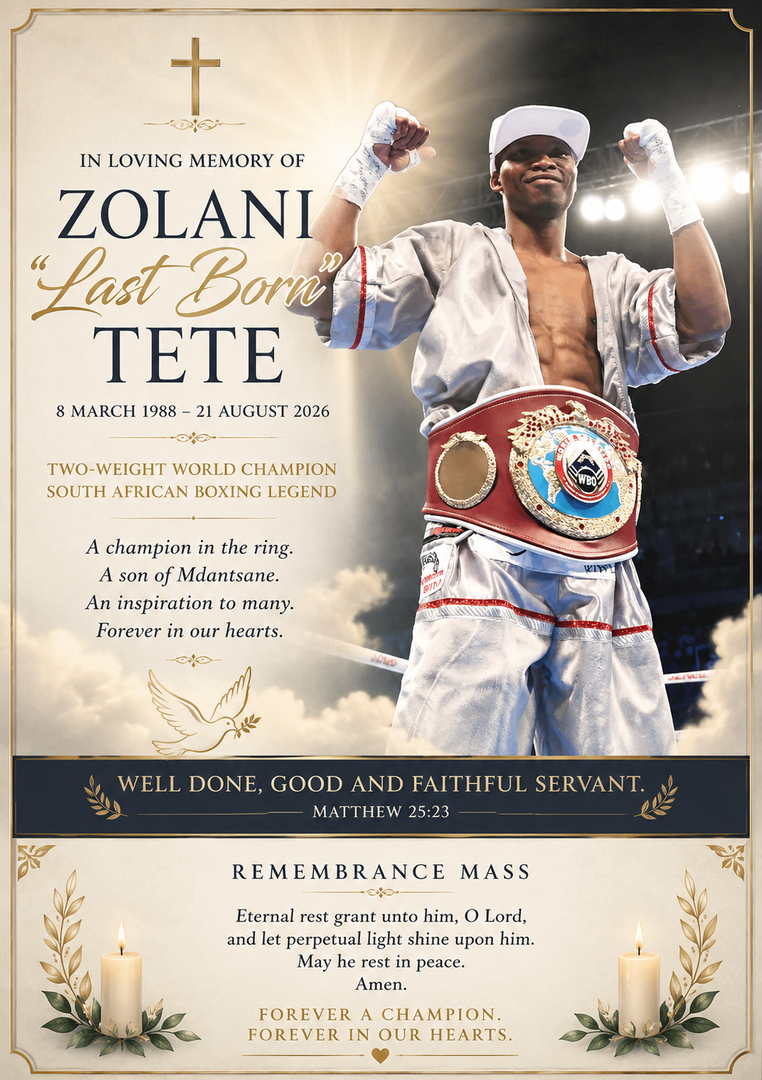
(August 22nd) South African boxing is mourning the death of former two-weight world champion Zolani “Last Born” Tete, who was fatally shot outside his home in Mdantsane on Friday evening, August 21, at the age of 38.
Tete was attacked as he arrived at his residence and waited for the gate to open. According to preliminary police reports, two-armed suspects wearing balaclavas emerged from another vehicle and opened fire on Tete and a 27-year-old woman travelling with him. Tete attempted to drive into his yard but suffered fatal injuries and was declared dead at the scene. The woman was also shot multiple times and was taken to hospital. Police have opened an investigation into the killing, while the suspects remain at large and the motive has not been established.
The circumstances of his death have sent shock waves through South African boxing. Tete was not simply a former world champion; he was one of the most accomplished fighters to emerge from Mdantsane, a township with a proud and distinguished boxing tradition.
Born on March 8, 1988, in Mdantsane, Tete was raised in the community that would remain central to his identity throughout his life. His nickname, “Last Born”, reflected his place within his family, while his boxing career began remarkably early.
Tete said he first became involved in boxing at the age of eight after he and his brother began sneaking away to a local gym. He recalled that boxing entered his life after the brothers had been bullied and discovered the sport as a means of learning discipline, confidence and self-defense.
His amateur background was extraordinary by any measure, although the precise number of contests came from Tete’s own account rather than a formally documented official record. He said he competed in more than 400 amateur bouts and suffered only three defeats, one of them against his own brother in a provincial final.
Tete also recalled being exceptionally small for his age. For one competition, he said, he had to put stones in his underwear to reach the minimum weight of 26 kilograms. He claimed three national gold medals and a bronze at an African zonal tournament, despite having only a handful of senior amateur contests before turning professional. Those early experiences helped shape a fighter who would eventually become an unusual physical presence in the lighter weight divisions.
Listed at 5 feet 9 inches with a 72-inch reach, Tete was a tall, rangy southpaw who possessed speed, accuracy and considerable punching power. He worked with respected South African trainers including Nick Durandt and Dundu Bungu, the latter himself a former world champion who emerged from the same Mdantsane boxing tradition. His international career was later developed under British promoter Frank Warren.
A Professional Career Built on Resilience, Tete turned professional on May 27, 2006, beginning a career that would ultimately encompass 34 bouts.
He won his first eight professional contests by stoppage and quickly established himself as one of South Africa’s most promising young fighters. In September 2007, he captured the World Boxing Foundation flyweight championship and successfully defended the title twice.
In September 2008, came an unexpected interruption. Shortly before a scheduled fight against Argentina’s Sergio Carlos Santillan, Tete collapsed at home and suffered convulsions and a loss of consciousness. Contemporary reports described the episode as an epileptic fit. He was hospitalized and underwent several days of medical testing, but doctors were unable to establish a definitive cause.
The episode kept him out of the ring for approximately eight months and forced him to relinquish his WBF title. For a young fighter whose career had appeared to be gathering momentum, it was a significant setback.
Tete responded in the only way he knew. He returned to the ring in March 2009 and stopped Rexon Flores in just 28 seconds. The explosive comeback was an early indication that the qualities that had made him such a dangerous prospect, speed, timing and power—had survived the lengthy absence.
From there, Tete continued to climb through the professional ranks. He defeated a number of respected opponents, including Juan Carlos Sánchez Jr., Paul Butler and Omar Narváez, and gradually established himself as a genuine international contender.
Tete’s first major world-title breakthrough came on July 18, 2014, when he travelled to Kobe, Japan, to challenge Teiru Kinoshita for the vacant IBF junior-bantamweight championship.
Over 12 rounds, Tete produced a disciplined performance and won a unanimous decision to become a world champion for the first time.
The victory confirmed that his unusual physical dimensions could be a major advantage at the lighter weights. His height and reach allowed him to fight from distance, while his southpaw stance and speed created difficult problems for opponents. He subsequently defended the IBF title against Paul Butler in Liverpool before eventually vacating the championship. But Tete was not finished. His second world-title reign produced the defining moment of his career.
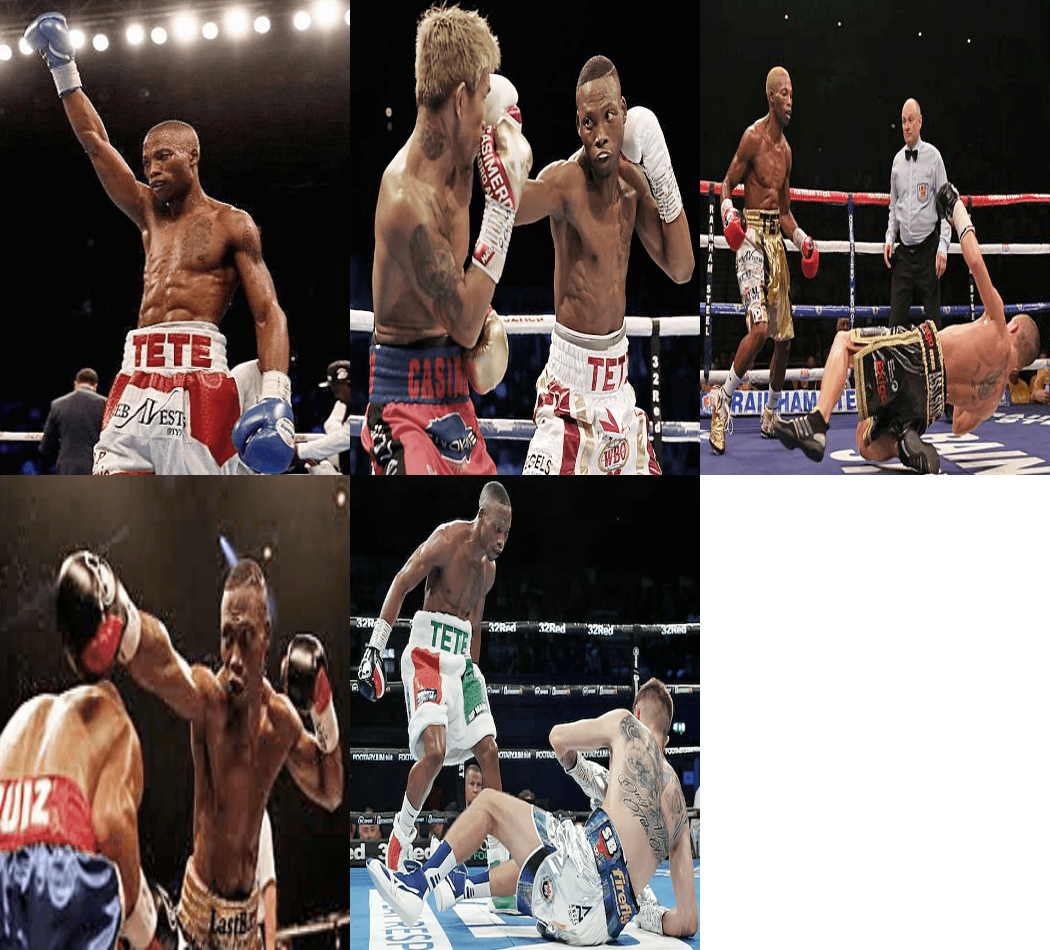
After moving up to bantamweight, Tete captured the WBO interim championship in 2017 and was subsequently elevated to full world champion. On November 18, 2017, at the SSE Arena in Belfast, he defended his WBO bantamweight title against fellow South African Siboniso Gonya. The fight lasted just 11 seconds.
Tete landed a right hand in the opening seconds, dropping Gonya and prompting the referee to stop the contest. The victory entered boxing history as the fastest knockout in a world-title fight and became the defining statistical achievement of Tete’s career.
Tete had previously recorded an even faster professional stoppage—10 seconds against Xolile Ngemntu—but the Gonya knockout carried a different significance. This was a world championship defense, and the extraordinary brevity of the contest made Tete an international boxing curiosity overnight. More importantly, it demonstrated the combination of speed, timing and power that had distinguished him throughout his career.
Tete subsequently defended the WBO bantamweight championship against respected opposition, including former world champion Omar Narváez and Mikhail Aloyan.
His reign eventually ended in November 2019 when he lost the title to John Riel Casimero. By then, however, Tete had already secured his place among South Africa’s most accomplished modern fighters. He had won world championships in two weight classes and had carried the South African flag into major boxing arenas around the world.
The difficult final chapter, Tete’s final professional appearance came in July 2022 against Britain’s Jason Cunningham at Wembley Arena in London.
Tete initially won by fourth-round knockout, but the result was subsequently changed to a no-contest following an anti-doping case involving stanozolol, an anabolic androgenic steroid.
UK Anti-Doping imposed a four-year period of ineligibility. The sanction commenced on July 30, 2022, and expired at 23:59 on July 29, 2026, making Tete eligible to return to competition shortly before his death. The suspension became the most difficult chapter of his boxing career.
Tete maintained that he had not knowingly taken the prohibited substance and continued to speak about his desire to return to the ring. Earlier in 2026, he was reported to be preparing for a comeback after the expiry of his suspension.
After four years away from professional competition, another chapter appeared to be within reach. Instead, his life ended violently outside the Mdantsane home that had remained central to his story.
A Tragedy in Mdantsane, police said the attack occurred as Tete waited for the gate of his residence to open.
Two-armed suspects wearing balaclavas allegedly emerged from another vehicle and opened fire. Tete attempted to drive into the property but suffered fatal injuries.
The 27-year-old woman accompanying him was also wounded and remains under medical care.
The motive for the attack has not been established, and authorities have not publicly identified the suspects. South African officials have urged the public not to speculate about the circumstances while the investigation continues.
South Africa’s Minister of Sport, Arts and Culture, Gayton McKenzie, mourned Tete and described him as one of the finest fighters the country had produced, while appealing for information that could assist the investigation.
For a boxer who had spent his life overcoming adversity, the circumstances of his death are particularly painful.
A legacy beyond the numbers, Tete leaves boxing with a professional record of 29 victories, including 22 knockouts, four defeats and one no-contest in 34 bouts.
His career took him through the flyweight, junior-bantamweight, bantamweight and super-bantamweight divisions. But numbers alone cannot adequately describe his significance.
Tete was a fighter who began boxing as a small child in Mdantsane and grew into a world champion. He overcame an unexplained health crisis early in his professional career, rebuilt his momentum, won championships in two divisions and produced one of the most extraordinary knockouts in world-title boxing history.
He also represented a remarkable continuity in the boxing history of Mdantsane.
The township has produced numerous distinguished fighters, and Tete carried that tradition onto the international stage. He brought the name of his home community to championship arenas in Japan, Britain and elsewhere, becoming one of the most recognizable boxers to emerge from the Eastern Cape.
For boxing historians, the 11-second destruction of Siboniso Gonya will forever be the statistical headline.
For those who followed Tete’s entire career, however, his legacy is broader.
It is the story of a young boy who discovered boxing at eight years old, a small amateur who dreamed beyond his physical limitations, a professional who endured setbacks, and a champion who ultimately conquered two weight divisions.
It is the story of a fighter whose career contained extraordinary achievement, difficult adversity and remarkable resilience.
What might have been, perhaps the most poignant element of Tete’s death is its timing. His four-year suspension had expired only weeks earlier. After years away from professional competition, he was once again eligible to box. Reports indicated that he was considering a return to the ring.
At 38, the former champion was preparing to write one more chapter. That opportunity has now been taken away. Zolani “Last Born” Tete was more than the man who stopped a world-title fight in 11 seconds.
He was a Mdantsane-born champion, a proud South African southpaw, a two-weight world champion and a fighter whose career reflected both extraordinary achievement and considerable resilience.
His record will preserve the statistics: 34 professional bouts, 29 victories, 22 knockouts, four defeats, one no-contest and two world championships.
His 11-second knockout of Siboniso Gonya will remain one of the sport’s most remarkable records. But statistics cannot capture the full measure of a fighter’s life.
Tete’s greatest legacy may instead be found in the community that produced him, in the generations of young boxers who will hear his name, and in the memory of a champion who carried Mdantsane with him wherever he fought.
South African boxing now mourns a champion whose greatest achievements had already secured his place in the sport’s history, but whose final chapter will forever be remembered for what might have been.
May Zolani “Last Born” Tete’s memory forever be honored in the rings where he made history, in the Mdantsane community that shaped him, and in the hearts of those who knew and admired him.
Rest In Peace, Zolani “Last Born” Tete.
May Your Legacy Endure.

 Print
Print