
On This Day In Boxing History!

1917: Charley Burley Was Born!
Charley Burley
Born: September 6th, 1917
Birth Name: Charles Duane Burley
Birth Place: Bessemer, Pennsylvania
Residence: Pittsburgh, Pennsylvania
Pro Debut: September 29th, 1936
Division: Welterweight
Stance: Orthodox
Height: 5′ 9″
Reach: 75″
Bouts: 98
Rounds: 699
Ko’s: 51%
Record: 83-12-2, 50Ko’s
Died: Age 75, October 16th, 1992
Born, Charley Duane Burley, September 6th, 1917 in Bessemer, Pennsylvania, Burley was a boxer of the 1940s, compiling a record of 83 wins (50 by knockout), 12 losses, and 2 draws with 1 "no contest". However, because he was so formidable, Burley was never granted a title shot by any of the welterweight and middleweight champions of that era and was also avoided by many of the top white contenders (Burley's father was black and his mother white). Among the fighters who "ducked" Burley were Hall of Famers Billy Conn (who fought Joe Louis for the heavyweight title), Frenchman Marcel Cerdan (who was supposed to face Burley in his American debut), Jake LaMotta (who had fought the likes of power-puncher Bob Satterfield, Sugar Ray Robinson, and Holman Williams, who was Burley's greatest rival), and even Sugar Ray Robinson, considered by many boxing historians as the best pound-for-pound fighter of all time.
Of course, not everyone ducked the slick Pittsburgh warrior. Burley won two out of three matches against future welterweight champion Fritzie Zivic, defeated the great Archie Moore by decision, and easily defeated future NYSAC middleweight king Billy Soose. Burley also faced future heavyweight champion Ezzard Charles, but dropped two 10 round decisions to him (the bouts were contested within a five-week period, sandwiching a fight against Williams). Another notable Burley fight was the one against heavyweight J.D. Turner, who outweighed him by around 70 lbs. "Turner, face beaten to raw beefsteak in six rounds, failed to answer the bell for the seventh." (The Ring, June 1942). Burley himself was never stopped in 98 bouts.
There exists only one near complete film of Burley in action: his second fight with Oakland Billy Smith in 1946. It shows a conservative counter-puncher taming a much larger opponent with relative ease.
Burley's former sparring partner A.J. "Blackie" Nelson offers this comparison: "I see a lot of Charley in this kid, Roy Jones Junior. Both had unorthodox styles, could hit you from any angle, both hard to hit. Charley jabbed more than Jones, if Jones would concentrate on boxing as Charley did, he would become an all-time great."
Eddie Futch, the great trainer, called Burley "the finest all-around fighter I ever saw."
Burley was among a group of feared and avoided black fighters in the 1940s referred to as "The Black Murderers' Row".
George Gainford, manager of Sugar Ray Robinson, admitted that he "bypassed" Burley "because his style was such he would have counteracted Robinson's."
Johnny Ray, manager of Billy Conn, shouted at matchmaker Art Rooney, who proposed Burley as an opponent, "No! No! No!
Fritzie Zivic, who lost two out of three fights to Burley, had his manager, Luke Carney, take over Burley's contract to ensure he would never have to face him again.
Career
Burley was named to the Ring Magazine's list of 100 greatest punchers of all time, elected to the Boxing Hall of Fame in 1983 and the International Boxing Hall of Fame in 1992.
Burley was ranked 39th on Ring Magazine's list of the 80 Best Fighters of the Last 80 Years.
An exhibit at The Western Pennsylvania Sports Museum at the Pittsburgh History Center states that Burley was the model for the character Troy in August Wilson's play Fences.
Boxing Legend Inspired ‘Fences’!
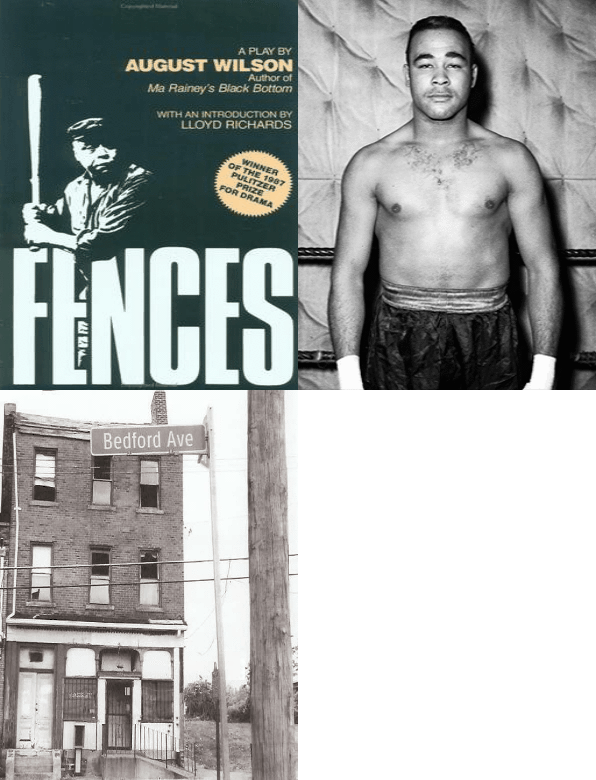
The film "Fences" based on the 1985 Pulitzer Prize-winning play by August Wilson, which delves into the African-American experience in Pittsburgh in the 1950s. While the character of Troy Maxson is not based on a real person, August Wilson drew inspiration from boxer Charley Burley who lived across the street from him on Bedford Ave in Pittsburgh's Hill District. Burley was denied his shot at fame in segregated America and faced similar obstacles and financial struggles due to racial barriers but his dignity and character would end up inspiring one of the best plays about sports.
For more on Charley Burley and August Wilson's "Fences" - (click here).
Similarities Between Charley Burley and Troy Maxson
Racial Barriers: Both faced severe racial discrimination that blocked their potential in their respective fields.
Financial Struggles: Due to the systemic racism they encountered, both men experienced significant financial hardships, forcing them to work in undesirable jobs.
Uncrowned Champions: Burley was an exceptionally skilled boxer who never got a title shot, and Troy, in his youth, was a talented baseball player whose opportunities were limited by the color line.
Inspiration for Troy: August Wilson explicitly drew upon Charley Burley's life, particularly his inability to turn his boxing prowess into mainstream success, to shape the character of Troy.
Significance
The parallels between Burley and Troy highlight the broader theme of the play: the profound impact of societal injustice and oppression on the lives of Black men in America. Wilson used Burley's real-life experiences to ground the fictional Troy in the very real struggles of the African American community during the 20th century.
1920: Boxings Biggest Day!
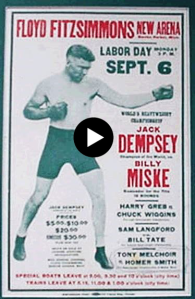
Jack DempseyKO3Billy Miske
World Heavyweight Title
Miske took a count of three in the second round, said to be the first knockdown of his career.In the third round, he was down for "nine" before taking the full count. This was actually a no-decision fight.
Harry Greb WNWS6 Chuck Wiggins
Reported as a win for Greb by the Chicago Tribune and the Pittsburgh Post. According to the Post, Wiggins emulated Johnny Dundee's leaping attack and did rather well in the first three rounds. Greb then opened up and won handily.
Bill Tate WNWS6 Sam Langford
The match between Tate and Langford was a "no-decision" bout, a common practice at the time where the official outcome was determined by newspaper reporters rather than a sanctioned result. According to reports from both the Bismarck and Chicago Tribunes, Tate won the newspaper decision "by a shade."
This was one of at least nine, and possibly as many as ten, fights between the two men. They had a long and storied rivalry, with Langford ultimately winning the series with five victories to Tate's four, with one draw. The fact that the much smaller Langford 5’7” ½, 191lb was able to have the upper hand against the 6'6½", 230lb Tate is often cited as a testament to Langford's skill and boxing genius.
September 6th
1867: Tommy “Spider” Kelly born in New York, New York
1904: Maxie Rosenbloom born in Leonard's Bridge, Connecticut
1909: Al Singer born in New York, New York
1910: Sam Langford W15 Joe Jeanette
1917: Charley Burley was born in Bessemer, Pennsylvania
Harry Greb ND10 Battling Levinsky, Pittsburgh. The Pittsburgh Post had Greb winner of the newspaper decision by a wide margin even though Levinsky had a 25-pound weight advantage. Greb won 8 rounds and two were even but it was still a hard battle. Greb was the aggressor throughout. Levinsky looked good but Greb's superior speed and busy style were too much for him. Not until the sixth round did Greb hurt Levinsky, which he did then with a terrific left hook. In the 8th, Levinsky got his big chance when he hurt Greb badly with a right to the body. Greb ceased attacking and tried to kid Levinsky, who then took the lead and landed some of his cleanest blows of the fight. Greb stopped Levinsky's attack early in the 9th with a terrific hook. In the 10th he put Levinsky down for a 3-count and had him in serious trouble as the fight ended.
1920: Jack Dempsey KO3 Billy Miske, Sam Langford ND6 Bill Tate, Harry Greb ND6 Chuck Wiggins – all on same card - Floyd Fitzsimmons Arena, Benton Harbor, Michigan
1944: Ike Williams W10 Sammy Angott
Willie Joyce W10 Chester Slider
1979: Ricardo Cardona W15 Yukio Segawa
1980: Ayub Kalule W15 Bushy Bester
Samuel Peter born in Akwa Ibom, Nigeria
1985: Azumah Nelson KO5 Juvenal Ordenes
1986: Michael Spinks KO4 Steffan Tangstad
Bobby Czyz KO 5 Slobodan Kacar
Patrizio Oliva KO3 Brian Brunette
1991: James Warring KO1 James Pritchard
1992: Manny Melchor W12 Phalan Lukmingkwan
1995: Buster Mathis passed age 52
1996: Regilio Tuur KO1 Jose Vida Ramos
Alberto Jimenez D12 Carlos Salazar
1997: Erik Morales KO11 Daniel Zaragoza
2002: Eric Lucas W12 Omar Sheika
Pongsaklek Wongjongkam W12 Jesus Martinez
2003: Sven Ottke W12 Mads Larsen
2008: Juan Diaz WSD12 Michael Katsidis
Breidis Prescott KO1 Amir Khan
Nicky Cook W12 Alex Arthur
Galina Koleva Ivanova D10 Zulina Munoz
2014: Carl Frampton W12 Kiko Martinez
Lucas Martin Matthysse KO2 Roberto Ortiz
Adrien Broner W12 Emanuel Taylor
2015: Jamie McDonnell W12 Tomoki Kameda
Nicole Wesner W10 Irma Balijagic Adler
2020: Yordenis Ugas WSD12 Abel Ramos
 Print
Print