
TONY MUNDINE OAM:
THE FIGHTER WHO PAVED THE WAY
Australian Boxing Loses One of its Great Originals — A Champion,
Trailblazer, Mentor and Man Whose Legacy Stretches Far Beyond the Ring
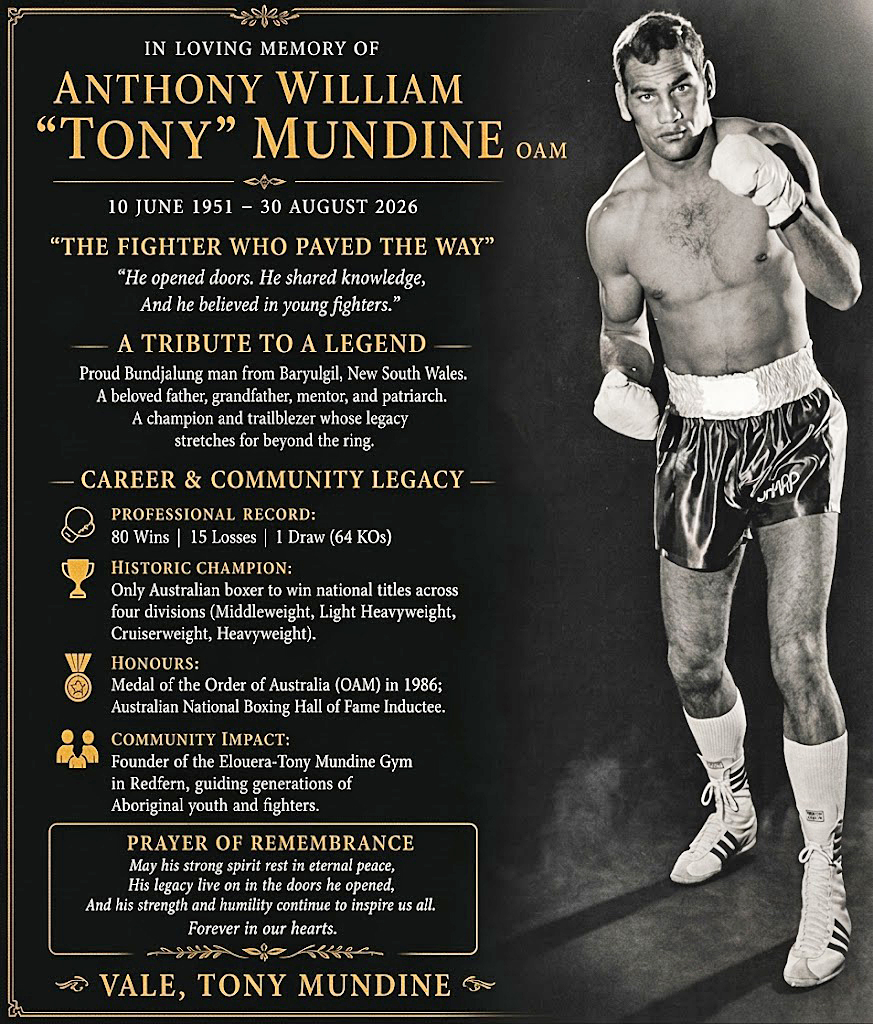
Australian boxing is mourning the passing of one of its most formidable and influential figures, Anthony William “Tony” Mundine OAM, who died on Sunday, August 30, 2026, aged 75.
Mundine, a proud Bundjalung man from Baryulgil in northern New South Wales, died following a heart attack. His death was confirmed by his son, former world champion Anthony Mundine, who paid an emotional tribute to his father, describing himself as “broken” and thanking him for the love, strength and support he had provided throughout his life.
For those who know Australian boxing history, the numbers alone tell an extraordinary story.
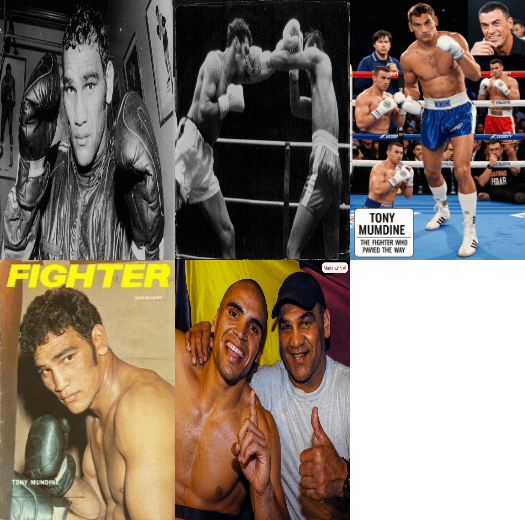
Tony Mundine finished his professional career with 80 victories, 15 defeats and one draw, including 64 victories by knockout or technical knockout. He competed across middleweight, light heavyweight, cruiserweight and heavyweight and became the only Australian boxer to hold Australian national titles in all four divisions. He also won Commonwealth titles at middleweight and light heavyweight.
But the numbers do not tell the story of Tony Mundine. To understand the man, you have to go back to Baryulgil. Born on June 10, 1951, Mundine grew up in difficult circumstances in a large family in a community profoundly affected by the asbestos industry.
His early life was a world away from the bright lights of international boxing. He worked as a stockman and in the mines, helping his family, and as a teenager discovered that boxing could provide both a modest income and, perhaps, an escape from hardship. Mundine later recalled the devastating impact the asbestos industry had on his family and community.
His earliest paid contests were not in major arenas.
They came in the travelling boxing tents of Jimmy Sharman, where young Mundine would climb through the ropes for a few pounds and learn the unforgiving lessons of the fight game.
Mundine later recalled fighting in the tents when they came to Grafton, earning £5 for three or four rounds — significant money for a poor teenager at the time.
The experience helped shape the toughness that would become one of his trademarks. Boxing, however, was not originally supposed to be his destination.
Mundine moved to Sydney with rugby league ambitions and was offered a place with the Redfern All Blacks. He trained at Ern McQuillan’s gym during the football off-season to keep himself fit. There, McQuillan recognised the young athlete’s natural speed, power and physical ability and helped guide him toward boxing.
The rugby league dream gave way to a boxing career, and in 1969 Tony Mundine turned professional. What followed was extraordinary.
Within little more than a year, he had won the Australian middleweight championship. He later moved through the divisions, capturing Australian titles at heavyweight, light heavyweight and cruiserweight, while also becoming Commonwealth champion at middleweight and light heavyweight. It was a career built on ambition, toughness and an unusual willingness to challenge men who were often much bigger than him.
In February 1972, at just 20 years of age, Mundine defeated Foster Bibron for the Australian heavyweight championship, despite the considerable difference in size. It was an early indication that Mundine was not interested in conventional boundaries.
If there was a bigger man in front of him, he fought him.
If there was another division above him, he entered it.
If an opportunity came, he took it.
That mindset ultimately carried him onto the biggest international stage of his career.
On October 5, 1974, Tony Mundine walked into Luna Park in Buenos Aires to challenge Argentina’s legendary Carlos Monzón for the WBA world middleweight championship. Monzón was one of the dominant champions of his era, and Mundine had travelled to Argentina for the opportunity of a lifetime.
The Australian was stopped by knockout in the seventh round. But the defeat did not diminish the significance of the occasion.
Mundine had come from Baryulgil to Buenos Aires to challenge one of the world’s great champions. He had taken an Australian boxing career onto the international stage at a time when opportunities for Australian fighters and particularly Indigenous Australian fighters were far less accessible than they are today.
For Mundine, simply being there represented the fulfilment of a dream.
His journey from a small Indigenous community in northern New South Wales to a world championship fight in Buenos Aires remains one of the defining stories of Australian boxing.
The young man who had once fought in travelling boxing tents had travelled the world. He had made it.
Tony Mundine’s significance, however, was never confined to titles and statistics. He became one of the most important Indigenous figures in Australian sport during a period when Indigenous athletes faced barriers that extended far beyond the sporting arena. Mundine’s success helped establish a pathway.
He was inspired by Lionel Rose, whose world championship breakthrough in 1968 demonstrated to young Indigenous Australians that they could compete and succeed at the highest level. Mundine would eventually become an inspiration himself.
His career showed that an Aboriginal fighter from Baryulgil could become an Australian champion across four weight divisions, challenge for a world title and earn international respect. But perhaps his greatest contribution came after his own fighting career ended.
Mundine retired from professional boxing in 1984, but he never really left boxing. He remained involved as a trainer, mentor and community figure, with the Elouera-Tony Mundine Gym in Redfern becoming a central part of his legacy. The gym was more than a place to learn how to box. It became a place where young people could train, develop discipline, build confidence and find another path.
That was Tony Mundine.
He opened doors.
He shared knowledge.
And he believed in young fighters.
A particularly revealing example came in the story of an Aboriginal Olympian who trained at Elouera.
When the young fighter needed additional preparation, Mundine opened the gym and worked with him himself. The story, recalled in SBS NITV’s tribute to Mundine, captures something fundamental about the man: he did not need to be asked twice to help another young Indigenous athlete. He simply opened the doors and got to work.
There was no fuss. No demand for recognition. He simply helped another young Aboriginal athlete prepare to represent Australia and his people on the world stage. His influence also lived on through his family.
Tony was the father of Anthony “Choc” Mundine, who followed his father into professional boxing after an accomplished rugby league career and went on to become a world champion. He was also grandfather to professional boxer Rahim Mundine.
Three generations of the Mundine family have therefore carried the family’s boxing name forward — an extraordinary sporting legacy in its own right.
Tony’s relationship with his son was complex, as family relationships often are, but his influence was profound. Having experienced the physical demands and dangers of boxing himself, he initially discouraged Anthony from entering the sport. Once Anthony committed to boxing, however, Tony became a trainer, mentor and important figure in his son’s development.
The fighter who had once been reluctant to see his son enter the ring ultimately helped guide him toward world championship success. And now Anthony must face the hardest fight of all, saying goodbye to his father.
Those who knew Mundine often spoke about his extraordinary discipline. He carried the habits of a fighter into every part of his life. Accounts of his later years described a man who remained fiercely committed to physical fitness and self-discipline. Some of the stories told about his conditioning late in life are extraordinary, including reports that he could still perform hundreds of push-ups and sit-ups each day.
Those claims are best regarded as reported anecdotes rather than independently verified athletic testing, but they capture the image of a man who never stopped thinking like a fighter. That discipline was accompanied by a strong sense of responsibility toward young people.
On January 26, 1986, Mundine was awarded the Medal of the Order of Australia for his service to sport, particularly boxing, and to Aboriginal youth. In 2005, he was inducted into the Australian National Boxing Hall of Fame.
The honours recognised what boxing had long understood:
Tony Mundine had become much more than a former champion.
He had become an institution.
THE MAN BEHIND THE RECORD
It is tempting, when a great fighter dies, to reduce his life to statistics.
80 wins.
64 knockouts.
Four Australian divisions.
Two Commonwealth divisions.
One world championship challenge.
A professional career spanning 1969 to 1984.
But Tony Mundine’s story was never just about the record.
It was about where he came from.
It was about how far he travelled.
And it was about how many people he helped along the way.
He came from Baryulgil.
He fought in boxing tents.
He worked to help his family.
He went to Sydney chasing a rugby league dream.
He was discovered in a boxing gym.
He became a professional fighter.
He became an Australian champion.
Then another.
Then another.
And another.
He fought at middleweight.
He fought at light heavyweight.
He fought at cruiserweight.
He fought at heavyweight.
He travelled to Buenos Aires to challenge Carlos Monzón for a world title.
And when the gloves finally came off for good,
he did not walk away from the sport.
He gave back.
Anthony Mundine has spoken of his father as the man who gave him love, strength and support. Other members of the Australian boxing community have remembered Tony not only for his toughness and achievements but for his generosity, humility and willingness to help the next generation.
That may ultimately be the finest description of Tony Mundine.
He opened doors.
For Indigenous athletes.
For young boxers.
For his family.
For the generations who followed him.
The championships will remain in the record books.
The knockouts will remain in the statistics.
The photographs from Buenos Aires will remain
part of Australian boxing history.
But the people he influenced will carry his memory forward.
Tony Mundine did not simply win fights.
He changed what was possible.
He showed that a young Indigenous man from Baryulgil could stand
beneath the brightest lights in world boxing.
He showed that a fighter could move through four weight divisions and become champion in every one of them.
He showed that success did not have to mean walking away from the community that produced you.
And he showed that the greatest legacy of a fighter may not be the number of opponents he defeated, but the number of people he helped
after his own fighting days were over.
Australian boxing has lost a champion.
Indigenous Australia has lost a trailblazer.
The Mundine family has lost its patriarch.
And generations of fighters have lost a mentor.
But the legacy remains.
It lives in the gym.
It lives in the fighters he trained.
It lives in his son and grandson.
It lives in the young people who walked through the doors he opened.
And it lives in every young boxer from an unlikely beginning who dares to believe that the world stage might belong to them too.
Tony Mundine came a long way from Baryulgil.
He fought his way there.
He earned his place there.
And he never forgot where he came from.
Tony Mundine OAM — 10 June 1951 – 30 August 2026.
Champion. Trailblazer. Mentor. Father.
One of Australian boxing’s true originals.
Vale, Tony Mundine.

 Print
Print