
Soviet Amateur Boxing Standout and Undefeated Professional Ruslan Taramov Passes Away Age 61!
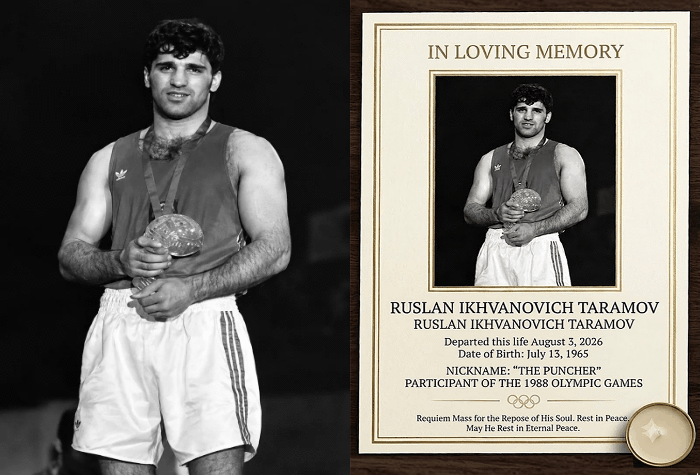
(August 3rd) The international boxing community is mourning the loss of Ruslan Ikhvanovich Taramov (Руслан Ихванович Тарамов), one of the Soviet Union's most accomplished amateur middleweights of the 1980s and an undefeated professional boxer. Taramov passed away during the early morning hours of August 3, 2026, at the age of 61. According to relatives who spoke with TASS, he died at approximately 3:00 a.m. on Monday. No official cause of death has been publicly disclosed. Initial reports indicated that funeral arrangements would be announced in the coming days.
Born on July 13, 1965, in Grozny, Chechen-Ingush ASSR, Russian SFSR, USSR, Taramov emerged from the famed Soviet amateur boxing system to become one of the most feared punchers of his generation. Standing between 180 and 182 centimeters (5-foot-11), the ethnic Chechen represented Dynamo Grozny throughout his amateur career. Although he would later compete as a cruiserweight and heavyweight in the professional ranks, it was at middleweight where he established his enduring reputation as one of the Soviet Union's elite fighters.
Taramov's path to boxing was unconventional. Like many young Chechen athletes, he first excelled in wrestling before discovering boxing at age 15 after watching the memorable middleweight final between Viktor Savchenko of the Soviet Union and Cuba's José Gómez during the 1980 Moscow Olympic Games. Inspired, he walked into the Dynamo boxing gym the very next day, where respected coach Vladimir Morebis, an Honored Trainer of the RSFSR, immediately recognized his exceptional physical gifts. The young prospect developed into an aggressive pressure fighter whose devastating hooks and uppercuts earned him the nickname "Pancher" ("The Puncher").
Taramov quickly established himself among the Soviet Union's deepest and most competitive boxing talent pool. He captured the USSR Youth Championship in 1984 before winning the USSR Middleweight Championship in 1985, stopping Asylbek Kilimov in the championship bout after Kilimov's corner threw in the towel. Despite suffering repeated hand fractures throughout his career—injuries caused largely by his extraordinary punching power—Taramov remained one of the nation's premier middleweights, adding another Soviet title in 1988 with a victory over future world champion Andrey Kurnyavka in the final. While some historical accounts list him as a three-time Soviet champion including 1986, the most consistently documented championship victories are 1985 and 1988, with a bronze-medal finish after injury at the 1986 national championships.
One of the defining moments of his career came at the inaugural 1986 Goodwill Games in Moscow, where Taramov captured the middleweight gold medal and was named the tournament's Best Boxer. In the championship bout, he defeated American Bomani "White" Parker before receiving his gold medal from legendary three-time Olympic champion László Papp. His performance also earned him the prestigious Komsomol "For Courage" badge. That same year he added victories at the USSR Spartakiad and USSR Cup, further cementing his status among the finest amateur boxers in the world.
Internationally, Taramov earned a bronze medal at the 1987 European Championships in Turin, defeating France's Hamedidi Maimoun and Bulgaria's Kalin Stoyanov before falling in the semifinals to eventual Olympic champion Henry Maske of East Germany. He also built an outstanding reputation during the famed USA–USSR dual meets, recording multiple victories over top American amateurs, including future professional world champion Darin Allen, whom he defeated in one of the series' most memorable contests. Those performances established Taramov as one of the Soviet team's most reliable international competitors during the mid-1980s.
Taramov represented the Soviet Union at the 1988 Seoul Olympic Games, advancing past Sierra Leone's Samuel Simbo with a first-round knockout before losing in the Round of 16 to West Germany's Sven Ottke, who would later become one of professional boxing's longest-reigning undefeated world champions. Although his Olympic journey ended earlier than many expected, Taramov's accomplishments had already secured his place among the Soviet Union's elite amateurs. He also held the prestigious title of Master of Sport of the USSR, International Class.
Many within Soviet boxing believed Taramov's greatest achievements were ultimately limited by recurring hand injuries. Scientific testing conducted under Soviet sports researchers reportedly measured his punching force at more than 800 kilograms-force, an extraordinary figure for a middleweight. Coaches and teammates frequently described him as one of the fastest punchers on the Soviet national team, and stories of his punching power—including one tale of him breaking a heavy bag—became part of Soviet boxing folklore.
Following the Seoul Olympics, Taramov joined the first wave of Soviet fighters to enter the professional ranks during the Perestroika era. Making the unusual leap from amateur middleweight directly into the cruiserweight and heavyweight divisions, he fought primarily in Japan between 1990 and 1992, competing at renowned venues including Korakuen Hall and the Kokugikan. He compiled a perfect 8-0 professional record with five knockouts, recording victories over opponents including Johnny Feemster, Leland Hardy, Ladislao Mijangos, Terry Verners, Nam Shin Hyun and others before closing out his career undefeated. Despite his success, management issues prevented him from securing the major international opportunities many believed his talent deserved, particularly in the United States, leading to his retirement while still unbeaten.
After boxing, Taramov dedicated much of his life to developing the next generation of fighters. He worked for many years as a youth boxing coach in Tolyatti before returning to Grozny around 2006, where he served in an administrative role with the Chechen Boxing Federation. His commitment to grassroots boxing ensured that his experience and knowledge continued benefiting young athletes long after his own competitive career had ended.
Throughout Chechnya and across the former Soviet boxing community, Ruslan Taramov is remembered not only for his accomplishments but for the immense potential many believe was never fully realized because of injuries and the difficult transition between the Soviet amateur system and professional boxing in the early 1990s. Nevertheless, his achievements, including Goodwill Games gold, European Championship bronze, multiple Soviet national titles, Olympic representation, and an undefeated professional record of eight wins with five of those wins coming by knockout, securing his place among the most accomplished fighters to emerge from the North Caucasus.
Ruslan Taramov leaves behind a legacy defined by extraordinary natural power, relentless determination, and unwavering dedication to the sport of boxing. His name will forever remain synonymous with one of the Soviet Union's hardest-hitting middleweights and one of Chechnya's greatest boxing champions. May he rest in peace.
 Print
Print