
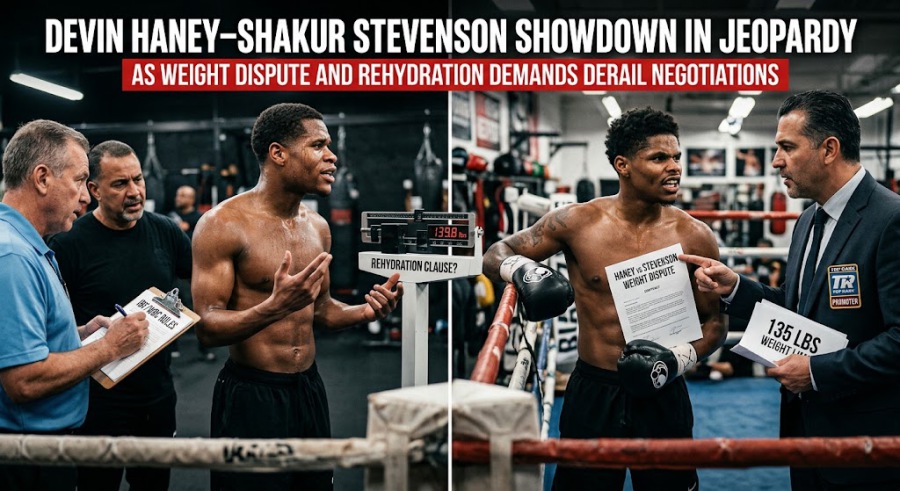
Devin Haney - Shakur Stevenson Showdown
In Jeopardy As Weight Dispute Revives
Boxing’s Longstanding Rehydration Debate!
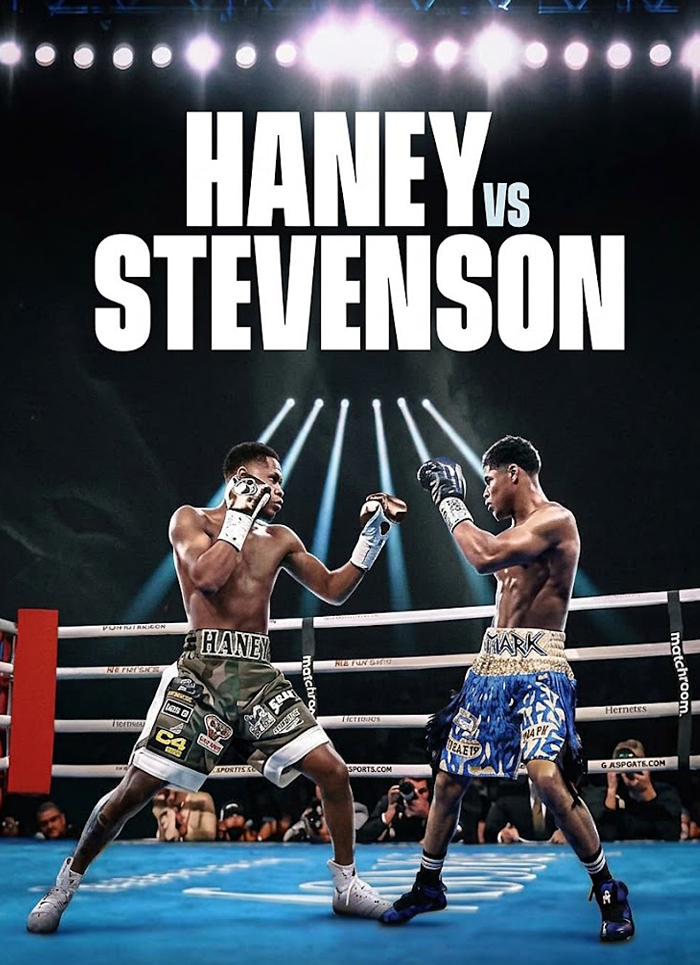
(October 16th) The proposed Devin Haney–Shakur Stevenson showdown has become boxing’s version of television’s former reality hit The Biggest Loser, with two elite champions debating pounds, weight limits and how much weight a fighter should be permitted to regain after the official weigh-in. Behind the public exchanges, however, lies a serious issue that has challenged professional boxing for decades: the relationship between weight cutting, rehydration, competitive fairness and fighter safety.
The negotiations between WBO welterweight champion Devin Haney and WBO junior welterweight champion Shakur Stevenson appeared to be progressing toward a compromise earlier this month, when both fighters publicly discussed a 145-pound catchweight. However, their competing accounts of the subsequent discussions have placed the proposed blockbuster contest in jeopardy, with Stevenson accusing Haney of changing his position at the last minute and Haney insisting that a proposed rehydration clause was the real obstacle.
The latest controversy erupted on October 16 when Stevenson took to social media platform X to express his frustration with the negotiating process. According to the four-division world champion, discussions had progressed from an initial 144-pound catchweight to 145 pounds before Haney's representatives allegedly reverted to demanding the full 147-pound welterweight limit.
"At the 11th hour, after agreeing to 144 and then 145[lbs], DeeHoe had his lawyer email and say that he would only fight at 147. Big waste of everybody's time," Stevenson wrote.
Haney, 27, responded directly, rejecting the suggestion that he had withdrawn his willingness to compete below the welterweight limit.
"You're cap. I agreed to 145 u went missing for days. Tried to put a rehydration clause on me. I wasted 6 months negotiating with you," Haney countered.
Haney also referred to discussions dating back to the period when he was considering a deal with Zuffa Boxing. His response suggested that, from his perspective, the sticking point was not necessarily the agreed weight itself but the additional conditions Stevenson allegedly sought to impose.
Neither fighter has publicly released a complete proposed contract or the underlying correspondence necessary to establish precisely which terms were accepted, when the conditions changed or which party was responsible for the breakdown. Their statements establish that negotiations have encountered significant difficulties, but the competing accusations remain disputed claims rather than independently verified contractual facts.
A 145lb COMPROMISE THAT APPEARED TO BRING THE FIGHT TOGETHER
The latest disagreement is particularly significant because the fighters appeared to have made considerable progress earlier in October.
Stevenson initially proposed a 144-pound catchweight, accompanied by a reported restriction on how much weight Haney could regain after the official weigh-in. Haney, who has established himself in the welterweight division, maintained that he preferred to fight at the full 147-pound limit without a rehydration restriction.
On October 6, however, Haney publicly offered a compromise. "Let's do this 145 no rehydration clause @ShakurStevenson," Haney posted.
Stevenson responded enthusiastically: "145.0 U GOT A DEAL DEEHOE!!!!"
The exchange appeared to bring the two champions closer to an agreement. Haney subsequently suggested that defeating Stevenson would strengthen his claim to being boxing's leading pound-for-pound fighter.
Nevertheless, a public exchange on social media does not necessarily constitute a completed professional boxing contract. The fighters still needed to settle the full terms, including any rehydration provisions, financial arrangements, promotional responsibilities and the regulatory requirements associated with the proposed contest.
The subsequent disagreement demonstrates why an apparent agreement on the contracted weight does not automatically mean every condition of a proposed fight has been resolved.
THE WEIGHT DIFFERENCE: 140, 145 OR 147 POUNDS?
The proposed fight presents a significant divisional question because Stevenson and Haney currently hold world championships at different weight limits.
Stevenson, 29, captured the WBO junior welterweight championship with a unanimous-decision victory over Teofimo Lopez on January 31, 2026, at Madison Square Garden in New York City. The victory elevated Stevenson to four-division world champion status, following his previous championship achievements at featherweight, junior lightweight and lightweight.
Haney has followed a different path through the professional ranks. The former undisputed lightweight champion subsequently established himself at junior welterweight before moving into the welterweight division.
On November 22, 2025, Haney defeated previously unbeaten Brian Norman Jr. by unanimous decision in Riyadh, Saudi Arabia, to capture the WBO welterweight championship and become a three-division world champion.
The distinction between their current divisions is central to the negotiations. The junior welterweight limit is 140 pounds, while welterweight extends to 147 pounds. A 145-pound catchweight would place the contracted limit five pounds above Stevenson's championship division and two pounds below Haney's.
For Stevenson, moving to 145 pounds would represent a significant step above the division in which he won his latest world title. A contest at 147 pounds would require him to compete at the full welterweight limit.
Haney, meanwhile, would be accepting a contracted weight below his championship division if he agreed to 145 pounds.
Neither fighter is automatically entitled to insist on a particular arrangement in a voluntary contest. The weight limit and any additional restrictions must be negotiated and incorporated into the terms accepted by both parties.
WHY THE REHYDRATION CLAUSE MATTERS
At the center of the dispute is Stevenson's reported desire to restrict how much weight Haney could regain after the official weigh-in.
Under the reported proposal for a 10-pound rehydration limit, a fighter weighing 145 pounds at the official weigh-in would be restricted to approximately 155 pounds at the designated secondary check. The precise effect would depend on the contract's timing, enforcement provisions and any additional restrictions governing weight gain after that check.
The distinction between the two conditions is crucial.
A catchweight establishes the maximum permitted weight at the official weigh-in. A rehydration clause imposes an additional restriction on how much weight a fighter may regain afterward. Agreeing to one does not automatically constitute agreement to the other.
Stevenson's reported concern is that Haney could enjoy a substantial physical advantage by entering the ring considerably heavier than his official weigh-in weight. Having competed at lighter weights for much of his career, Stevenson has an understandable competitive interest in limiting the size difference when facing an established welterweight champion.
Haney, by contrast, has resisted the proposed restriction, maintaining that he should be permitted to rehydrate without an additional contractual limit.
A rehydration clause could reduce the potential disparity between the fighters, but it would not necessarily establish their exact weights when the contest begins. Nor would it automatically determine whether either boxer had undergone an excessive or medically dangerous weight cut.
That distinction makes the current disagreement more complicated than a simple argument over two pounds. It involves the initial contracted weight, the recovery period following the weigh-in and the conditions under which each fighter would enter the ring.
BOXING'S VERSION OF THE BIGGEST LOSER
The comparison with television's former reality hit The Biggest Loser provides a memorable description of two professional fighters negotiating over pounds. Unlike contestants attempting to achieve a weight-loss target for a television competition, however, boxers must make weight within a competitive framework that can involve substantial short-term changes in body mass.
Professional fighters routinely adjust their diets, training and fluid intake to meet contractual weight limits. Some also undertake aggressive weight-cutting practices, including substantial dehydration, to qualify for a particular division.
The ability to regain weight after the official weigh-in has consequently become an important consideration in boxing. A fighter who loses substantial weight before the weigh-in may have additional time to recover and regain mass if the official measurement occurs the day before the contest.
That recovery period can be beneficial, but it can also create an incentive for fighters to cut more weight than they might otherwise attempt.
The issue is not simply whether a fighter gains weight after the weigh-in. It is whether the process of making weight and recovering afterward creates unacceptable medical risks or undermines the competitive purpose of weight divisions.
The Haney–Stevenson negotiations have brought that longstanding problem into public view. Stevenson wants protection against a potential size disadvantage, while Haney opposes an additional restriction on his ability to rehydrate. Both positions reflect a competitive calculation, but the wider question concerns how boxing can establish rules that protect athletes without unfairly disadvantaging either participant.
FROM SAME-DAY WEIGH-INS TO DAY-BEFORE PROCEDURES
The dispute also revives an important historical question: did boxing's move toward day-before weigh-ins solve the sport's weight-cutting problem, or did it simply give fighters more time to regain the pounds they had shed?
Historically, weigh-in procedures have varied among boxing jurisdictions. In some jurisdictions and under certain rules, fighters weighed in on the day of the contest, leaving relatively little time to recover after making weight.
During the 1980s, Nevada moved toward day-before weigh-ins, and the practice subsequently became widespread in professional boxing.
The intention was to provide fighters with additional time to recover after making weight, particularly when weight loss involved dehydration. Allowing more time for recovery can be beneficial, as a boxer who has lost substantial fluid may need time to restore hydration and other physiological functions before competing.
However, it would be inaccurate to claim that same-day weigh-ins have been abolished universally. Requirements continue to vary by jurisdiction, competition and regulatory authority. The sport does not operate under one worldwide weigh-in schedule.
Nor did the move toward day-before weigh-ins eliminate extreme weight cutting. In some circumstances, the longer interval between the official measurement and the contest can encourage fighters to shed substantial weight before the weigh-in and regain it afterward. The resulting problem is that a fighter's official weight may not accurately represent the fighter's physical size when entering the ring.
ARTURO GATTI, JOEY GAMACHE AND THE DANGERS OF WEIGHT DISPARITY
One of boxing’s most frequently cited examples of the potential dangers of substantial post-weigh-in weight gain is the February 2000 bout between Arturo Gatti and Joey Gamache at Madison Square Garden in New York.
In a subsequent press release, the California State Athletic Commission noted that the fighters had weighed within half a pound of each other at the official weigh-in. By fight night, however, Gatti reportedly outweighed Gamache by approximately three weight classes.
Gatti stopped Gamache in the second round. Gamache suffered a severe knockout and never fought professionally again.
In a December 2005 press release, the California commission cited the case while examining the relationship between weight disparities and boxing safety. The commission noted that experts believed the weight difference and the use of lighter gloves contributed to the outcome.
The case does not establish that weight disparity alone caused Gamache's injuries. It does, however, illustrate why the relationship between official weigh-in weight and fight-night size has long been a concern among boxing regulators and medical professionals.
The California State Athletic Commission returned to the issue in December 2015 with its Dehydration and Weight Cutting Summit. The discussions examined the potential dangers associated with rapid weight loss and subsequent rehydration, along with possible regulatory measures to discourage extreme weight-cutting practices.
The debate highlighted a difficult balance. Moving weigh-ins closer to fight time might discourage some fighters from attempting severe weight cuts because they would have less recovery time. However, shortening the recovery period could also leave a fighter more dehydrated when entering the ring, potentially increasing the medical risks.
There is therefore no simple solution in which moving the weigh-in forward or backward automatically guarantees fighter safety.
Effective weight management requires consideration of the athlete's condition, the extent of any weight cut, the available recovery period and the medical safeguards governing the contest.
CAN A REHYDRATION CLAUSE SOLVE THE PROBLEM?
A contractual rehydration restriction can be one way of limiting a potential size disparity between opponents, but it is not a complete solution to the problems associated with extreme weight cutting.
A fighter may comply with a contracted weight and still be inadequately hydrated. Conversely, regaining weight after an official weigh-in does not automatically mean a boxer has acted improperly or is medically unfit to compete.
A rehydration clause also requires clear contractual language specifying the permitted weight, the timing of any secondary measurement, the enforcement procedure and the consequences of exceeding the limit.
Without those details, even an apparent agreement on a numerical restriction can leave room for further disagreement.
In the Haney–Stevenson case, the fighters' public statements suggest that the rehydration provision became a significant obstacle despite their apparent willingness to consider a 145-pound catchweight.
The dispute illustrates the limitations of relying solely on a negotiated weight limit to resolve concerns about physical size. The contracted weight, post-weigh-in weight and medical condition of each fighter are related but distinct considerations.
Ultimately, the responsibility for determining the applicable weigh-in procedures, medical requirements and permissible contractual conditions rests with the relevant regulatory authorities, subject to their governing rules.
THE KEYSHAWN DAVIS FACTOR AND HANEY'S WBO OBLIGATIONS
Haney's immediate championship future also involves a separate matter concerning Keyshawn Davis and the WBO's mandatory-challenger process.
The organization previously ordered negotiations between Haney and Davis for the welterweight championship. When the negotiations failed to produce an agreement, the matter progressed to a purse bid, with Top Rank securing promotional rights through a reported winning bid of $8.55 million. Davis subsequently withdrew from the proposed contest following a disagreement over the financial terms, and the matter was referred for further consideration under the WBO's regulations.
During the October 16 exchange, Haney also accused Stevenson's side of putting Davis in his path. That allegation should not be confused with the documented WBO process. The mandatory-challenger proceedings were a separate regulatory matter, and no publicly established evidence demonstrates that Stevenson controlled or directed the organization's decisions.
The situation is relevant because a proposed Haney–Stevenson contest does not automatically remove existing championship obligations. Any implications for Haney's WBO title would depend on the organization's rules, the status of the mandatory-challenger process and the terms of any eventual agreement.
The administrative considerations surrounding Haney's title therefore represent another issue that would need to be resolved before a championship contest could be formally arranged.
ZUFFA BOXING, FINANCIAL TERMS AND THE PROPOSED ATLANTA DATE
Stevenson's promotional relationship with Zuffa Boxing adds another dimension to the negotiations.
The four-division champion joined the Dana White-led organization earlier in 2026. Haney's October 16 reference to his own earlier discussions with Zuffa provides context for the length of their negotiations, but it does not establish that Haney signed the same promotional agreement.
A fight of this magnitude requires more than agreement between the boxers on a weight limit. Financial guarantees, promotional responsibilities, broadcast arrangements, venue commitments and regulatory approval may all affect whether an event can proceed.
November 28, 2026, emerged as a proposed date for the contest, with Atlanta, Georgia, identified as the intended host city and State Farm Arena discussed as a possible venue. Bill Haney, Devin's father, trainer and manager, publicly indicated that his team was preparing for a 145-pound contest and expressed confidence that the fight could be arranged.
However, the proposed date and venue have not been established as finalized arrangements. Discussions about a potential event do not constitute an official announcement, and the latest disagreement over weight and rehydration conditions leaves the contest's immediate future uncertain.
Financial considerations have also been identified in media reports as a possible obstacle, although the precise terms of any proposed purse agreement have not been publicly established in a complete contract.
The October 16 exchange therefore leaves several questions unanswered: whether the fighters can agree on the contracted weight, whether either side will accept a rehydration restriction, whether the financial arrangements are satisfactory and whether the necessary promotional and regulatory conditions can be fulfilled.
A HIGH-STAKES MATCHUP THAT BOXING FANS WANT TO SEE
Beyond the contractual dispute, Haney against Stevenson remains one of the most compelling potential matchups in professional boxing.
Both fighters developed distinguished amateur backgrounds before establishing themselves among the sport's elite professionals. Haney has built his reputation on an educated jab, disciplined footwork, accurate counterpunching and the ability to control distance.
Stevenson, a southpaw and silver medalist at the 2016 Olympic Games in Rio de Janeiro, is widely recognized for his defensive skills, exceptional ring awareness, timing and ability to neutralize an opponent's offense.
Their contrasting styles promise a tactical contest between two fighters accustomed to controlling the pace and geography of their bouts.
Haney would seek to use his reach, jab and positional discipline to dictate exchanges, while Stevenson would look to exploit his defensive reactions, movement and counterpunching ability.
Both men have also established championship credentials across multiple weight divisions. A victory over the other would carry considerable significance for their legacies and their positions in boxing's pound-for-pound debate.
The contest would therefore offer substantial sporting interest beyond the controversy surrounding the negotiations.
Nevertheless, the competitive appeal of the matchup has yet to overcome the practical difficulties involved in arranging it.
WHAT HAPPENS NEXT?
As of October 16, 2026, the proposed Haney–Stevenson showdown remains unsigned and has not been officially announced.
The fighters have publicly indicated a willingness to consider a 145-pound catchweight, but their subsequent statements leave unresolved whether that agreement remained intact, whether a rehydration restriction was part of the proposed terms and whether Haney's representatives subsequently insisted on returning to the 147-pound limit.
The negotiations have also been complicated by reported financial considerations, promotional arrangements and Haney's separate championship obligations.
Stevenson's position appears focused on limiting the potential physical disadvantage of facing a welterweight champion moving into the ring at a substantially greater weight than the official limit. Haney's position has centered on accepting a lower contracted weight without an additional restriction on rehydration.
Neither fighter's public statements independently establish the complete contractual position, and responsibility for the breakdown remains disputed.
The immediate challenge is to translate the fighters' earlier public expressions of agreement into a comprehensive contract covering the weight limit, any rehydration provision, financial compensation, promotional responsibilities and championship requirements.
Put aside fighters winning title 10-15 pounds above the division limit, for boxing more broadly, the dispute is another reminder that weight management is not simply a matter of pounds on a scale. The sport's move toward day-before weigh-ins gave fighters additional recovery time, but it did not eliminate extreme weight cutting or the potential disparity between official weigh-in weight and fight-night size.
The comparison with The Biggest Loser may provide an attention-grabbing introduction, but the consequences of professional weight cutting are far more serious than a television competition. The challenge for boxing is to balance competitive fairness with effective medical safeguards while ensuring that contractual weight requirements are clear, enforceable and consistent with the applicable regulations.
For now, Haney and Stevenson remain divided over the terms of a fight that would represent a major attraction for the sport. Whether negotiations can be revived will depend on the willingness of both camps to resolve their differences and establish conditions acceptable to the fighters, their representatives and the relevant regulatory authorities.
Until that happens, the proposed showdown remains a compelling possibility rather than a confirmed event—and the latest weight dispute has once again placed boxing's longstanding rehydration debate firmly in the spotlight.

 Print
Print