
Former WBA Middleweight World Champion
Jorge “Locomotora” Castro Dies at 59!
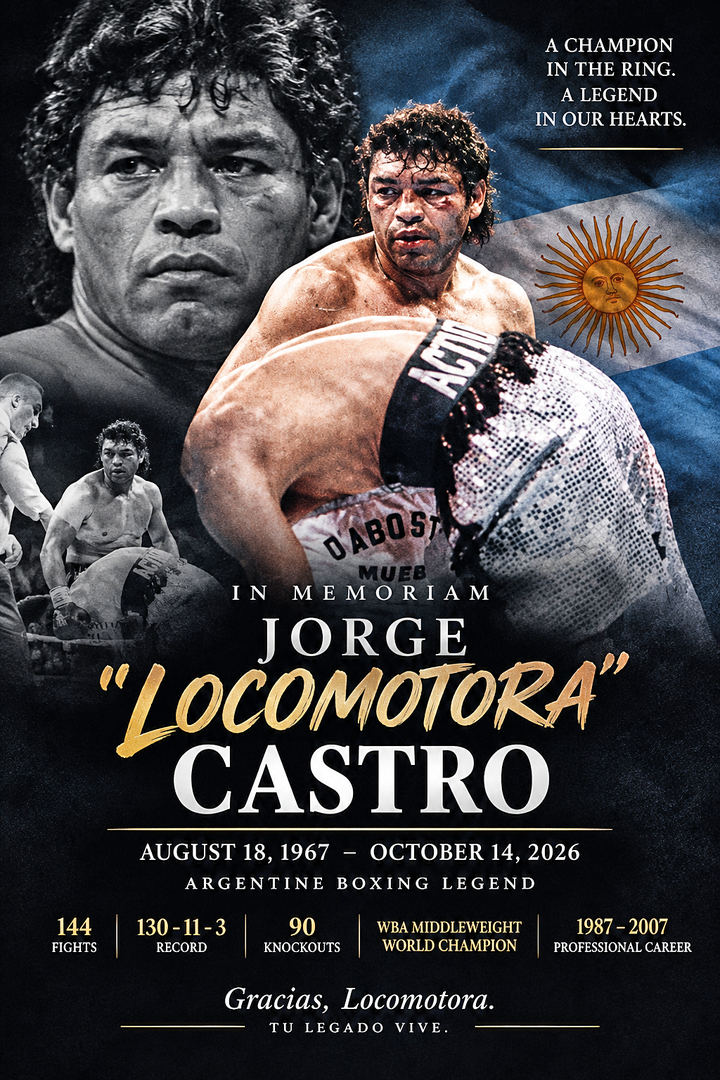
(October 15th) The international boxing community is mourning the loss of former WBA middleweight world champion Jorge Fernando “Locomotora” Castro, one of Argentina’s most celebrated, resilient, and prolific fighters, who passed away Wednesday, October 14, at the age of 59. Known affectionately as “El Roña” and “Locomotora,” Castro compiled an extraordinary professional record of 130 victories, 11 defeats, and three draws, including 90 knockouts, across 144 bouts during a remarkable 20-year career spanning 1987 to 2007. A national sporting icon whose relentless fighting style, extraordinary durability, and unforgettable comeback victories earned him international recognition, Castro leaves behind a legacy that extends far beyond his accomplishments inside the ring.
Castro died during the early morning hours of October 14 after suffering a sudden medical emergency at the Bingo de Morón in Buenos Aires Province, Argentina. The former world champion was reportedly accompanied by his daughter, Quimey, and a former partner when he began experiencing chest pains before collapsing. Despite the efforts of emergency medical personnel, who attempted to resuscitate him at the scene, Castro could not be revived. Preliminary autopsy findings reportedly identified acute pulmonary edema associated with cardiac failure as the cause of death, with forensic investigators finding no evidence of traumatic injuries. Castro, who had a history of diabetes, was believed to have suffered a sudden cardiac event, with family members describing his passing as the result of natural causes.
Born August 18, 1967, in Caleta Olivia, Santa Cruz Province, Argentina, Castro overcame a difficult childhood marked by poverty and family hardships before discovering boxing as an outlet for his fighting spirit. His nickname, “El Roña,” became synonymous with his combative personality, while “Locomotora,” meaning “Locomotive,” perfectly captured the relentless forward pressure and aggressive style that would define his professional career. Even before entering the paid ranks, Castro demonstrated the resilience that would become his trademark, recovering from a serious bicycle accident in the mid-1980s despite medical predictions that his injuries would prevent him from pursuing a professional boxing career.
Castro made his professional debut on February 14, 1987, beginning an extraordinary journey that would establish him among Argentina’s most accomplished prizefighters. Fighting primarily as an orthodox boxer, Castro developed a reputation for his exceptional toughness, powerful punches, and willingness to engage opponents in punishing exchanges. He captured the Argentine super welterweight championship in 1989 and the South American super welterweight title in 1990, establishing himself as a formidable contender on the international boxing scene.
His ascent to world championship prominence came on August 12, 1994, when he defeated American contender Reggie Johnson by a hard-fought 12-round split decision to capture the vacant World Boxing Association (WBA) middleweight championship. The victory represented the crowning achievement of Castro’s career, elevating the determined Argentine to the pinnacle of the 160-pound division and securing his place among his country’s world champions.
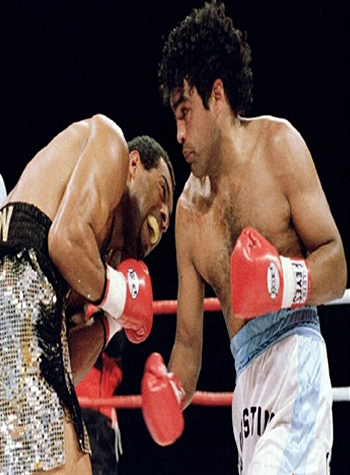
Castro successfully defended his WBA middleweight championship four times, but it was his unforgettable December 10, 1994, confrontation with former world champion John David Jackson in Monterrey, Mexico, that forever cemented his reputation as one of boxing’s greatest comeback artists. Severely battered and trailing decisively on the judges’ scorecards, Castro appeared headed toward certain defeat as Jackson continued to dominate their championship encounter. With the fight slipping away, Castro suddenly unleashed a devastating left hook in the ninth round that sent Jackson crashing to the canvas. Displaying the extraordinary determination that defined his career, Castro followed with two additional knockdowns before the contest was stopped at 2:43 of the ninth round, completing one of the most dramatic reversals in world championship boxing history.
The remarkable Castro-Jackson encounter was subsequently honored by The Ring magazine as its 1994 Fight of the Year, while the explosive ninth round received Round of the Year recognition. More than three decades later, the extraordinary comeback remains one of the defining moments in Argentine boxing history and a lasting testament to Castro’s refusal to surrender, regardless of the punishment he endured or the seemingly impossible odds confronting him.
During his championship reign, Castro also recorded successful title defenses against Alex Ramos, Anthony Andrews, and Reggie Johnson in their rematch. His reign ended on December 19, 1995, when Japan’s Shinji Takehara defeated him by unanimous decision over 12 rounds in Tokyo, claiming the WBA middleweight championship. Although Castro relinquished his world title, his competitive spirit remained undiminished, and he continued fighting internationally for more than another decade.
Throughout his extensive professional career, Castro shared the ring with some of boxing’s most recognizable names, including Terry Norris, Roy Jones Jr., Roberto Durán, Reggie Johnson, John David Jackson, Juan Carlos Gómez, and Vassiliy Jirov. On December 13, 1991, he challenged Norris for the WBC super welterweight championship, losing a 12-round unanimous decision. On June 30, 1992, Castro became the first professional opponent to take future pound-for-pound superstar Roy Jones Jr. the scheduled distance, losing a 10-round unanimous decision and ending Jones’ remarkable streak of 17 consecutive knockout victories to begin his professional career.
Castro also engaged legendary former four-division world champion Roberto Durán in two memorable encounters during 1997, winning their first meeting by unanimous decision before Durán avenged the defeat in their rematch. As his career progressed, Castro moved through several weight divisions, capturing additional regional championships and challenging for world titles at cruiserweight. He faced Juan Carlos Gómez for the WBC cruiserweight championship in December 2000 and Vassiliy Jirov for the IBF cruiserweight crown in February 2002, further demonstrating his willingness to confront elite opposition across multiple divisions.
In June 2005, Castro survived a devastating automobile accident that left him with severe injuries, including damage to both lungs and multiple fractures involving his ribs, pelvis, shoulder blade, and thigh. The injuries threatened not only his boxing career but also his long-term health. Nevertheless, displaying the same extraordinary resilience that had characterized his years in the ring, Castro recovered sufficiently to return to professional competition. After suffering a fourth-round technical knockout defeat against José Luis Herrera in 2006, he concluded his remarkable career on January 27, 2007, with a second-round technical knockout victory over Herrera in Mar del Plata, Argentina.
When Castro finally retired, his professional record stood at an extraordinary 130 wins, 11 losses, and three draws, with 90 victories by knockout. His 144 professional appearances and 90 knockout victories placed him among the most prolific fighters of his generation. Over two decades, he captured national, continental, regional, and world championship honors while building a reputation for durability, determination, and an uncompromising fighting style that made him a favorite among boxing fans throughout Argentina and beyond.
Following his retirement, Castro remained a recognizable figure in Argentine popular culture, appearing on television programs including Gran Hermano Famosos in 2007 and Bailando in 2011. Away from the spotlight, he also devoted time to charitable initiatives, supporting community kitchens, neighborhood organizations, and programs assisting disadvantaged families and young people in the Buenos Aires metropolitan area. Having experienced poverty and adversity firsthand, Castro maintained a strong connection with working-class communities and frequently used his public profile to help those facing difficult circumstances.
Castro is survived by his 15 children and 14 grandchildren, leaving behind a large extended family mourning the loss of the former world champion. His daughter, Quimey Castro, who was present during his final moments, publicly expressed the family's grief while requesting privacy as relatives and loved ones prepared to say their final farewells. He is also survived by his companion, Noe Vigliarolo, with whom he had reportedly planned to become engaged during an upcoming trip to the Argentine coast. Despite the demands of his lengthy boxing career and public life, Castro frequently spoke about his children and grandchildren, expressing pride in his large family and the relationships he maintained with loved ones throughout Argentina and abroad.
Family members, close friends, and associates gathered Wednesday evening, October 14, to pay their final respects during a wake at Cochería Pache in Morón, Buenos Aires Province. The farewell began at approximately 6 p.m. and continued into Thursday morning, allowing those closest to the former champion to honor his memory. Burial was scheduled for Thursday, October 15, at noon at the municipal cemetery in Morón. The intimate gathering reflected the family's wishes for privacy during a period of profound grief, as Argentina prepared to bid farewell to one of its most beloved boxing figures.
Castro's passing prompted an outpouring of grief throughout Argentina, where he remained one of the country's most recognizable former world champions. Boxing supporters, sports journalists, former fighters, and admirers remembered not only his championship achievements and unforgettable battles but also his colorful personality, generosity, and enduring relationship with the communities that supported him throughout his career.
Jorge Fernando Castro represented an era of boxing defined by relentless determination, physical courage, and the willingness to overcome seemingly insurmountable adversity. From his humble beginnings in southern Argentina to the heights of world championship glory, his journey embodied the perseverance and fighting spirit that made him a national sporting hero. His legendary comeback against John David Jackson will forever stand among boxing’s most dramatic championship moments, while his extraordinary 144-fight career remains a lasting testament to his toughness, dedication, and love for the sport.
Jorge “Locomotora” Castro will be remembered not simply as a world champion with 90 knockouts, but as a fighter who refused to quit, a survivor who repeatedly overcame adversity, and an Argentine boxing legend whose courage and determination inspired generations of fighters and fans.
Rest in peace, champion. Jorge Fernando “Locomotora” Castro (August 18, 1967 – October 14, 2026).

 Print
Print