
On This Day
In Boxing History!
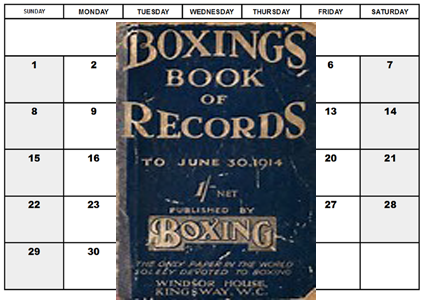
1992: Charley Burley Passes!
CHARLEY BURLEY: THE FORGOTTEN MASTER OF BOXING’S MURDERERS’ ROW
The Pittsburgh Boxing Legend Who Conquered Champions, Was Feared by the Best, and Never Received His Shot at a World Championship
One of boxing’s greatest untold stories, Charley Burley defeated future world champions, dominated legendary opponents, and earned the admiration of boxing’s most respected figures. Yet, despite an extraordinary professional career spanning 98 fights without ever being stopped, the brilliant welterweight and middleweight was denied the opportunity to compete for a recognized world championship.
In the rich and often unforgiving history of professional boxing, few fighters have commanded greater respect from their peers while receiving less recognition from the sporting public than Charley Burley. A master technician, devastating counterpuncher, and extraordinarily gifted ring strategist, Burley was among the most feared fighters of boxing's golden era. He defeated future world champions, outclassed Hall of Fame opponents, and established himself as one of the finest welterweights and middleweights of the 1930s and 1940s. Yet, despite his exceptional ability and years among the world's leading contenders, he never received the opportunity to fight for a recognized world championship. His story remains one of boxing's most compelling examples of extraordinary talent denied its ultimate reward.
Born Charles Duane Burley on September 6, 1917, in Bessemer, Pennsylvania, the future boxing legend grew up in a working-class family. His father was a Black coal miner, while his mother was an Irish immigrant from County Cork, Ireland. Following his father's death in an industrial accident in 1925, the family relocated to Pittsburgh, where Burley would develop into one of the most accomplished fighters the city ever produced. Growing up during the Great Depression, he learned early the importance of discipline, determination, and hard work, qualities that would become defining characteristics of his remarkable boxing career.
Burley's introduction to boxing came at approximately 12 years old when he began training at Pittsburgh's Kay Boys Club under the guidance of Leonard Payne and Howard Turner. His natural athleticism, exceptional coordination, and remarkable understanding of distance and timing quickly distinguished him from other young fighters. As an amateur, he captured junior boxing honors and Golden Gloves recognition before establishing himself among the nation's leading welterweight prospects. An accomplished all-around athlete, Burley was also a talented baseball player who reportedly attracted interest from the legendary Homestead Grays of the Negro leagues. However, it was inside the squared circle that he would establish his enduring legacy.
In 1936, Burley made a decision that reflected his principles as much as his competitive ambitions. Although he was a leading amateur prospect, he declined to participate in the American Olympic selection process for the Berlin Games because of his opposition to Nazi Germany's racist policies. He instead accepted an invitation to participate in the alternative People's Olympiad in Barcelona, Spain. However, the outbreak of the Spanish Civil War forced the cancellation of that competition. With his Olympic aspirations effectively ended, Burley turned his attention toward the professional ranks.
On September 29, 1936, the 19-year-old Pittsburgh prospect launched his professional career with a fourth-round knockout of George Liggins. It was the beginning of a 14-year journey that would establish Burley as one of boxing's most accomplished competitors. Fighting primarily between the welterweight and middleweight divisions, he developed a reputation as an exceptionally difficult opponent, combining superb defensive instincts, intelligent footwork, deceptive feints, accurate counterpunching, and surprising punching power. His ability to anticipate an opponent's movements and exploit even the smallest opening made him a formidable challenge for virtually anyone willing to share the ring with him.
By 1938, Burley had established himself as a legitimate welterweight contender. On August 22 of that year, he defeated the highly respected Cocoa Kid over 15 rounds in Millvale, Pennsylvania, capturing the World Colored Welterweight Championship. The title existed during an era when racial discrimination severely restricted opportunities for Black fighters to challenge for widely recognized world championships. Although it was not equivalent to the universally recognized world welterweight crown, the victory demonstrated Burley's standing among the division's elite competitors.
As his career progressed, Burley continued to build an impressive résumé against some of the toughest fighters of his generation. Among his most significant victories were triumphs over future world champions Billy Soose and Fritzie Zivic, the latter of whom Burley defeated twice in three meetings. He also recorded important victories over formidable contenders such as Jack Chase, Aaron "Tiger" Wade, Cocoa Kid, and Holman Williams. These were not carefully selected opponents designed to inflate a fighter's record. They were accomplished professionals, many of whom possessed championship-level talent and were considered among the most dangerous fighters of their era.
Burley became a prominent member of the legendary collection of African American contenders known as "Murderers' Row," a group of exceptionally talented fighters who frequently struggled to secure championship opportunities. Alongside Burley, the group included Holman Williams, Eddie Booker, Lloyd Marshall, Jack Chase, Cocoa Kid, Bert Lytell, and Aaron Wade. These fighters were often considered too dangerous for the financial rewards associated with facing them. Consequently, they frequently fought one another, producing a series of fiercely competitive contests that demonstrated their extraordinary abilities while doing little to advance their prospects of receiving recognized world-title opportunities.
Perhaps no rivalry better illustrated the extraordinary competitive standards of Murderers' Row than Burley's seven-fight series against Holman Williams. Between 1939 and 1945, the two elite technicians met repeatedly, with Burley winning three contests, Williams winning three, and one bout ending in a no contest. Their encounters were demanding tests of boxing intelligence, adaptability, and technical excellence. On August 14, 1942, Burley scored one of his most significant victories when he stopped Williams in the ninth round in New Orleans to capture the World Colored Middleweight Championship.
That same year, Burley twice faced future heavyweight champion Ezzard Charles, losing both encounters by decision. The defeats were significant but did little to diminish his reputation. Charles would eventually become one of boxing's most accomplished champions, and Burley's willingness to challenge such dangerous opposition further demonstrated his competitive ambition. Remarkably, between his two meetings with Charles, Burley registered his stoppage victory over Williams, illustrating the demanding schedule and exceptional quality of opposition that characterized his career.
Burley's defining performance came on April 21, 1944, when he faced future light heavyweight champion Archie "The Old Mongoose" Moore at Legion Stadium in Hollywood, California. Despite conceding approximately six pounds to Moore, Burley delivered a masterful display of precision punching, defensive brilliance, and tactical superiority. Over ten rounds, he repeatedly frustrated and punished his celebrated opponent, scoring multiple knockdowns and earning a convincing decision victory. Contemporary newspaper accounts differed slightly on the official number of knockdowns, but reports from the Los Angeles Times credited Burley with flooring Moore four times.
The victory became one of the most celebrated performances of Burley's career and helped establish his reputation among boxing historians as an extraordinary fighter. Moore, who would go on to become one of the greatest light heavyweight champions in history, later acknowledged the brilliance of the man who had defeated him. Reflecting on their encounter, Moore admitted, "Burley gave me a boxing lesson." It was an extraordinary endorsement from a fighter who would eventually share the ring with such legendary names as Rocky Marciano, Floyd Patterson, and Muhammad Ali.
Only 15 days before defeating Moore, Burley had captured the California State Middleweight Championship with a ninth-round knockout of Jack Chase on April 6, 1944. The two victories, achieved against dangerous and highly respected opponents within barely two weeks, represented one of the most impressive stretches of his professional career. Burley's ability to defeat accomplished fighters in rapid succession further demonstrated the exceptional combination of skill, toughness, and determination that made him so difficult to beat.
Throughout his career, Burley's greatest strengths were not limited to his punching power. He possessed a sophisticated defensive style that allowed him to slip punches, control distance, manipulate angles, and counterattack with remarkable accuracy. His use of feints and subtle changes in positioning frequently caused opponents to commit themselves to attacks that left them vulnerable. He was equally effective boxing at range or engaging at closer quarters, demonstrating a versatility that separated him from many of his contemporaries.
Legendary trainer Eddie Futch, whose extraordinary career included working with some of boxing's greatest champions, offered one of the most significant assessments of Burley's ability, describing him as the greatest all-around fighter he had ever seen. Coming from a trainer whose boxing knowledge and accomplishments were universally respected, the assessment underscored the remarkable esteem in which Burley was held by those who understood the sport at its highest level.
One of the most intriguing chapters of Burley's career involved the possibility of a showdown with the legendary Sugar Ray Robinson. Although both men competed during the same era and were among the outstanding fighters of their generation, the highly anticipated matchup never materialized. Robinson's manager, George Gainford, later acknowledged having bypassed Burley because his difficult style presented a particularly unfavorable challenge. The admission reinforced Burley's reputation as a fighter whose extraordinary abilities made him a dangerous proposition even for boxing's greatest champions.
However, the absence of a Burley-Robinson encounter remains one of boxing history's great unanswered questions. No one can know how such a contest would have unfolded, but the fact that Burley was regarded as a serious threat to Robinson speaks volumes about his standing among the sport's elite. For Burley, the frustration was part of a much larger struggle to secure opportunities against the recognized champions of his time.
Despite consistently proving himself against world-class opposition, Burley never received a recognized world championship opportunity. Racial discrimination, restrictive matchmaking practices, financial considerations, and the reluctance of leading fighters and their managers to accept high-risk assignments all contributed to the obstacles he faced. While many of his contemporaries achieved fame and financial security through championship opportunities, Burley was left to establish his greatness without the platform of a world-title fight.
The financial realities of his career were particularly harsh. Even as he defeated elite opponents, Burley frequently struggled to earn sufficient money from boxing to support himself and his family. During portions of his fighting career, he worked outside the ring, including employment in the aircraft industry. He later worked for the City of Pittsburgh in sanitation, a profession that offered greater financial stability than the unpredictable and often disappointing purses available to him as a professional fighter.
Burley continued fighting through the late 1940s, demonstrating that his considerable abilities remained intact. By the time he retired in 1950, he had completed an extraordinary professional career consisting of 98 bouts. His record is commonly listed as 83 victories, 12 defeats, two draws, and one no contest, including 50 knockouts, although the International Boxing Hall of Fame records his accomplishments as 84 victories, 11 defeats, two draws, and one no contest. The discrepancy reflects differences in historical recordkeeping, but one remarkable statistic remains undisputed: Charley Burley was never stopped in his entire professional career.
That achievement becomes even more impressive when considering the extraordinary caliber of opposition he faced. Throughout his career, Burley challenged naturally larger fighters, world-class contenders, and future champions, yet no opponent succeeded in knocking him out or forcing a stoppage. His durability, defensive mastery, and competitive instincts enabled him to withstand the challenges of an exceptionally demanding era.
Following his retirement, Burley largely disappeared from the national boxing spotlight. Unlike many celebrated champions of his generation, he did not enjoy the financial rewards, publicity, or public recognition that his remarkable abilities might otherwise have commanded. Instead, he continued working in Pittsburgh and lived a comparatively quiet life, far removed from the glamour and attention associated with boxing's biggest stars.
Although his accomplishments were overlooked by much of the general public during his fighting years, boxing historians, trainers, and former champions never forgot his extraordinary talent. His reputation gradually grew as researchers and boxing enthusiasts revisited the achievements of Murderers' Row and examined the careers of the outstanding fighters who had been denied championship opportunities.
Burley's historical standing was eventually recognized through induction into The Ring magazine's Boxing Hall of Fame in 1983, the World Boxing Hall of Fame in 1987, and the International Boxing Hall of Fame in 1992. These honors acknowledged what many of his contemporaries had understood decades earlier: Charley Burley belonged among boxing's all-time greats.
Tragically, Burley died on October 16, 1992, in Pittsburgh, Pennsylvania, at the age of 75, during the same year he was inducted into the International Boxing Hall of Fame. Although he lived long enough to see his remarkable career receive formal recognition, his achievements never brought him the widespread fame or fortune enjoyed by many of the champions he had defeated.
His legacy nevertheless extends far beyond championships, rankings, and statistics. Burley represents a generation of extraordinary African American fighters whose opportunities were restricted by racial discrimination and the business realities of professional boxing. His career serves as a reminder that championship belts do not always identify the greatest fighters of an era and that some of boxing's most remarkable talents were never given the opportunity to compete for the sport's highest honors.
Today, Charley Burley remains a revered figure among boxing historians and knowledgeable enthusiasts. His victories over future champions, his dominance against elite opposition, his remarkable defensive skills, and his undefeated record against the ultimate test of being stopped have secured his place among the sport's most accomplished competitors.
Charley Burley never held a universally recognized world championship. He never enjoyed the financial rewards of boxing's biggest attractions. And he never received the opportunity to prove himself on the championship stage he so richly deserved.
But inside the ring, where reputations were tested and greatness was measured one round at a time, Charley Burley proved himself a champion in every sense of the word.
He was the fighter champions feared, the master technicians admired, and the forgotten legend whose greatness could never be measured by a championship belt.
Charley Burley
Born: September 6th, 1917
Birth Name: Charles Duane Burley
Birth Place: Bessemer, Pennsylvania
Pro-Debut: September 29th, 1936
Residence: Pittsburgh, Pennsylvania
Division: Welterweight
Stance: Orthodox
Height: 5′ 9″
Reach: 75″
Bouts: 98
Rounds: 699
Ko’s: 51%
Record: 83-12-2, 50Ko’s
Died: Age 75, October 16th,1992
International Hall of Fame: Class of 1992
Amateur Career
At age 12, Burley joined the Kay Boys Club in Pittsburgh, Pennsylvania, where he took up boxing under the tutelage of local trainers Leonard Payne and Howard Turner.
Burley won a Golden Gloves Junior title at lightweight and a Golden Gloves Senior title at welterweight.
Burley lost to Leo Sweeney in the welterweight final of the National AAU Tournament.
In 1936, Burley was invited to Chicago to attend the box-offs for the Summer Olympics in Berlin, Germany, but he declined as he objected to the racial and religious persecution taking place in Germany. Instead, he received an invitation to represent the United States at the Workers' Games, which were being held in Barcelona, Spain, as an alternative to the Olympics. However, the Workers' Games never took place because of the outbreak of the Spanish Civil War.
Professional Career
On August 22, 1938, Burley defeated Cocoa Kid by a fifteen-round unanimous decision to win the "Colored" World Welterweight Championship.
On April 6, 1944, Burley defeated Jack Chase by a ninth-round knockout to win the California State Middleweight Championship.
Burley defeated future World Champions Fritzie Zivic, Billy Soose and Archie Moore.
Burley fought Holman Williams seven times between 1939 and 1945. Burley won three, Williams won three and one was a no contest.
BoxRec lists Burley's record as 83-12-2 with 1 no contest, and the International Boxing Hall of Fame lists his record as 84-11-2 with 1 no contest.
Burley was never stopped in 98 professional fights.
Honors & Recognition
Inducted into The Ring Magazine Boxing Hall of Fame in 1983.
Inducted into the World Boxing Hall of Fame in 1987.
Inducted into the International Boxing Hall of Fame in 1992.
Ranked 39th on The Ring Magazine's 2002 list - The 80 Best Fighters of the Last 80 Years.
Ranked 86th on The Ring Magazine's 2003 list - The 100 Greatest Punchers of All-Time!
Ranked 6th on The Ring Magazine's 2004 list The Greatest Middleweights of All-Time.
Ranked 4th on The Ring Magazine's 2008 list The Greatest Welterweights of All-Time.
Legendary trainer Eddie Futch said, "Charley Burley was the finest all-around fighter I ever saw."
Charles Duane Burley is buried at the Allegheny Cemetery in Pittsburgh.
2019: Patrick Day Passes!
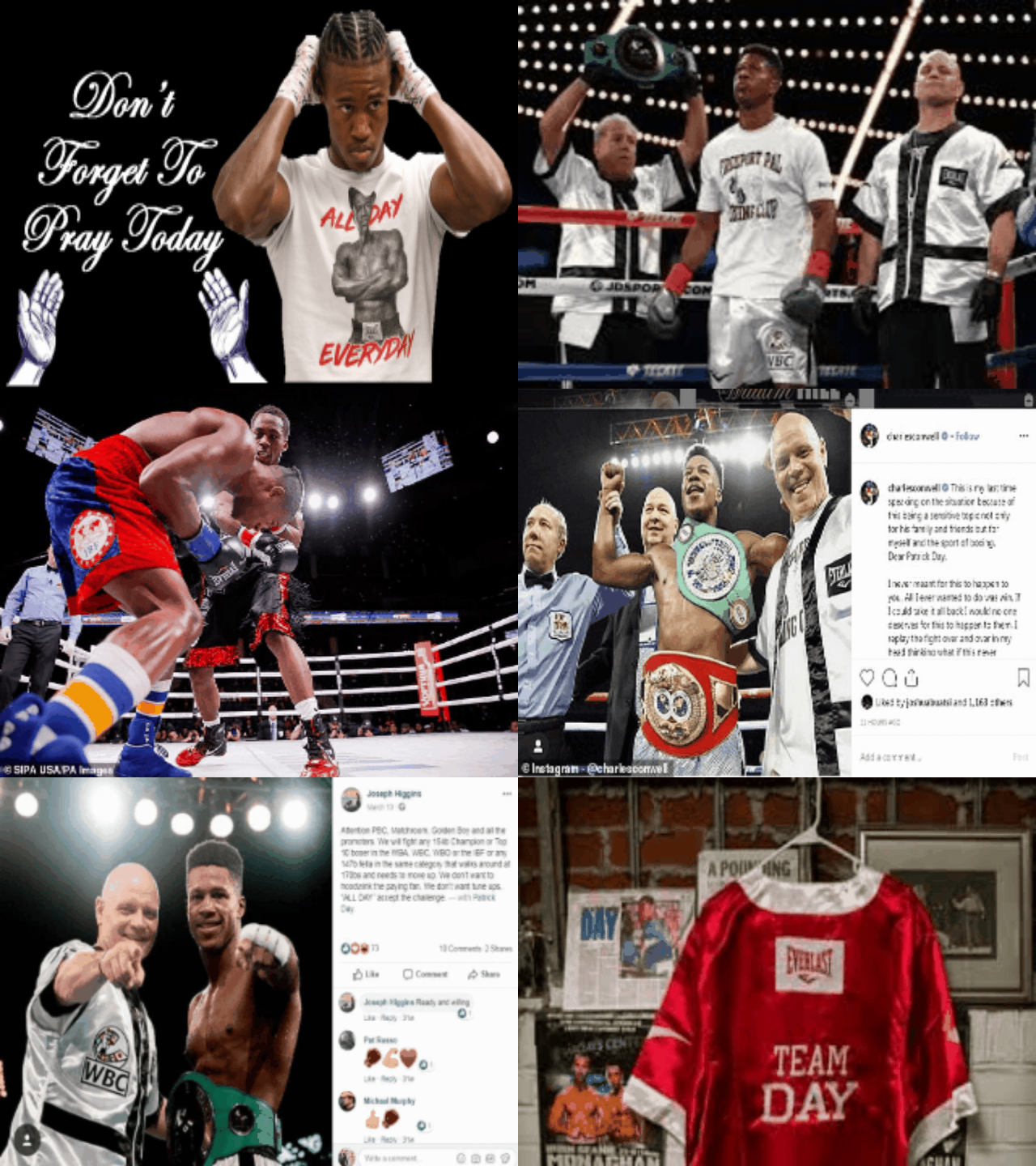
On October 12, 2019, a professional boxing match at Wintrust Arena in Chicago became a turning point in a year marked by devastating losses in the sport. Patrick Day, a light middleweight boxer from Freeport, Long Island, New York, suffered a traumatic brain injury during a knockout loss to Charles Conwell in a USBA super welterweight title bout, and died four days later. He was 27 years old.
Patrick Day
Born: August 9th, 1992
Birth Place: Freeport, New York
Residence: Freeport, New York
Pro-Debut: January 23rd, 2013
Alias: "All Day"
Division: Super Welterweight
Stance: Orthodox
Height: 5′ 9″
Reach: 74″
Career: 2013-2019
Record: 17-4-1, 6Ko’s
Bouts: 22
Rounds: 126
Ko’s: 27.27%
Died: October 16th, 2019
The fighter who entered the ring that Saturday night was more than just an athlete. Patrick was the son of Haitian immigrants and had earned an associate degree in nutrition from Nassau Community College and a bachelor's degree in health and wellness from Kaplan University.
A bright and charismatic young man with a smile that would have made a model jealous. Day started boxing in 2006 under the guidance of highly regarded U.S. Marine, NYC Firefighter and boxing trainer Joe Higgins, and quickly rose through the amateur ranks. In 2012, he won two nationals titles, the New York Golden Gloves tournament and was an Olympic team alternate. His amateur record was 75–5, and he was recognized as the number-one ranked amateur boxer in the United States in the 152-pound division.
Day turned professional in 2013 and overcame early career struggles to become a world-rated junior middleweight contender. He captured the WBC Continental Americas championship in 2017 and the IBF Intercontinental championship in 2019. In June 2019, he was rated in the top 10 by both the WBC and IBF. By the time he faced Charles Conwell, Day had a professional record of 17-4-1 with six wins by knockout.
Day was knocked down in the fourth and eighth rounds of the bout before several punches to the head from Conwell again sent him to the canvas in the 10th and final round. The final knockdown was particularly brutal—Day's head bounced off the canvas and the ref immediately stopped the fight.
Day was attended to by medical personnel before he was taken from the arena on a stretcher. What began as a devastating loss in the ring became something far more tragic. Day suffered a seizure after the fight and then fell into a coma. He later underwent emergency brain surgery.
Perhaps no one felt the weight of this tragedy more intensely than Joe Higgins, the man who had coached Day from the day the 14-year-old wandered into his garage in 2006. Higgins, a retired firefighter and 9/11 first responder who had lost his brother Timothy in the Twin Towers collapse and worked the recovery site, had found healing in Day's presence and infectious spirit.
Day's trainer, Joe Higgins, a hero of the 9/11 terror attacks who ran into the fire to try to help people and has suffered a lifetime of illness and health issues as a result, was distraught. Day's family lived across the street from Higgins', and Higgins still remembers the day when Day's family brought infant Patrick home from the hospital.
In the hours before Day's death, Higgins sent a text to ESPN that revealed the depths of his anguish: "I'm dying. I feel like I'm responsible, like I let him down. My special kid." The trainer vowed never to participate in boxing again: "I'm never watching another boxing match. I'm never training another kid. I'm never going to put another kid in danger of a punch. Ever." He called boxing "a bloodsucker sport."
In a moment of profound grief, Higgins instructed his assistants to shutter the Freeport PAL gym and change the locks: "In honor of Patrick Day, no one's going to hit the last bag he hit, or spar in the last ring he sparred in. I'm not even donating it. That stuff's going somewhere no one can ever find it again. That's just the way I feel."
Yet amid the darkness, Higgins found clarity about his role in Day's life and legacy. "Pat saved my life," said Higgins. "And now I'm praying God saves his." He would later explain that he did not feel responsible for Patrick's death. Instead, he believed "God knew that" Patrick "said he was gonna change the world," and it was now up to him to complete that mission: "I'm gonna complete his mission. I'm going after it, and if the conditions don't change, then boxing will be abolished!"
Most remarkably, Higgins extended compassion to Charles Conwell. After receiving Conwell's emotional letter expressing remorse, Higgins opened a social media account to reach out: "Hello Charles, I am Patrick Day's trainer Joe Higgins. I just wanted you to know that we do understand what you must be going thru as well. As devastated as we are we realize you are equally devastated. We know if it was the other way around we would be just as distraught. Thank you for your kind words. Patrick was born across the street from me so our relationship is special. He would have wanted you to continue. I'm rooting for you to reach your dream, the same one he had. God Bless your Team and we will keep you in our prayers as well."
Day died Wednesday, four days after sustaining head injuries in the fight. Promoter Lou DiBella said Day died at Northwestern Memorial Hospital. He was surrounded by his family, close friends and members of his boxing team, including his mentor, friend and trainer Joe Higgins.
In the wake of Day's death, his management company issued a statement that transcended the moment of loss to address boxing itself. DiBella Entertainment said that Day's death made it "very difficult to explain away or justify the dangers of boxing at a time like this. While we don't have the answers, we certainly know many of the questions, have the means to answer them, and have the opportunity to respond responsibly and accordingly and make boxing safer for all who participate."
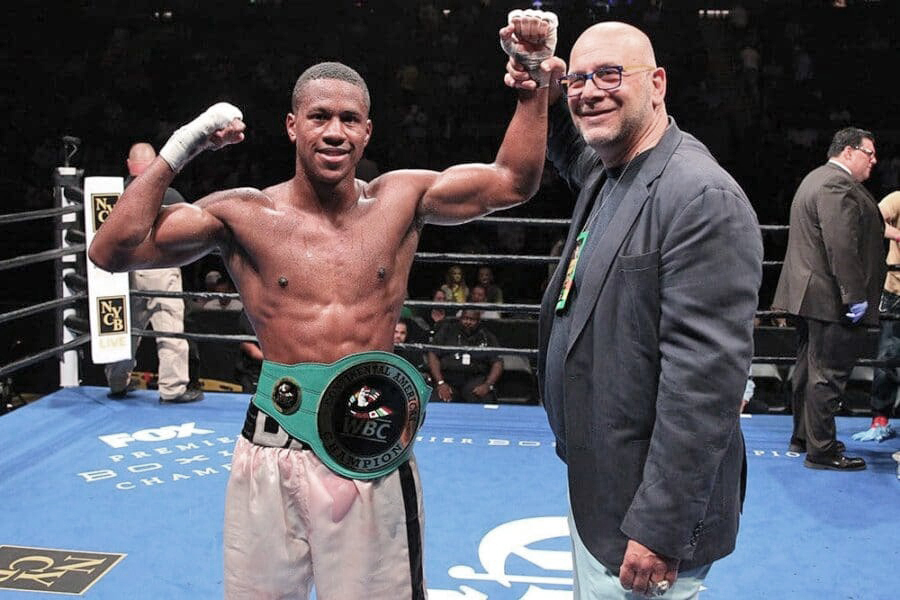
(DiBella Entertainment — October 16, 2019)
Patrick Day passed away today, October 16, 2019, succumbing to the traumatic brain injury he suffered in his fight this past Saturday, October 12, at the Wintrust Arena in Chicago, IL. He was surrounded by his family, close friends and members of his boxing team, including his mentor, friend, and trainer Joe Higgins. On behalf of Patrick’s family, team, and those closest to him, we are grateful for the prayers, expressions of support and outpouring of love for Pat that have been so obvious since his injury.
Before establishing himself as a world-class professional fighter, Pat was a highly decorated amateur. He won two Nationals titles, the New York Golden Gloves tournament, and was an Olympic Team alternate, all in 2012. Day turned pro in 2013 and overcame early career struggles to become a world-rated super welterweight contender. He captured the WBC Continental Americas championship in 2017 and the IBF Intercontinental championship in 2019. In June 2019, he was rated in the top-ten by both the WBC and IBF.
He was also a dedicated college student, having earned an Associate’s degree in Food and Nutrition from Nassau Community College and, subsequently, a Bachelor’s degree in Health and Wellness from Kaplan University. He was a son, brother, and good friend to many. Pat’s kindness, positivity, and generosity of spirit made a lasting impression with everyone he met. During his short life, boxing allowed Patrick to impact many communities, both big and small. In his hometown of Freeport, Long Island, he was a beacon of light and the star pupil at the Freeport PAL, the gym he trained in from the moment he began boxing until the last bout of his career. He was recognized as one of Long Island’s finest professional fighters for years. He was a fixture in the boxing community throughout New York City. Patrick was even known in Japan, where he had traveled to spar with his friend and colleague, world champion Ryota Murata.
Patrick Day didn’t need to box. He came from a good family, he was smart, educated, had good values, and had other avenues available to him to earn a living. He chose to box, knowing the inherent risks that every fighter faces when he or she walks into a boxing ring. Boxing is what Pat loved to do. It’s how he inspired people and it was something that made him feel alive.
It becomes very difficult to explain away or justify the dangers of boxing at a time like this. This is not a time where edicts or pronouncements are appropriate, or the answers are readily available. It is, however, a time for a call to action. While we don’t have the answers, we certainly know many of the questions, have the means to answer them, and have the opportunity to respond responsibly and accordingly and make boxing safer for all who participate.
This is a way we can honor the legacy of Pat Day. Many people live much longer than Patrick’s 27 years, wondering if they made a difference or positively affected their world. This was not the case for Patrick Day when he left us. Rest in peace and power, Pat, with the angels.
Let his bright light live on and shine a spotlight on future safety measures for this dangerous sport.
For Charles Conwell, the outcome of the match created an entirely different kind of trauma. Conwell was a 2016 Olympian who competed in the men's middleweight event at the 2016 Summer Olympics. At just 21 years old, Conwell faced the crushing weight of knowing that his performance in the ring had resulted in another fighter's death.
Conwell posted an open letter stating: "I never meant for this to happen to you. All I wanted to do was win. If I could take it all back, I would. No one deserves for this to happen to them. I replay the fight over and over in my head thinking what if this never happened and why did it happen to you."
Dear Patrick Day,
I never meant for this to happen to you. All I ever wanted to do was win. If I could take it all back I would no one deserves for this to happen to them. I replay the fight over and over in my head thinking what if this never happened and why did it happen to you.
I can't stop thinking about it myself I prayed for you so many times and shedded so many tears because I couldn't even imagine how my family and friends would feel. I see you everywhere I go and all I hear is wonderful things about you.
I thought about quitting boxing but I know that's not what you would want I know that you were a fighter at heart so I decided not to but to fight and win a world title because that's what you wanted and thats what I want so I'll use you as motivation every day and make sure I always leave it all in the ring every time.
With Compassion, Charles Conwell
Those closest to Day understood that his decision to pursue boxing was his own. Day didn't need to box—he came from a good family, was smart, educated, had good values and had other avenues available to him to earn a living. He chose to box, knowing the inherent risks that every fighter faces when he or she walks into a boxing ring.
Boxing was what Pat loved to do. It's how he inspired people and it was something that made him feel alive.
Day's death was not an isolated tragedy. His death was the latest in a string of recent fatalities in the sport. Maxim Dadashev, a 28-year-old Russian, died in July after a fight at MGM National Harbor casino in Oxon Hill, Maryland. And 23-year-old Hugo Santillan reportedly suffered cardiorespiratory failure after fighting to a draw in his native Argentina days after Dadashev's death. A Bulgarian boxer, Boris Stanchov, reportedly died in the ring in September during a fight in Albania.
Patrick Day is remembered not as a fighter defeated, but as a young man who pursued his passion despite the known risks—a fighter who loved what he did and inspired those around him. His legacy serves as a sobering reminder of both the dreams that drive athletes and the real dangers that exist within the sport they love. Always Missed and Remembered, Rest In Peace Patrick…
October 16th
1900: Matty Matthews W15 James Ferns
1902: Young Corbett KO 8 Joe Berstein
1903: Frankie Neil D 20 Johnny Reagan
1906: Honey Mellody W15 Joe Walcott
1909: Jack Johnson KO12 Stanley Ketchel
1932: Ingemar Johansson was born in Gothenburg, Sweden
1942: Natl Boxing Assn freezes titles of those serving in armed services.
1950: Sugar Ray Robinson TKO6 Joe Rindone
1969: Charles Brewer is born in Philadelphia, PA.
1970: Chucho Castillo KO14 Ruben Olivares
1976: Wilfred Benitez KO3 Tony Petronelli
Samuel Serrano W15 Ben Villaflor
Alfonso Zamora KO12 Soo Hwan Hong
1980: Livingstone Bramble age 20 debuts TKO1 Jesus Serrano
1982: Eusebio Pedroza D15 Bernard Taylor
1987: Mike Tyson KO7 Tyrell Biggs
Matthew Hilton KO2 Jack Callahan
Jeff Fenech TD4 Carlos Zarate
1988: Juan Jose Estrada KO11 Takuya Muguruma
1990: James Toney W10 Sanderline Williams
Winky Wright W4 Anthony Salerno
1992: Anaclet Wamba W12 Andrew Maynard
Charley Burley passes.
1993: Anaclet Wamba KO7 Akim Tafer
1997: Boxer Mike Tyson is ordered to pay boxer Mitch Green $45,000 even though a jury ruled the former heavyweight champion was provoked into a Harlem-street fight in 1988.
1999: Irene Pacheco KO4 Ferid Ben Jeddou
2008: Oscar Larios W12 Takahiro Aoh
Hozumi Hasegawa KO2 Alejandro Valdez
2010: Vitali Klitschko W12 Shannon Briggs
Julio Cesar Miranda TKO2 Michael Arango
Silverio Ortiz KO2 Elvin Perez
Wilfredo Vazquez Jr TKO11 Ivan Hernandez
Lindsay Garbatt DMD10 Melissa Hernandez
2015: Kohei Kono W12 Koki Kameda
Lusanda Komanisi KO5 Roli Gasca
2019: Freeport, Long Island, New York's, popular light middleweight Patrick “All” Day passed from brain trauma sustained in a knockout loss October 12th, 2019 against unbeaten 2016 Olympian, Charles Conwell.
2021: Mairis Briedis TKO3 Artur Mann
Savannah MarshallTKO2 Lolita Muzeya
2022: Devin Haney W12 George Kambosos Jr.
 Print
Print