
On This Day In Boxing History!
1942: Carlos Monzon Was Born!
Carlos Monzón was born on August 7, 1942, in San Javier, Argentina, before moving to the capital of Santa Fe Province. As a youth, he showed an early interest in boxing. Monzón rose to international fame when he became the undisputed world middleweight champion in 1970 by knocking out the then-champion Nino Benvenuti in the 12th round in Rome, a stunning upset as few expected him to win against the well-established Benvenuti. He also won their rematch decisively in Monte Carlo, stopping Benvenuti in three rounds after his corner threw in the towel.
Monzón successfully defended his middleweight title 14 times between 1970 and 1977 against 11 different fighters, setting a division record for title defenses at the time. His notable opponents included Hall of Famers such as Emile Griffith, whom he stopped in 14 rounds in 1971 and then out-pointed in a 15-round decision, José Nápoles (knocked out in seven rounds in Paris), Bennie Briscoe (a tough but ultimately eight-round decision win), and Rodrigo Valdez, whom he defeated twice in classic fights to unify the WBA and WBC titles. The first Valdez fight in 1976 saw Monzón outpoint an uninterested Valdez, and in the rematch, despite being knocked down for the only time in his career, Monzón rallied to win a unanimous decision in a memorable comeback. His 15 world title fights included 10 victories by knockout, highlighting his power and skill.
Monzón’s professional record ended at 87 wins, 3 losses, 9 draws, and 1 no contest, with 59 knockouts. His three losses were early in his career and were all avenged later. In 1975, the WBC stripped him of their middleweight title for not facing mandatory challenger Rodrigo Valdez, though he retained the WBA title until his retirement after his second win over Valdez in 1977. After retiring, he kept a low public profile.
Outside the ring, Monzón’s life was marked by turbulence and violence. Known as charismatic but also violent, he was accused multiple times of domestic abuse by his wives and mistresses and reputed for physically attacking paparazzi. His romantic relationship with famous Argentine actress Susana Giménez from 1975 until 1980 attracted intense media attention, during which he was repeatedly detained for violent incidents. After his split with Giménez, his abusive behavior continued with his concubine, Alicia Muñiz. In 1989, after a brutal fight, Monzón pushed Muñiz off a balcony, causing her death. He was convicted of second-degree murder and sentenced to 11 years in prison.
Monzón died tragically in a car crash on January 8, 1995, near the prison where he was serving his sentence, after returning from a weekend furlough granted to visit his family. There have been unproven rumors about suicide, but no evidence supports this.
Despite his personal controversies, Monzón is remembered as one of boxing’s all-time great middleweights. He was inducted into the International Boxing Hall of Fame in 1990 and is remembered for his aggressive fighting style, technical skill, and power. Modern rankings place him among the greatest pound-for-pound fighters and the third-best middleweight in history, trailing only Marvin Hagler and Sugar Ray Robinson.
Carlos Monzon
Born: August 7th, 1942
Birth Name: Carlos Roque Monzón
Birth Place: San Javier, Santa Fe, Argentina
Residence: Santa Fe, Santa Fe, Argentina
Pro-Debut: February 6th, 1963
Division: Middleweight
Alias: Escopeta
Stance: Orthodox
Height: 5′ 11½″
Reach: 76″
Bouts: 100
Rounds: 761
Record: 87-3-9, 59Ko’s
Ko’s: 59%
Died: Age 52, January 8th, 1995
Career
WBA Middleweight Champion
1970 Nov 7 – 1977 Aug 29
WBC Middleweight Champion
1970 Nov 7 – 1974 Feb 9
WBC Middleweight Champion
1976 Jun 26 – 1977 Aug 29
In February 1988, Monzon was convicted of killing his common-law wife, Alicia Muniz and was sentenced him to eleven years in prison.
Age 52, on a two-week furlough Monzon died January 1995 when his car ran off a country road and overturned returning to Las Flores Prison.
Monzon was inducted into the International Boxing Hall of Fame in 1990.
1960: “The Wild Bull of the Pampas”
Luis Ángel Firpo Passes!
Luis Angel Firpo
Born: October 11th, 1894
Birth Place: Junín, Buenos Aires, Argentina
Residence: Buenos Aires, Argentina
Nationality: Argentine
Pro-Debut: December 10th, 1917
Division: Heavyweight
Alias: “The Wild Bull of the Pampas”
Stance: Orthodox
Height: 6′ 2½″
Reach: 79″
Bouts: 36
Rounds: 193
Ko’s: 72.22%
Career: 1917-1936
Record: 31-4, 26Ko’s
Luis Ángel Firpo was an Argentine boxer born October 11th, 1894 in Junín, Argentina, he was nicknamed The Wild Bull of the Pampas.
In 1917, Firpo began his professional boxing career by beating Frank Hagney by a decision in six in Buenos Aires. Originally declared a no decision, the bout's result was later changed to a win for Firpo.
For his second bout, he traveled, in January 1918, to Montevideo, Uruguay, where he suffered his first defeat, a first-round knockout at the hands of Angel Rodriguez. He put a string of six wins in a row after that, and so on November 1, 1919, he found himself challenging Dave Mills in Santiago, for the South American Heavyweight title. He lost on that occasion by a decision in 15 rounds, but then came back with a win over Andres Balsa by a knockout in round six.
On April 20, 1920, he and Mills had a rematch and Firpo won the title with a first-round knockout. After one more win, he and Mills faced each other in a rubber match, and the result was the same as that of their second bout: Firpo the winner by a knockout in the first. In 1921, the quality of Firpo's challengers improved, when he defeated fringe contender Gunboat Smith twice, the first by decision in 12 and the second by knockout, also in 12.
In 1922, he continued his rise in the Heavyweight rankings by winning all four of his fights by a knockout.
Firpo began 1923 by knocking out former title challenger Bill Brennan in the 12th round. He followed that with seven more wins in a row, including wins over Jack McAuliffe and former world champion Jess Willard. After a win against Charlie Weinert, Firpo challenged world heavyweight champion Jack Dempsey at New York City on September 14, becoming the first Latin American in history to challenge for the title.
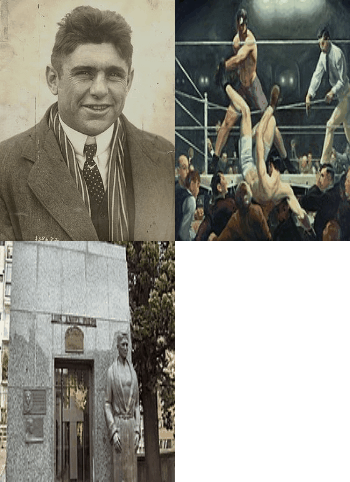
Firpo was floored seven times in the first round of the bout, before he trapped Dempsey against the ropes and launched a combination that sent the champion out of the ring. Dempsey hit his head against a writer's typing machine, and for a moment, it looked as if Firpo would become world Heavyweight champion. But Dempsey was helped into the ring at the count of nine (in spite of having been seventeen seconds outside the ring; fighters are given a twenty-second count when they are knocked through the ropes) and he eventually knocked out Firpo in the second round. This fight has been regarded by critics and experts as one of the greatest fights in history. Boxing historian Bert Sugar called it the greatest fight in the history of the sport. Despite losing, Firpo gained substantial fame all over Latin America after this bout, as many people in different parts of that region spoke about his feat of dropping Dempsey. This fight remained so inspirational that, for instance, it led to the naming of the Salvadorian football club C.D. Luis Ángel Firpo.
Firpo sending Dempsey outside the ring; Dempsey and Firpo, 1923 painting by George Bellows.
In 1924, Firpo won his first three fights by knockout, but then lost his last two by decision, the last to legendary challenger Harry Wills.
His fighting prime clearly passed him, Firpo's private life became a bigger issue in the papers than his professional life. In 1925, religious lawmakers brought charges against Firpo for bringing a married woman from Argentina to the U.S. for immoral purposes. Additional charges of falsifying details on his immigration papers sealed the deal. Luis preempted deportation by voluntarily returning to Argentina permanently.
He retired for a short period, but came back in 1926 to beat Erminio Spalla by a decision in ten. Then, he kept away from the fight game for nine years, but he attempted another comeback in 1936, winning two fights before being beaten by a knockout in three by future Joe Louis challenger Arturo Godoy. Firpo finally retired after compiling a record of 32 wins and 6 losses in 38 fights, with 26 wins by knockout.
Afterwards, Firpo became a car-dealer for Stutz and a rancher. By 1940 he was ranching on a large scale in Carlos Casares with 8,000 cattle, 4,000 sheep and 400 horses. He discovered the boxer Abel Cestac in July 1940. Firpo and Jack Dempsey agreed to jointly manage Cestac, who went on to become the South American heavyweight champion.
On his passing in 1960, Luis Firpo was buried in La Recoleta Cemetery in Buenos Aires. His mausoleum has a statue of him at the front.
Luis Angel Firpo vault in the Cemetery of Recoleta, Buenos Aires, where his remains were interred.
Firpo's popularity around Latin America was immeasurable. Years later, C.D. Luis Ángel Firpo, a professional football team in El Salvador, was named after him. In addition, various schools, streets, and avenues across Latin America have been named after him.
In 2003, he was named by The Ring as one of the 100 greatest punchers of all time.
August 7th
1910: Sam McVea D15 Battling Jim Johnson
1930: Jack Berg W10 Kid Chocolate
1935: Joe Louis TKO1 King Levinsky
1942: Carlos was Monzon born in San Javier, Santa Fe, Argentina
Manuel Ortiz W12 Lou Salica
Former World Light Heavyweight Champion Jack Dillon passes age 51
1960: Luis "El Toro Salvaje de las Pampas" Firpo passes age 65
1966: Vicente Saldivar W15 Mitsunori Seki
1968: Bennie Briscoe KO8 Gene Bryant
1971: Gerry Penalosa was born in San Carlos City, Negros Occidental, Philippines
1979: Salvador Sanchez KO5 Felix Trinidad Sr.
1982: Dwight Qawi KO6 Matthew Saad Muhammad
Eddie Mustafa Muhammad W10 Pablo Ramos
1983: Hector Camacho KO5 Rafael Limon
1989: Maurice Hooker is born in Dallas, Texas
1993: Gregorio Vargas KO3 Clifford Hicks
1994: Hiroshi Kawashima W12 Carlos Salazar
1997: Roy Jones Jr. KO1 Montell Griffin
1999: Frans Botha D10 Shannon Briggs
Marco Antonio Barrera W12 Pastor Maurin
Acelino Freitas KO1 Anatoly Alexandrov
Johnny Nelson RTD4 Willard Lewis
Stefano Zoff W12 Julien Lorcy
2001: Former WBA Super Featherweight & Lightweight belt holder Joey Gamache reaches a $2-million settlement of his lawsuit against the United Bank of Bangor (Maine). Gamache contended that the bank backed out of a commitment to loan him $285,000 to open a restaurant, costing him his life savings.
2004: Diego Corrales KO10 Acelino Freitas
Yodsanan Nanthachai W12 Steve Forbes
2005: Chris John TKO10 Tommy Browne
2010: Cornelius Bundrage KO5 Cory Spinks
2004: Diego Corrales TKO10 Acelino Freitas
Yodsanan Nanthachai W12 Steve Forbes
2021: Fabio Wardley TKO1 Nick Webb

 Print
Print