
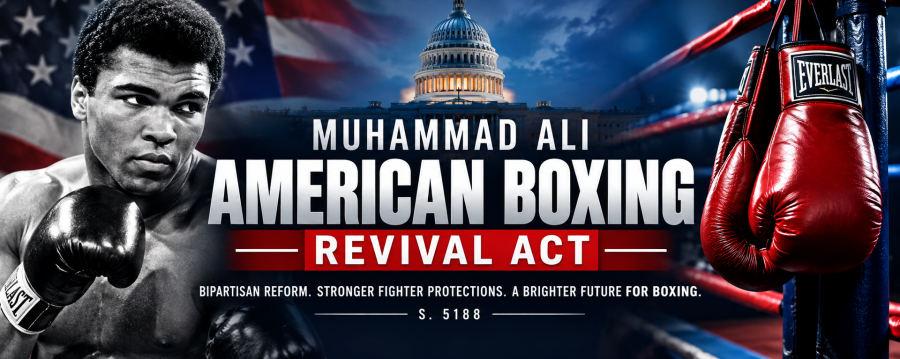
Muhammad Ali American Boxing Revival Act
Advances To Full Senate As Commerce Committee
Moves Sweeping Boxing Reform Bill Forward!
(September 18th) The Muhammad Ali American Boxing Revival Act of 2026 has cleared another major hurdle in Congress, with the U.S. Senate Committee on Commerce, Science, and Transportation advancing S. 5188 to the full Senate for consideration. The legislation, introduced by Senate Commerce Committee Chairman Ted Cruz (R-Texas) and Senator Jacky Rosen (D-Nev.), would amend the Professional Boxing Safety Act of 1996 and establish a voluntary alternative framework for professional boxing built around newly defined Unified Boxing Organizations, or UBOs. The committee action took place during an executive session where S. 5188 was advanced by voice vote after the committee considered and adopted a Cruz-Rosen substitute and a series of modified amendments offered by Senator Maria Cantwell.
The legislation represents the Senate version of a broader effort that began in the House of Representatives with H.R. 4624, also titled the Muhammad Ali American Boxing Revival Act. The House measure, introduced by Representatives Brian Jack (R-Ga.) and Sharice Davids (D-Kan.), passed the House by voice vote on March 24, 2026, following committee approval in January. The House legislation was the first boxing bill to pass the chamber in more than two decades and established the foundation for the Senate's subsequent consideration of professional boxing reform.
The Senate's consideration of the measure followed an April 22 hearing titled “Return to Your Corners: Have Federal Boxing Laws Gone the Distance or Slipped the Jab?” That hearing brought together Golden Boy Promotions chairman Oscar De La Hoya, Association of Boxing Commissions and Combative Sports president Timothy Shipman, professional boxer Nico Ali Walsh, and WWE president and TKO executive Nick Khan to examine the existing federal boxing framework and the House-passed legislation. Chairman Cruz argued that the current system, while providing important protections for fighters, has also contributed to fragmentation through competing interests, multiple sanctioning bodies and barriers to organizing major fights. The April hearing became the principal Senate public examination of the proposal before Cruz and Rosen introduced S. 5188 in July.
S. 5188 was formally introduced on July 30, 2026, by Cruz with Rosen as its Democratic cosponsor. The official title is the Muhammad Ali American Boxing Revival Act of 2026, and the bill's stated purpose is to amend the Professional Boxing Safety Act of 1996 by establishing requirements for Unified Boxing Organizations and further enhancing the well-being of professional boxers. The legislation would allow voluntary UBOs to operate alongside the traditional promoter-and-sanctioning-body structure rather than replacing that system outright, giving professional boxers another organizational option.
At the center of the legislation is the UBO concept. Under the proposal, a Unified Boxing Organization could provide a more centralized, league-style structure for organizing professional boxing while existing promoters and sanctioning organizations continue to operate. Supporters of the legislation argue that the parallel model could create additional competition, more opportunities for fighters and a clearer pathway toward meaningful matchmaking and title opportunities. The Senate Commerce Committee described the legislation as a way to remove legal barriers to voluntary league-style UBOs while strengthening fighter protections and creating new opportunities for organizations to compete.
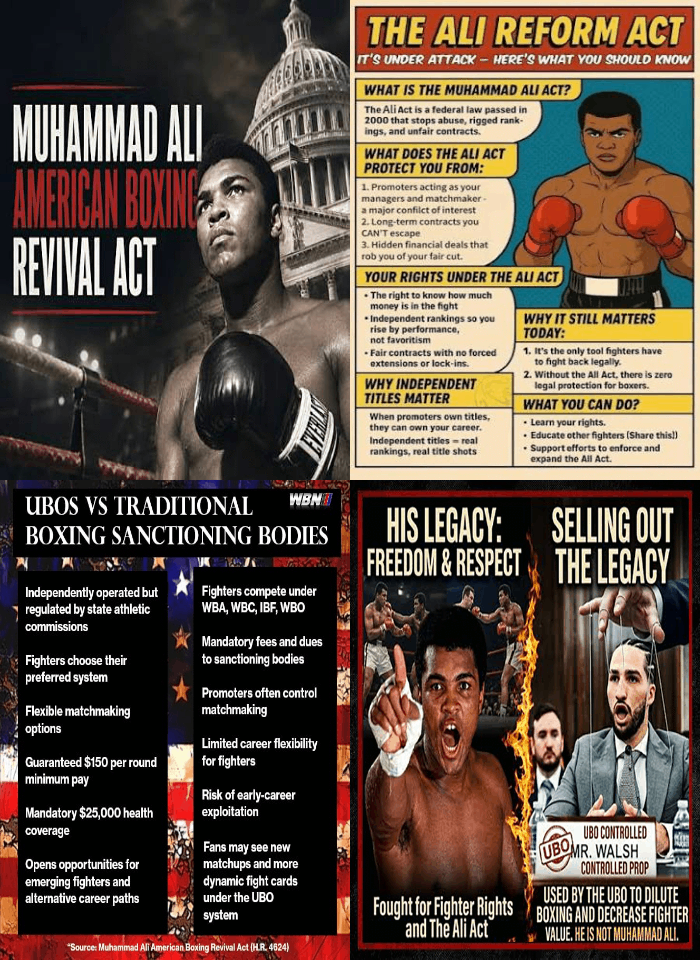
The proposed framework also contains significant fighter compensation, contractual and activity provisions. The legislation establishes a minimum payment of $200 per round scheduled for covered bouts and requires qualifying UBO contracts to provide for a minimum of one covered match every six months or, subject to specified exceptions, annual compensation equal to at least ten times the minimum payment for one round. Contracts with UBOs generally could not exceed six years, while a boxer's first professional promotional agreement with a UBO would be limited to three years. The bill also extends specified contractual protections to promotional agreements outside the UBO system.
Medical and safety standards are another major component of the proposal. The legislation would establish additional medical requirements for professional boxers competing under the UBO framework, including enhanced examinations following knockouts and additional requirements for older fighters. It also provides for medical personnel and ambulances at events, ringside physician standards, injury insurance and additional health protections. Earlier versions and supporting materials associated with the legislation described minimum insurance protections and enhanced medical testing as central elements of the reform effort.
The measure also addresses boxing's integrity and potential conflicts of interest. The proposal contains provisions concerning financial disclosures, fighter-promoter contracts, management relationships and the separation of interests involving UBO personnel, promoters and fighter managers. The legislation also establishes anti-doping requirements and restrictions intended to address conflicts that could arise when a single organization occupies multiple roles within the boxing business. The precise legal effect of those provisions is determined by the amended Senate text now moving forward rather than solely by the original July introduction.
One of the most notable developments surrounding the Senate version has been the changing position of Nico Ali Walsh, Muhammad Ali's grandson and a professional boxer who testified before the Senate Commerce Committee in April. Ali Walsh initially opposed the legislation in its earlier form, raising concerns about fighter protections and the concentration of power that could accompany a league-style system. After months of discussions with senators, policymakers and attorneys, however, Ali Walsh endorsed the revised legislation in a September 10 letter. He said the changes he advocated for included shorter promotional contracts, a meaningful path toward free agency, transparent and accountable ranking systems, a firewall between UBOs, promoters and fighter managers, and financial disclosure requirements applying to UBOs.
That reversal became particularly significant as the committee prepared to act on S. 5188. Cruz and Rosen have subsequently highlighted Ali Walsh's involvement in the legislative process and his endorsement of the revised measure. The Senate Commerce Committee characterized Ali Walsh as a supporter of the bill and pointed to his participation as part of the stakeholder discussions that preceded committee passage. Ali Walsh's support, however, should not be interpreted as evidence of unanimous support throughout the boxing community; the April Senate hearing demonstrated that the legislation has generated differing views among fighters, promoters and other boxing stakeholders.
The September 16 committee action also materially changed the procedural status of the legislation. The committee did not simply advance the original July Senate text. According to the Senate Commerce Committee's official record, S. 5188 was advanced as amended by the Cruz-Rosen substitute amendment, along with Cantwell Amendments 2, 3, 4 and 5, with the Cantwell amendments adopted in modified form. The committee advanced the measure by voice vote. That distinction is important because the version now proceeding toward the Senate floor is the committee-amended legislation rather than the bill as it was originally introduced on July 30.
Cruz and Rosen celebrated the committee action as a bipartisan step toward changing the structure of professional boxing. Cruz said the legislation would create more opportunities for fighters and help bring marquee matchups back to the sport, while Rosen emphasized fighter safety and the importance of boxing to Nevada and its economy. The committee's official statement said the legislation would provide boxers with more choices, strengthen fighter protections and safety standards, and create opportunities for organizations to compete.
The legislation's supporters have framed the proposal as an effort to modernize a sport that remains governed under a federal framework dating principally to the Professional Boxing Safety Act of 1996 and the Muhammad Ali Boxing Reform Act of 2000, commonly known together as the Ali Act. The current proposal does not simply repeal the existing system; rather, it seeks to create an additional organizational model while imposing new federal requirements involving safety, compensation, contracts and boxing operations. The Senate's April hearing specifically examined whether the existing federal framework remains adequate for the modern boxing industry and whether Congress should permit a more centralized alternative structure.
Despite the committee's action, the Muhammad Ali American Boxing Revival Act is not law. S. 5188 has not yet passed the full Senate, and the committee's approval does not itself change the federal rules governing professional boxing. The bill must still receive consideration and approval by the full Senate. If Senate action produces legislation different from the House-passed measure, the chambers would need to resolve the differences before identical legislation could be sent to the President. Only after passage by both chambers and presidential approval, or a constitutionally sufficient override of a veto, would the measure become federal law. The legislation also contains an implementation period under which its amendments would apply to professional boxing matches occurring 180 days after enactment.
For professional boxing, the Senate committee's action represents the most significant federal legislative movement on the sport's regulatory structure in years. What began with the House's passage of H.R. 4624 has now advanced through a Senate hearing, the introduction of S. 5188, months of stakeholder discussions and a Senate Commerce Committee markup. The amended bill now moves to the full Senate, where lawmakers will determine whether the proposed UBO system, enhanced fighter protections, compensation standards, contractual reforms and other provisions will advance to the next stage of the legislative process.
To read the 119th CONGRESS 2d Session Bill S. 5188 just (click here).
“The Muhammad Ali American Boxing Revival Act, which I introduced with Senator Rosen, would establish a new option for league-style ‘Unified Boxing Organizations.’ Unlike other major professional sports, boxing has no central authority to govern itself, leading to the decline of the sport. The bill is widely supported by boxing organizations and fighters, including Nico Ali Walsh, the grandson of Muhammad Ali.

 Print
Print