

One Last Dance: Felix Sturm
Steps Into the Ring One Final Time!

(May 21st) After more than two decades of battles, broken noses, disputed decisions, and belt ceremonies, Adnan Ćatić, the man Germany knows and loves as Felix Sturm, is finally and definitively ready to hang up the gloves.
On July 11th at the Porsche Arena in Stuttgart, Germany’s most decorated middleweight will make his official farewell appearance in a scheduled ten-round professional bout, signing off on one of the richest and most turbulent careers European boxing has produced in the modern era. He is 47 years old. He has fought 55 times. He has held world titles four times across three different governing bodies. Not a bad return for a boy from Leverkusen who fell in love with boxing at the age of eleven.
The event, billed “One Last Dance,” is a collaboration between Sturm Box-Promotion and Ringside Zone and will feature more than ten undercard professional bouts alongside the main event. It is a fitting production scale for a man who spent much of his career filling arenas across Germany. The Porsche Arena itself holds particular meaning: it was in December 2013 that Sturm captured the IBF middleweight title from Darren Barker, becoming the first and only German boxer to win four professional world championship belts. That night feels like both prologue and epilogue now. Stuttgart has seen Felix Sturm at his very best. On July 11th, it will bid him farewell.
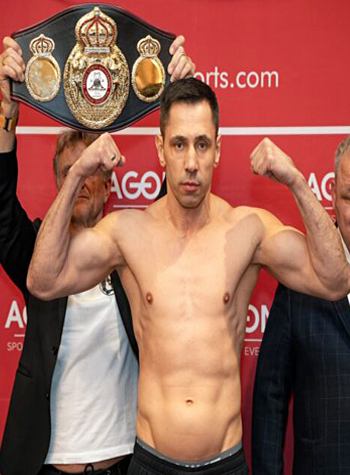
Born on January 31, 1979, in Leverkusen, North Rhine-Westphalia, to Bosnian immigrant parents who had settled in Germany in the 1970s, Adnan Ćatić
adopted the ring name Felix Sturm when he turned professional, a marketing decision that stuck so completely that even today most German boxing fans know little of Adnan Ćatić and everything of Felix Sturm. He discovered boxing at eleven, and by the age of eighteen it was already clear this was no hobby. In 1997, he won the Junior European Championship, announcing himself as one of the most promising amateurs on the continent.
Three years later, in the summer of 2000, the twenty-one-year-old Sturm traveled to Tampere, Finland, and returned with a gold medal from the European Championships. Months after that, he was in Sydney, representing Germany at the Olympic Games, the pinnacle of amateur competition. His Olympic campaign ended with a painful razor-thin loss to American Jermain Taylor in the third round, a defeat that stung deeply at the time. Taylor would go on to become the undisputed middleweight champion of the world. In retrospect, losing to him at the Olympics was no disgrace. But Sturm did not wait for the verdict of history. He turned professional in January 2001, ready to prove his worth on the paid circuit.
His debut year under Universum Box-Promotion was immaculate. Ten fights, ten wins, and by 2003 he was ready for his first world title shot. When stablemate Bert Schenk was forced to withdraw on short notice from a fight against WBO middleweight champion Hector Javier Velazco in Berlin, Sturm stepped in without hesitation. He boxed beautifully and took the decision and with it the belt. Germany had a world champion.
If one single night explains Felix Sturm to an international audience, it is June 5, 2004, at the MGM Grand Garden Arena in Las Vegas. Sturm, the reigning WBO middleweight champion, had been matched against Oscar De La Hoya, a multiple-division world champion, an American superstar, and quite possibly the most marketable boxer on the planet at the time. De La Hoya had moved up from junior middleweight for the contest and, by most accounts, arrived in less than peak condition. The oddsmakers and the promotional machinery may have expected a statement win for the Golden Boy. What they got instead was one of the most contentious decisions in the sport’s recent memory.
Sturm fought the fight of his career that night. Calm, technically precise, and relentless in his movement and counterpunching, he outworked and outboxed De La Hoya across twelve rounds. The ringside media, the broadcasters, the fans watching around the world, the overwhelming consensus was that the German champion had done more than enough to retain his belt. When the scorecards were announced and De La Hoya was awarded a unanimous decision victory, the reaction was one of near-universal disbelief. Critics were blunt: Felix Sturm had been robbed.
The controversy surrounding that fight has never fully subsided. It is regularly cited as one of the most questionable decisions in modern boxing, and the sense that a visiting European champion had been denied his due in Las Vegas against an American icon on American soil became part of boxing’s broader conversation about the integrity of judging. Sturm lost his WBO title that night on paper. But something else happened too: an international reputation was born. The fighter who might have remained a respected domestic German champion became a figure known across the boxing world. The loss that wasn’t a loss became the making of Felix Sturm.
Sturm fought back with characteristic determination. In March 2006, he won the WBA middleweight title by defeating the hard-punching Maselino Masoe, capturing his second world belt. His first title defense ended in a shocking TKO upset to the experienced Spaniard Javier Castillejo, but Sturm, never a man to accept defeat lying down, came straight back nine months later and outpointed Castillejo clearly in their rematch to regain his crown.
The years between 2006 and 2013 were eventful in the extreme. Sturm parted with Universum Box-Promotion in 2010 and founded Sturm Box-Promotion, becoming his own promoter. He won a controversial decision over Irishman Matthew Macklin, fought to a draw with unbeaten contender Martin Murray, and in April 2012 delivered one of the defining performances of his career, stopping former champion Sebastian Zbik before 20,000 fans at the Lanxess Arena in Cologne. Later that year, he challenged Australian IBF champion Daniel Geale in a unification fight in Oberhausen, losing a split decision in a grueling twelve-round war.
The crowning achievement came in December 2013 in Stuttgart. Facing British IBF champion Darren Barker, Sturm captured the title when Barker was forced to retire after the second round with an injury. The belt was Sturm’s fourth professional world title, a feat no German boxer had ever achieved before or has matched since. Germany’s first and only four-time professional world champion stood in the Porsche Arena that night with his arms raised. It was, in many ways, the peak of the mountain.
From 2014 onward, the story grew darker. Doping allegations, disputed test results, dubious decisions in the ring, and ultimately criminal charges for tax evasion cast a long and complicated shadow over what had been an illustrious career. Sturm served time in prison, a fall from grace that would have ended many careers permanently. The man who had once filled arenas and challenged legends in Las Vegas found himself fighting a very different kind of battle.
But Felix Sturm has never been easily written off. In 2020, he returned to the ring, and the comeback defied easy dismissal. Going 5–1 since his return, including a fight against Benjamin Blindert as recently as February 15, 2025, Sturm has demonstrated that the competitive instinct which carried him to four world titles remains stubbornly alive. The comeback has been measured and controlled rather than spectacular, a seasoned craftsman at work rather than a young lion hunting knockouts, but it has been real and legitimate.

Anyone expecting a comfortable farewell procession should study the name on the opposite side of the contract. Granit Stein carries a record of 20–2–1, 11Ko's and a fighting style that is about as unpleasant to deal with as the sport produces. An aggressive pressure fighter with strong recent form, Stein is known for his relentless forward momentum, the kind of opponent who never lets an aging champion settle into the comfort of his own rhythm. He is physically imposing, technically capable, and extremely uncomfortable to fight.
Crucially, Stein arrives in Stuttgart with something to prove. He lost a split decision to Diego Carmona just this past weekend in a WBA Continental title fight, a close contest but a defeat nonetheless. That result means Stein needs a significant scalp to restore his momentum and credibility. A win over a four-time world champion, even a 47-year-old one making his farewell, would do exactly that. Do not expect him to be in a sentimental mood when the bell rings.
Sturm, for his part, brings qualities that Stein cannot manufacture: four world title reigns, 441 professional rounds, and the kind of ring intelligence that only comes from a lifetime spent in the sport’s deepest waters. His recent style has been economical and controlled — he picks his moments rather than forcing action. Whether that approach can contain Stein’s pressure over ten rounds is the central sporting question of this fight, and the reason it promises genuine tension rather than a sentimental exhibition.
Felix Sturm, 45-6-3, 20Ko's is, by any honest measure, one of the most significant figures German boxing has produced. From the Junior European titles of his teenage years through the Sydney Olympics, from the Berlin arena where he first won a world title to the Las Vegas ring where he was arguably cheated out of one, from the Cologne nights that roared with 20,000 voices to the Stuttgart evening where he made history as a four-time champion, the career of Adnan Ćatić, alias Felix Sturm, has been one worth watching in full.
It ends where so much of it unfolded: in Germany, in front of the crowd that claimed him as its own. The Porsche Arena in Stuttgart on July 11th will not be an easy night, because nothing about this man’s story has ever been easy. But it will be a fitting one. A fighter’s farewell, contested properly, against a live opponent, in a venue packed with people who understand what they are witnessing. One last dance. The curtain comes down.

 Print
Print