
On This Day In Boxing History
1897: Gene Tunney Was Born!
Gene Tunney, born James Joseph Tunney on May 25, 1897, in New York City — remains one of boxing’s most fascinating and accomplished champions. Though the world came to know him as “Gene,” the nickname reportedly came from his younger sister, who struggled to pronounce “James.” Raised in Bridgeport, Connecticut, Tunney discovered boxing at an early age after his father gave him a pair of gloves to defend himself against school bullies. Former boxer Willie Green later recognized his talent and helped develop the fundamentals that would shape one of the sport’s greatest technical fighters.
Tunney turned professional on November 14, 1919, and stormed through the heavyweight ranks with 24 consecutive victories in just two years, establishing himself as one of the era’s premier contenders. His professional record ultimately stood at 65-1-1 with 45 knockouts, and he retired as the only undefeated heavyweight champion in boxing history. His lone acknowledged professional defeat came against the legendary Harry Greb in 1922, beginning one of boxing’s greatest rivalries. Tunney and Greb fought five memorable times, with Tunney later winning three bouts and drawing another. Many historians still regard the series as one of the finest rivalries the sport has ever seen.
Before reaching heavyweight greatness, Tunney captured the American light heavyweight championship and scored major victories over stars such as Georges Carpentier. His crowning achievement came on September 23, 1926, when he defeated Jack Dempsey before more than 120,000 spectators to win the world heavyweight championship. Their 1927 rematch at Soldier Field in Chicago became immortalized as the famous “Long Count Fight,” one of the most controversial and dramatic bouts in boxing history.
In the seventh round, Dempsey floored Tunney with a devastating combination and appeared on the verge of reclaiming the heavyweight crown. However, Dempsey failed to immediately move to a neutral corner as required under the rules, delaying referee Dave Barry’s count and giving Tunney valuable extra seconds to recover. Tunney eventually rose at the count of nine after being down roughly 13 to 14 seconds, depending on the source.
What is often overlooked, however, is what happened immediately afterward. Rather than merely surviving the controversy, Tunney regained control of the fight and dramatically turned the momentum in his favor. In the eighth round, he knocked Dempsey down with a sharp counterattack, stunning the former champion and silencing the crowd. Tunney then dominated the closing rounds with superior boxing skill, movement, and conditioning to retain the heavyweight championship by unanimous decision. The knockdown of Dempsey after surviving the “long count” became one of the defining examples of Tunney’s resilience, ring intelligence, and composure under pressure.
Tunney’s greatness came not from overwhelming physical power alone, but from extraordinary ring intelligence. Early in his career, he reportedly broke both hands, forcing him to abandon a more aggressive punching style and evolve into a master technician who relied on footwork, timing, defense, conditioning, and strategy. His style combined superb defensive instincts with tremendous courage and a dangerous right hand, making him one of the most complete tactical fighters the sport has produced. Remarkably durable throughout his career, Tunney was never knocked out and was officially knocked down only once — during the “Long Count” fight against Dempsey.
Unlike many fighters of his generation, Tunney became equally famous for his intellect outside the ring. A voracious reader and self-educated student of literature and philosophy, he developed a deep admiration for William Shakespeare and frequently quoted classic literature in interviews. Sportswriters often joked about “the Fighting Marine who quotes Hamlet.” Tunney lectured on Shakespeare at Yale University and developed friendships with literary figures such as George Bernard Shaw. His intellectual curiosity made him one of the most unique personalities ever to hold the heavyweight championship.
Tunney’s discipline extended beyond boxing. After winning the American Expeditionary Forces light heavyweight title during World War I, he spent the winter of 1921 working anonymously as a lumberjack in northern Ontario for the J.R. Booth Company. He deliberately concealed his fame as a boxer, seeking what he described as the “solitude and strenuous labors” that would strengthen both his body and mind. He also briefly entered the film world in 1926, starring in the now-lost movie The Fighting Marine shortly after becoming heavyweight champion.
Military service remained central to Tunney’s identity throughout his life. He earned the nickname “The Fighting Marine” while serving in the U.S. Marine Corps during World War I, where he boxed in military competitions while stationed in France. During World War II, he returned to service in the Navy and later directed physical fitness programs for servicemen. Tunney often credited part of his confidence against Dempsey to advice he received during WWI from a Marine corporal and former sportswriter who believed Dempsey’s aggressive style could be neutralized by superior boxing technique and movement.
Following his retirement after defeating Tom Heeney in 1928, Tunney successfully transitioned from sports hero to businessman and public figure. He married heiress Polly Lauder and became a successful executive involved in banking, manufacturing, insurance, and publishing, including serving as a director of The Globe and Mail. One of his sons, John Tunney, later became a United States senator.
Tunney spent his later years in Greenwich, Connecticut, while remaining active in civic and charitable work, including leadership roles with the Boy Scouts of America and the Catholic Youth Organization. He died on November 7, 1978, at age 81, leaving behind a legacy that extends far beyond championship belts. His achievements have been recognized through induction into the International Boxing Hall of Fame, the World Boxing Hall of Fame, and the Marine Corps Sports Hall of Fame.
Today, Gene Tunney is remembered as a true rags-to-riches American success story — the son of Irish immigrants who combined toughness, discipline, education, and strategic brilliance to become one of the greatest heavyweight champions in boxing history. Though often overshadowed in popular memory by more flamboyant personalities like Dempsey, Tunney remains revered by historians and purists as one of the most technically skilled and intellectually sophisticated fighters the sport has ever known.
Gene Tunney
Born: May 25th, 1897
Birth Name: James Joseph Tunney
Birth Place: Greenwich Village, New York, NY
Residence: Greenwich, Connecticut
Pro Debut: 1915-07-03
Division: Light Heavyweight
Alias: "The Fighting Marine"
Stance: Orthodox
Height: 6′ 0″
Reach: 76″
Bouts: 68
Rounds: 426
KO’s: 71%
Record: 65-1-1, 48Ko’s
Died: Age 81, November 7th, 1978
Career
World Heavyweight Champion
NBA World Heavyweight Champion
NYSAC World Heavyweight Champion
Sept 23rd - 1926 X Jul 31, 1928 – Retired
International Boxing Hall of Fame: Class of 1990
1942: Ezzard Charles vs Charley Burley
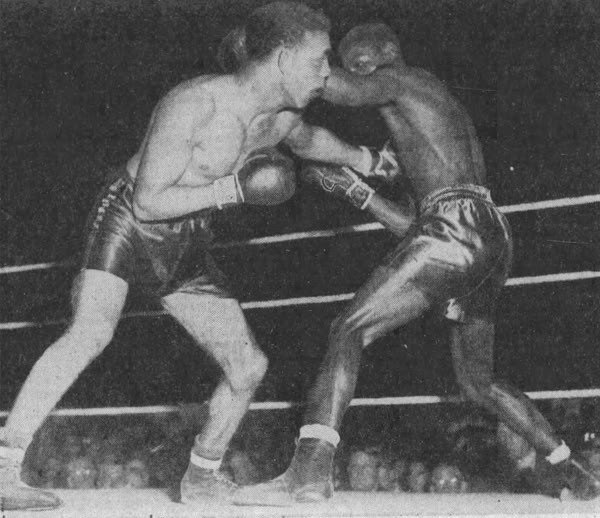
Few boxers have been as avoided as the legendary Charley Burley. Even such greats as Billy Conn and Ray Robinson were protected from facing him, such was his talent. Which makes Ezzard Charles’ dominant win in 1942 truly astounding as the 20-year-old “Cincinnati Cobra,” coming in as a late substitute no less, knocked a prime Burley down and almost stopped him. Burley fared little better in the immediate rematch.
On May 25, 1942, a 20-year-old Ezzard Charles (then 23-2-1) stepped into Forbes Field as a last-minute substitute for Ken Overlin, (131-19-8) to face the highly respected Pittsburgh veteran Charley Burley (51-5-1).
Burley, a slick, defensively brilliant middleweight regarded by many as one of the best fighters never to win a world title, entered the bout on a long winning streak (reportedly 20+ fights). Few gave the young Cincinnati fighter much of a chance in Burley’s hometown.
Instead, Charles delivered a breakout performance. He nearly knocked Burley out in the fourth round, rocking the veteran badly. Burley showed his toughness by surviving and even rallying in the fifth, but Charles dominated the later rounds with superior boxing skill, speed, and accuracy.
In the final round, Burley was dropped for a count of three. Charles cruised to a clear unanimous decision victory, snapping Burley’s 26 bout win streak and announcing himself as a legitimate force in the middleweight division.
This fight marked the beginning of a short but notable rivalry (Charles would win the rematch five weeks later). For Ezzard Charles, it was one of the key early wins that helped pave his path to becoming one of the greatest light heavyweights and eventual heavyweight champion of the world.
Muhammad Ali vs Sonny Liston II
May 25th, 1965
World Heavyweight Title
Central Maine Civic Center, Lewiston, Maine
*Attendance Only: 2,434*
May 25th
1876: Jack Root was born
1897: Gene Tunney born
1939: Henry Armstrong W15 Ernie Roderick
1942: Ezzard Charles W10 Charley Burley
1948: Ike Williams W15 Enrique Bolanos
1951: Jimmy Carter KO14 Ike Williams
1965: A very short, heavyweight title fight happened in Lewiston, ME. Cassius Clay knocked out challenger Sonny Liston in one minute and 56 seconds of the first round. Liston never saw the punch coming. Neither did an unbelieving crowd at ringside, nor those in theatres all over the world watching the fight on closed-circuit TV. The phantom punch was never explained, but Liston was either knocked cold from whatever Clay threw at him or he took a dive rather than a beating. Clay retains the heavyweight title and announces his name is now Mohammed Ali.
1968: Sandro Mazzinghi W15 Ki Soo Kim
1972: Joe Frazier KO5 Ron
1974: Rodrigo Valdez KO7 Bennie Briscoe
Rafael Herrera KO6 Romeo Anaya
1975: Miguel Canto W15 Betulio Gonzalez
1996: Henry Maske W12 John Scully
1999: Mike Tyson, 32, is released from Montgomery County (Maryland) Detention Center after serving 3½ months of a one-year sentence for assaulting two motorists.
2000: Freddy Norwood W12 Julio Pablo Chacon
2001: WBC Bantamweight Champion Willie Jorrin is arrested on felony counts of rape, domestic violence, false imprisonment and corporal injury in a case involving the mother of his two children.
2006: Takalani Ndlovu KO2 Giovanni Andrade
2013: Carl Froch W12 Mikkel Kessler
Omar Andres Narvaez WSD12 Felipe Orucuta
2014: Shindo Go TKO8 Sirilak Muangchoen
2016: John Riel Casimero KO4 Amnat Ruenroeng
2018: Brenden Ingle Passes

 Print
Print