

The WBC Joins Nico Ali Walsh’s Statement
Regarding the Muhammad Ali Boxing Reform Act!
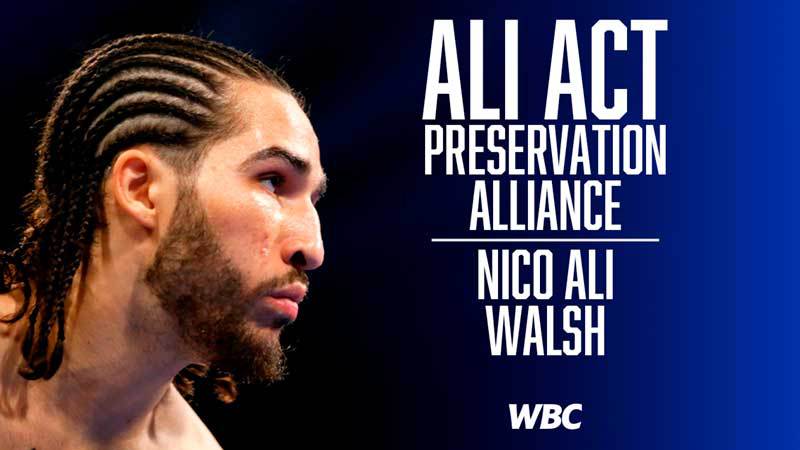
(April 10th) In response to pending legislation to amend the existing Muhammad Ali Boxing Reform Act (“the Act”), enacted in the year 2000, more than 30 key members and organizations in the community of professional boxing and prizefighting have come together to form the Ali Act Preservation Alliance.
The Alliance exists for one purpose only: to protect the best interests of the fighters, who risk everything in the ring fighting for a chance at a better life for themselves and for their families.
The existing Muhammad Ali Boxing Reform Act contains provisions that are critically important for the protection of boxers’ best interests, being:
Prohibitions on Coercive Contracts, preventing boxers from the worst exploitation.
Required Financial Disclosures, giving boxers the right to see what happens with the money.
Prevention of Conflicts of Interest, putting firewalls between promoters and managers and promoters and championship/ranking sanctioning organizations.
Mandatory disclosures by championship/ranking sanctioning organizations, including federal filings and monthly ratings and justifications of ratings changes.
However, currently pending before the U.S. Senate, the so-called “Muhammad Ali American Boxing Revival Act” would permit certain promoters (called “Unified Boxing Organizations”) to control a boxer’s contract, plus the boxer’s access to championships and ratings. Result? Promoter controlling contracts, rankings, and titles equals no negotiating leverage for the UBO’s fighters.
The sport and industry of boxing agree:
The existing Ali Act is ANTIMONOPOLY. This has prevented one entity from controlling the sport. Boxing’s free market results in up to 80% of the sport’s economics flowing to the fighters themselves, with the resulting gain – or frequently, losses – remaining for the promoters. (By contrast, in combat sport MMA, less than 20% of the economics are shared by the fighters.)
The proposed “Revival Act” is ANTILABOR. Creating exceptions to all the protections for boxers in the existing Ali Act will expose the boxers in the UBO to exploitation, since the promoter’s discretion alone will determine fighters’ rankings and who will have the opportunity to fight for championships.
If the proposed law is enacted, a UBO becomes an entity which has its own rankings, matchmaking, and awards its own championships belts, while being the promoter controlling all the aspects of the business as well.
Vitally important is that the proposed law – by creating new organizations and championship that cannot be unified with boxing’s existing titles – would prevent ever again having Undisputed Champions of the World, a huge step back rather than progress forward.
The voice of the Ali Act Preservation Alliance is its leader, active boxer and grandson of Muhammad Ali himself, Mr. Nico Ali Walsh. He has strongly condemned the new bill, posting on X: “As an Ali, I’m completely against altering the Muhammad Ali Act. My grandfather fought for it to protect fighters from getting screwed over. Remove it, and promoters take control while fighters get paid less. Keep the act and protect the fighters who put their lives on the line.” (Aug. 11, 2025).
Equally important is to see the negative effect on fighters that anticompetitive behavior – of the type the proposed law could permit – can have in combative sports like boxing.
In a class action antitrust lawsuit Cung Le, et al. v. Zuffa, LLC, d/b/a Ultimate Fighting Championship and UFC, Judge Richard F. Boulware, II’s order stated clearly the dangers:
“Due to this anticompetitive, coercive conduct, fighters were trapped by Zuffa’s exclusionary contracts and their restrictive terms, creating a situation in which Zuffa had unfettered power and opportunity to suppress fighters’ compensation.… In conclusion, the Court finds that Plaintiffs have established that Defendant’s tactics were anticompetitive. Defendant evinced a clear intent to acquire and maintain monopsony power.”
We also see the dangers of a promoter controlling the rules and regulations of combative sport. Zuffa, the lead proponent of the proposed law, is limiting its championships to only eight weight divisions. This means that outside of heavyweights, a boxer may have to fight an opponent who weighs from 8 up to almost 15 pounds more to compete for a championship. Recent events have shown the extreme danger for a fighter from either cutting too much weight, or fighting a much heavier opponent. The conflict of interest for a promoter to control rules such as weight divisions is not only unfair, but very dangerous for the health of the fighters.
In conclusion, the Ali Act Preservation Alliance believes it speaks for stakeholders across boxing and all combative sports in calling for the United States Senate to reject the so-called “Boxing Revival Act”, and see it for what it is: a dangerous and unfair exception to the law that protects the fighters, and which is named for boxing’s greatest hero, Muhammad Ali, who fought within the sport and society at large for justice and civil rights.

 Print
Print