

Redemption Run?
Julio César Chávez Jr.’s Comeback Campaign
Continues April 25th in Reynosa!
(March 26th) Julio César Chávez Jr. will continue what has become an unexpectedly active 2026 schedule when he returns to the ring on April 25 at Estadio Adolfo López Mateos in Reynosa, Tamaulipas. The bout, confirmed by the World Boxing Council, pits the 40-year-old former middleweight titleholder against Colombian prospect Jhon Caicedo, 13-1, 5Ko’s, a 21-year-old who is rebuilding after a June 2025 stoppage loss to Avni Yıldırım.
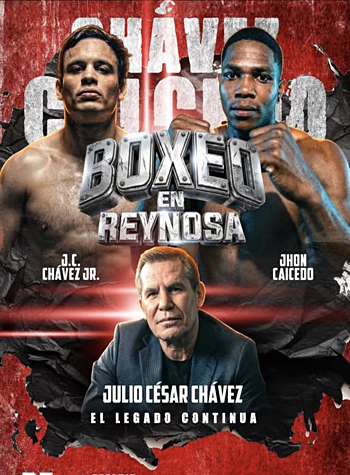
From a competitive standpoint, the matchup reflects the careful matchmaking that has defined Chávez Jr.’s recent activity. Caicedo brings youth and a respectable record, but his recent knockout defeat and limited experience at higher levels make him a manageable opponent for a veteran attempting to rebuild rhythm rather than chase immediate contention.
The fight will be Chávez Jr.’s second appearance of the year following his January 24 fourth-round TKO of Ángel Julián Sacco in San Luis Potosí. That victory halted a long stretch of inconsistency that has characterized his career since the early 2010s. Since 2012, Chávez Jr. has posted a 9-7 record with no wins over top contenders, leaving his once-promising trajectory largely stalled despite an overall ledger of 55-7-1 with 35 knockouts.
Outside the ring, the former champion remains in a complicated position. Chávez Jr. is currently based in Mexico following a turbulent 2025 that included a July arrest near Los Angeles for overstaying his visa and allegedly providing false information during a green-card application. U.S. authorities connected the case to broader investigations involving alleged Sinaloa Cartel links, arms-trafficking activity, and organized-crime warrants in Mexico. After being deported and released in August, he is now awaiting trial under legal restrictions that prevent him from leaving the country.
Those limitations have effectively reshaped the business structure of his career. Rather than operating under a traditional international promotional contract, Chávez Jr.’s current campaign is largely being organized through Chavez Promotions, a family-driven operation overseen by his father, legendary former champion Julio César Chávez. The approach allows him to remain active in Mexico while maintaining closer oversight of his training, finances, and public image during this transitional period.
The WBC has also played a visible role in facilitating his return. While sanctioning bodies rarely act as promoters, the organization has publicly supported Chávez Jr.’s rehabilitation efforts and helped platform his comeback appearances. In 2025 the WBC even introduced a symbolic “Guadalupan” belt recognizing his recovery journey, underscoring the sanctioning body’s willingness to keep him connected to the sport’s spotlight.
From a promotional standpoint, the Chavez brand still carries measurable commercial value in Mexico. Even after years of inconsistency, Chávez Jr. continues to attract casual fans, and broadcasters such as TV Azteca remain willing to televise his fights. For promoters, the equation is simple: recognizable name value combined with relatively controlled matchmaking can still produce viable television events.
Major Mexican promoter Zanfer Promotions, led by Fernando Beltrán, has also remained loosely connected to these events. The company frequently collaborates on Chávez family cards and was involved in the January 2026 show in San Luis Potosí, though it has not been formally listed as the lead promoter for the Reynosa event.
The structure represents a notable shift from Chávez Jr.’s recent association with U.S. promoters. In 2025 he briefly aligned with Most Valuable Promotions for a high-profile bout with Jake Paul. With his current legal status restricting travel to the United States, however, his 2026 schedule has pivoted entirely to Mexico-based shows built around the Chávez name.
In purely sporting terms, the strategy is clear: activity, manageable opposition, and gradual rebuilding. Chávez Jr. has indicated he hopes to fight two or three times in 2026, a level of activity he has not maintained consistently in more than a decade. Whether that schedule leads to anything beyond regional main events remains uncertain.
For now, the Reynosa bout serves as another checkpoint in a late-career attempt to stabilize both his professional trajectory and his personal life. The question surrounding Chávez Jr. is no longer whether he can return to championship level, but whether sustained activity and controlled matchmaking can restore a measure of credibility to one of boxing’s most turbulent modern careers.

 Print
Print