
Bert Randolph Sugar
Historian & Storyteller of the Sweet Science!
(March 25th) On television he was instantly recognizable: a tilted fedora, a thick cigar between his teeth, and a booming voice that sounded as though it had drifted out of a smoky Manhattan saloon from another era. To boxing fans, Bert Randolph Sugar was more than a writer. He was the sport’s living memory, a raconteur who could summon the ghosts of old prizefights as easily as if he had been ringside for all of them.
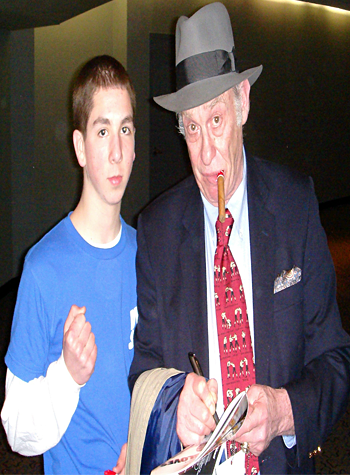
Born Herbert Randolph Sugar on June 7, 1936, in Washington, D.C., he developed an early fascination with sports history, statistics, and old newspaper clippings. Even as a boy he was drawn to the mythology of athletes from earlier generations. Boxing, in particular, appealed to him because it combined drama, characters, and history. Each fight seemed to be another chapter in a story stretching across decades.
Sugar’s formal education followed a conventional route. He graduated from the University of Maryland in 1957 with a degree in business administration, then attended the University of Michigan, where he earned both a Master of Business Administration and a law degree. While at Michigan he played rugby and wrote for The Michigan Daily, revealing the two sides of his personality: part competitor, part storyteller.
He passed the Washington, D.C., bar exam in 1961 but never practiced law. With typical humor he later explained his decision: “It was the only bar I ever passed.”
Instead, Sugar moved to New York City and entered the advertising world. During the 1960s he worked in the fast-paced Madison Avenue environment later popularized by Mad Men. The experience sharpened his ear for language and rhythm, qualities that later shaped his distinctive writing style. During this time he also helped create the well-known advertising jingle for Nestlé chocolate: “N-E-S-T-L-E-S, Nestlé’s makes the very best.”
Sugar’s real ambition, however, was sports writing. In 1962 he became publisher and editor of Baseball Monthly, an early publishing venture that reflected his love of statistics and sports history. He also wrote about sports collectibles and produced one of the earliest comprehensive guides to sports cards, helping legitimize a growing memorabilia market.
His breakthrough in boxing journalism came in 1969 when he purchased Boxing Illustrated with his own money and ran the magazine as editor until 1973. There he began developing the style that would define his career: part historian, part storyteller, mixing meticulous research with colorful anecdotes and sharp humor.
Sugar’s reputation grew steadily within the sport. In 1979 he became editor and publisher of The Ring, widely known as the “Bible of Boxing,” and remained in that position until 1983. At the magazine’s helm he blended historical scholarship with conversational writing that made boxing’s past feel vivid and alive.
Rather than presenting fighters as statistics on a page, Sugar treated them as characters in a continuing drama. He delighted in revisiting legendary bouts, ranking fighters across eras, and reminding readers that the sport’s present could only be understood through its past.
Later in his career he returned to Boxing Illustrated and in 1998 launched his own magazine, Bert Sugar’s Fight Game.
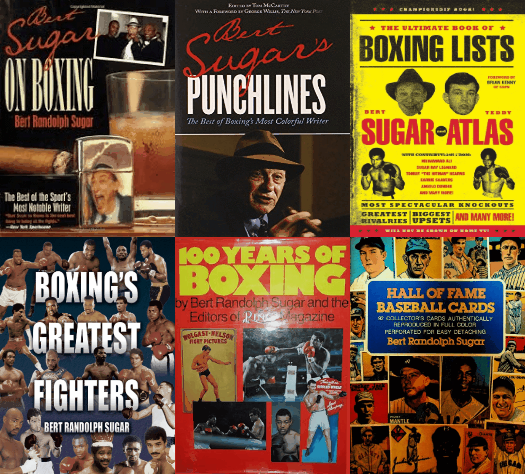
Over his lifetime Sugar wrote or co-wrote more than eighty books, many devoted to boxing history. Among the best known were Great Fights, Bert Sugar on Boxing, 100 Years of Boxing, and Boxing’s Greatest Fighters.
One notable collaboration was Sting Like a Bee, written with former light heavyweight champion José Torres, which examined the career and cultural impact of Muhammad Ali.
Sugar had a particular gift for ranking fighters and comparing champions from different eras. His opinions often sparked debate, but they were always grounded in a deep knowledge of the sport’s history.
Sugar’s encyclopedic memory made him a natural television presence. Networks such as ESPN and HBO regularly invited him to appear as a commentator and boxing historian. With his fedora, cigar, and booming delivery, he looked and sounded like a character from another era.
Broadcaster Bob Costas once described him as “Runyonesque,” comparing him to the colorful New York figures created by writer Damon Runyon.
The persona carried into popular culture. Sugar appeared as himself in films including Night and the City, The Great White Hype, and Rocky Balboa, reinforcing his image as one of boxing’s permanent ringside characters.
Behind the theatrical appearance was a serious scholar of the sport. Sugar possessed an astonishing memory for names, dates, arenas, and fight results. Fellow writers often treated him as a walking archive capable of recalling obscure bouts without consulting notes.
His interests ranged well beyond boxing. He loved horse racing and enjoyed handicapping races using the Daily Racing Form. He also had a passion for trivia and obscure sports facts. In another unusual project he co-authored a biography of escape artist Harry Houdini with magician and skeptic James Randi.
Earlier in life he had helped revive the University of Michigan’s rugby program in 1959 and served as captain of the newly organized team.
Sugar’s work earned him widespread recognition within boxing journalism.
In 1990 the Boxing Writers Association of America awarded him the Nat Fleischer Award for career excellence in boxing journalism. In 2005 he was inducted into the International Boxing Hall of Fame, acknowledging that his writing had become part of the sport’s historical record.
The International Veterans Boxing Association named him the greatest boxing writer of the twentieth century. In 2010 he also received the Ellis Island Medal of Honor for his contributions to American cultural life.
Sugar married Suzanne Davis in 1960, and the couple had two children. They lived for many years in Chappaqua, New York. Despite his deep involvement in the boxing world, friends often recalled his generosity with fans and his willingness to talk about the sport with anyone who asked.
In a revealing example of his priorities, he skipped the heavyweight championship fight between Evander Holyfield and George Foreman in 1991 in order to attend his son’s wedding.
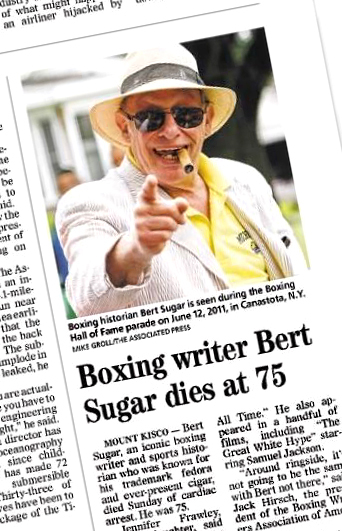
Bert Randolph Sugar died on March 25, 2012, in Mount Kisco, New York, from complications of lung cancer. He was seventy-five.
In the decades since, his fedora-and-cigar image has remained one of the most recognizable symbols in boxing journalism. More importantly, his work preserved the stories that define the sport: the champions, the underdogs, and the unforgettable nights when boxing’s drama rose above the ropes.
In many ways Sugar became what he admired most about boxing itself: a larger-than-life character whose storytelling kept the past alive. For generations of fans, understanding the history of the “sweet science” often meant listening to Bert Sugar tell the story.
A former Golden Gloves boxer, Bert Wells launched Sugar Bert Boxing Promotions (SBBP) in late 2015 while coaching at the Paul Murphy Boxing Gym north of Atlanta. The promotion organizes amateur boxing tournaments throughout the United States and takes its name from legendary boxing writer and historian Bert Sugar, honoring his larger-than-life personality and enduring influence on the sport.
SBBP’s flagship competition is the Sugar Bert Boxing Title Belt National Championship Series, a prominent amateur tournament circuit featuring multi-day events across the country. One of its signature stops is the annual championship in Kissimmee near Walt Disney World Resort, where amateur boxers from around the world compete through qualifiers or direct-entry divisions. Champions across weight classes receive custom title belts produced by TITLE Boxing, with plaques awarded for uncontested bouts.
The series continues to expand with events such as the 2026 Georgia Golden Gloves in Decatur and collaborative tournaments like the USA Boxing Regional Ranking Tournament in Pleasanton. Many events feature international competitors and guest commentators, including former world champion Paulie Malignaggi, and are streamed live on SBB-TV, promoting family-friendly amateur boxing for competitors of all ages and experience levels.

 Print
Print