
On This Day In Boxing History!
1969: Jimmy Wilde Passes!
Jimmy Wilde was born William James Wilde on 15 May 1892 in Quakers Yard, Treharris, in the county borough of Merthyr Tydfil, Wales. His birth certificate confirms this location, though his family relocated to the village of Tylorstown in the Rhondda Valley, the community with which he became most closely identified, when he was around six years old. He was the son of a coal miner, and like his father, Jimmy descended into the pits as a boy, small enough to crawl through gullies impassable to grown men, hacking coal in conditions that would have broken most adults.
It was in the pits that Wilde first encountered Dai Davies, an experienced mountain fighter who lodged nearby and whose daughter Elizabeth Wilde would later become Jimmy's wife. Davies taught him the rudiments of boxing in his attic bedroom, the only formal instruction Wilde ever received. Jimmy married Elizabeth in 1910 and became a father the same year, leaving Tylorstown Colliery permanently in 1913 to pursue boxing full-time.
Before any sanctioned record was kept, Wilde fought extensively in the fairground boxing booths that toured the Welsh valleys and beyond. Operated by figures such as Professor Jack Scarrott, these booths invited local men, miners, laborers and drifters to take on the house fighter for a small prize. Wilde, barely five feet tall and seldom weighing more than 100 pounds, took on all comers, including men weighing 170 to 200 pounds. Crowds were astonished by his ability to knock much bigger opponents down and out.
Wilde claimed to have had at least 800 such bouts, a figure considered greatly exaggerated by historians, though virtually all agree the true number far exceeded his recorded professional tally. The most commonly cited figure is 864 total contests across his entire career. These unrecorded engagements were the crucible in which his unique fighting style was forged: hands low at the hips, knees slightly bent, body executing a wave-like motion, sidestepping punches by fractions of an inch rather than blocking, conserving stamina while finding the precise angles from which his explosive right hand could do its most lethal work.
Wilde's first recorded professional bout was a third-round knockout of Ted Roberts in 1911, though historians note he had been competing professionally for at least four years prior. Managed by Teddy Lewis (formerly a reserve captain of Pontypridd RFC), Wilde tore through the British flyweight and bantamweight ranks at a relentless pace, fighting roughly every two weeks. He accumulated the longest unbeaten streak in the history of professional boxing: 103 consecutive undefeated bouts, a record that has never been broken and is unlikely ever to be. He achieved this in little more than four years, fighting every flyweight, bantamweight, and featherweight of note in Britain.
On 31 December 1912, Wilde won the British 7-stone (98-pound) championship by stopping Billy Padden in eighteen rounds in Glasgow. He continued his assault on heavier competition, and on 30 March 1914 he knocked out Eugene Husson of France in the sixth round to claim the European Flyweight Championship.
His only interruption came on 15 January 1915, when ill with influenza and against the advice of his corner he challenged Tancy Lee of Scotland for the British and European flyweight titles in London. Weakened by illness, Wilde was stopped in the seventeenth round of a scheduled twenty-round contest: his first professional loss and the end of his 103-fight unbeaten run. He was also hospitalized that year for an internal complaint requiring surgery. Undeterred, he embarked immediately on a sixteen-fight knockout streak upon his return.
On 14 February 1916, Wilde regained the British Flyweight title by knocking out Joe Symonds in twelve rounds at the National Sporting Club in London. On 26 June 1916, he avenged his sole defeat with an eleventh-round knockout of Tancy Lee, unifying the British and European titles. On 18 December 1916, at the Holborn Stadium, Wilde forced the corner of American champion Young Zulu Kid (Giuseppe Di Melfi) to throw in the towel in the eleventh round, becoming the first universally recognized World Flyweight Champion, the flyweight division having received American recognition only that year.
Wilde ruled the 112-pound division for seven years with an authority no subsequent flyweight champion has matched. He did not restrict himself to title defenses against flyweights, he regularly stepped up to bantamweights and even featherweights, and beat them too. In June 1918, he stopped Joe Conn, a class featherweight competing at 126 pounds, outweighing Wilde by roughly 20 pounds, knocking him down six times in the tenth round before finishing the fight in the twelfth.
In 1919, Wilde undertook an American tour, going undefeated in twelve bouts, including points decisions over Joe Lynch (a future World Bantamweight Champion) over fifteen rounds and Pal Moore, a highly regarded American bantamweight. In 1920, he won all twelve contests on a further U.S. tour, five inside the distance. Physicians were brought in to study him, perplexed by how a man of his dimensions could generate such force; none found a satisfying anatomical explanation.
Wilde suffered only three losses across his entire professional career. The first, at 94-0-1 to Tancy Lee in 1915, came while he was genuinely ill. The second came on 13 June 1921, when former World Bantamweight Champion Pete Herman, outweighing Wilde by more than a stone (approximately 14 pounds) and coming in closer to featherweight, battered a worn, aging champion for seventeen rounds before Wilde's corner stopped the contest. Herman afterwards named Wilde the best opponent he had ever faced.
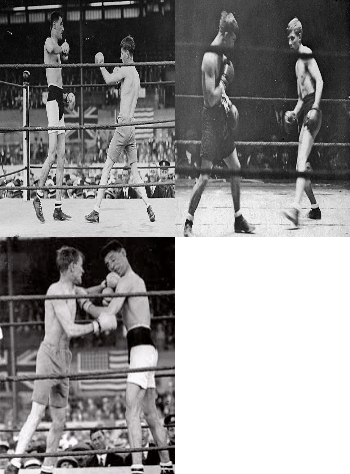
The third, two years later, on 18 June 1923, before a crowd of 23,000 at the Polo Grounds in New York, Wilde defended his title against the young Filipino phenom Pancho Villa. Wilde, aged 31, ring-worn after fifteen years of near-constant warfare, and carrying a $65,000 purse, held his own in the opening rounds, but a hard right hand from Villa at the close of the second dazed him irreparably. Villa cut Wilde and poured on the pressure, stopping him in the seventh round. Wilde never fought again.
Wilde stood 5 feet 2½ inches tall with a 66-inch reach, and rarely exceeded 108 pounds, often competing well below 100. The boxing world was baffled. Writers from The Ring magazine described his right hand as "said to be the heaviest punch ever delivered by a fellow of his weight." Doctors studied him in a genuine effort to determine the anatomical source of his power. None succeeded.
His style was a product of necessity and genius in equal measure. With his hands resting near his hips and no conventional guard, Wilde offered opponents a seemingly open target, only for a fractional shift of his head or body to render each blow harmless, the punch landing in empty air. He was always on his toes, his body in constant wavelike motion, feinting opponents into confusion before landing his concussive right. He never bandaged his hands until he began fighting in London, believing wrapping cramped his fist. He never had a formal trainer beyond his father-in-law's early lessons in an attic bedroom.
He was equally unconventional in his preparation, continuing to fight in boxing booths even after becoming world champion, and reportedly using his wife Elizabeth as a sparring partner. His unorthodox habits, combined with results that defied physical logic, made him one of boxing's most studied and least replicated champions.
Jimmy Wilde is unanimously regarded as the greatest flyweight in boxing history. Ring Magazine named him the greatest flyweight of all time on two separate occasions (March 1975 and May 1994) and ranked him the third-greatest puncher pound-for-pound of all time in their 2003 assessment. The International Boxing Research Organization (IBRO) ranked him the number-one flyweight of all time in 2006. Boxing writer Nat Fleischer and promoter Charley "Broadway" Rose both rated him the finest flyweight ever. Former heavyweight champion Gene Tunney called him simply "the greatest fighter I ever saw."
In 1990, Wilde was inducted into the International Boxing Hall of Fame as a member of the inaugural class, the highest honor in the sport. In 1992, he was inducted into the Welsh Sports Hall of Fame. He is also consistently considered the finest fighter, pound-for-pound, to have emerged from the British Isles.
After his final fight, Wilde returned to Wales. He wrote a weekly boxing column for the News of the World for nearly two decades, became President of the National Union of Boxers, served as a boxing referee, and in 1938 published his autobiography, Fighting Was My Business. He invested his ring earnings in several business ventures, including a Welsh cinema chain and a seafront café at Barry Island named "The Mighty Atom," but none were profitable, and he spent his later years in financial difficulty.
In 1965, Wilde was severely beaten in a mugging at a train station in Cardiff, injuries from which he never fully recovered. His wife Elizabeth died in 1967. Suffering from diabetes and dementia, Jimmy Wilde died on 10 March 1969 at Whitchurch Hospital, Cardiff, at the age of 76. He was buried at Barry Cemetery, South Wales.
"Jimmy Wilde was the greatest fighter I ever saw."
— Gene Tunney, Undisputed World Heavyweight Champion
Jimmy Wilde
Born: 1892-05-15
Birth Name: William James Wilde
Birth Place: Quakers Yard, Wales
Residence: Tylorstown, Wales
Pro-Debut: January 1st, 1911
Alias: The Mighty Atom
Division: Flyweight
Stance: Orthodox
Height: 5′ 2½″
Reach: 66″
Bouts: 143
Rounds: 1041
Ko’s: 69%
Record: 132-3-1, 99Ko’s
Died: Age 76, March 10th, 1969
International Boxing Hall of Fame - Class of 1990
March 10th
1888: John L. Sullivan D39 Charley Mitchell
1896: After Bob Fitzsimmons KOs much larger Jim Corbett to win world HW championship he says, "The bigger they are, the harder they fall".
1909: Jack Johnson No D6 McLaglen
1933: Maxie Rosenbloom W15 Adolf Heuser
1939: Heavyweight Leotis Martin was born in Helena, Arkansas
1943: Manuel Ortiz KO11 Lou Salica
1944: Sal Bartolo W15 Phil Terranova
1947: Ezzard Charles KO 4 Jimmy Bivins
1956: Joey Giardello W10 Hurley Sanders
Henry Davis WSD10 Art Ramponi
1969: Jimmy Wilde passes
1972: Alfonzo Frazer W15 Nicolino Locche
1974: Junior Witter was born in Bradford, West Yorkshire, England
1979: Danny Little Red Lopez KO2 Roberto Castanon
Carlos Zarate KO3 Mensah Kpalongo
1984: Tim Witherspoon WMD12 Greg Page
1986: Marvin Hagler KO11 John Mugabi
Thomas Hearns KO1 James Shuler
Gaby Canizales KO7 Richard Sandoval
1987: Wladimir Klitschko KO2 Ray Austin
1989: Fabrice Benichou W 12 Jose Sanabria
1990: Welcome Ncita W 12 Fabrice Benichou
2001: Shane Mosley KO 5 Shannon Taylor
2007: Wladimir Klitschko KO 2 Ray Austin
Souleymane MBaye D 12 Andreas Kotelnik
2012: Orlando Salido TKO 10 Juan Manuel Lopez
Mikey Garcia TKO7 Bernabe Concepcion
Ricky Burns W12 Paulus Moses
Teresa Perozzi W10 April Ward
2017: Segolene Lefebvre TKO9 Simone Aparecida Da Silva
2018: Mikey Garcia W12 Sergey Lipinets
Kiryl Relikh W12 Rances Barthelemy
Richard Commey TKO6 Alejandro Luna
Oscar Valdez W12 Scott Quigg
Dina Thorslund W10 Alicia Ashley
Brian Carlos Castano TKO12 Cedric Vitu
Raja Amasheh W10 Tamao Ozawa
Katharina Thanderz W8 Valgerdur Gudstensdott
2023: Angel Beltran W8 Louie Lopez

 Print
Print