
On This Day In Boxing History!
1949: George Foreman Was Born!
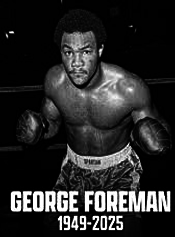
George Edward Foreman was born on January 10, 1949, in Marshall, Texas, the fifth of seven children. While still young, his family relocated to Houston’s Fifth Ward, one of the city’s most economically challenged neighborhoods. Raised primarily by his mother, Nancy Foreman, and stepfather J.D. Foreman—whom George believed to be his biological father until his teenage years—Foreman grew up in deep poverty. As a youth, he struggled with discipline, dropped out of high school, and became involved in street fights and petty crime, later describing himself as angry and directionless.
That trajectory changed in 1965 when Foreman enrolled in President Lyndon B. Johnson’s Job Corps program, a federal initiative designed to provide education and vocational training to disadvantaged youth. Sent to Oregon, Foreman encountered boxing for the first time under the guidance of counselor and trainer Doc Broaddus. Though he began the sport relatively late, his exceptional size, athleticism, and raw punching power were immediately evident. Foreman committed himself fully, training with uncommon intensity and focus.
Foreman’s amateur career was remarkably brief but impactful. In roughly three years, he compiled an amateur record generally cited between 16–4 and 22–4, depending on sources. His rapid development culminated at the 1968 Mexico City Olympic Games, where he represented the United States in the heavyweight division despite having limited international experience.
At the Olympics, Foreman powered through the field and captured the gold medal by stopping Soviet heavyweight Jonas Čepulis in the second round of the final. Moments after the victory, Foreman waved a small American flag inside the ring—a spontaneous act that resonated strongly during a politically turbulent Olympics marked by protest and unrest. Overnight, he became one of the most recognizable young athletes in the country.
Foreman turned professional in June 1969 under the management of Dick Sadler. From the outset, he was a force of destruction. Between 1969 and early 1973, Foreman amassed a perfect 37–0 record, scoring 34 knockouts, many of them in the opening rounds. His heavy power, physical strength, and relentless pressure quickly established him as the most feared contender in boxing.
That dominance peaked on January 22, 1973, in Kingston, Jamaica, when Foreman challenged undefeated heavyweight champion Joe Frazier. In one of the most shocking title fights in boxing history, Foreman knocked Frazier down six times in less than two rounds, winning by technical knockout and capturing the world heavyweight championship at just 24 years old.
Foreman successfully defended his title twice in 1974. He stopped Joe Roman in the first round, then demolished Ken Norton—who had previously broken Muhammad Ali’s jaw—in two rounds, reinforcing the perception that Foreman was nearly unbeatable.
On October 30, 1974, Foreman traveled to Kinshasa, Zaire (now the Democratic Republic of the Congo), to face Muhammad Ali in the historic “Rumble in the Jungle.” Entering the bout as a heavy favorite, Foreman controlled the early rounds with brute force. However, Ali unveiled his now-famous “rope-a-dope” strategy, absorbing punches while leaning against the ropes and allowing Foreman to exhaust himself.
In the eighth round, Ali seized the moment, unleashing a sudden combination that knocked Foreman out. The defeat cost Foreman his title and deeply affected him both professionally and emotionally, marking a turning point in his life.
Foreman continued boxing but suffered a pivotal loss to Jimmy Young on March 17, 1977. Following that bout, Foreman experienced a profound religious episode in his dressing room, later describing it as a near-death spiritual awakening. Soon afterward, he retired from boxing at age 28.
Foreman became a born-again Christian, was ordained as a minister, and founded The Church of the Lord Jesus Christ in Houston. He devoted the next decade to preaching and community work, including the establishment of the George Foreman Youth and Community Center, aimed at providing guidance and opportunity to disadvantaged young people.
In 1987, at age 38 and more than a decade removed from competition, Foreman announced an unlikely return to boxing. Initially intended as a fundraiser for his youth center, the comeback was widely dismissed. Foreman appeared heavier, slower, and far removed from his prime.
Instead, he steadily rebuilt his career. Over time, Foreman transformed his public image from a menacing destroyer into a warm, humorous, and self-aware veteran. His durability, experience, and still-formidable power carried him to the brink of another title opportunity.
On November 5, 1994, in Las Vegas, Foreman challenged undefeated champion Michael Moorer for the heavyweight title. At 45 years old, Foreman trailed badly on the scorecards entering the tenth round. Then, with a single perfectly timed right hand, he knocked Moorer out cold.
The victory made George Foreman the oldest heavyweight champion in boxing history, a record that still stands. The triumph came exactly 20 years after he had lost the title to Muhammad Ali, completing one of the most extraordinary comebacks in sports history.
Foreman continued fighting into his late forties and retired permanently in 1997 following a close decision loss to Shannon Briggs. He finished his professional career with a record of 76 wins and 5 losses, including 68 knockouts.
Outside boxing, Foreman achieved unprecedented success as a businessman and pitchman. The George Foreman Grill, introduced in 1994, became a global phenomenon, eventually selling more than 100 million units. In 1999, Foreman sold the rights to his name for an estimated $138 million—earning far more from the grill than from his entire boxing career.
Foreman authored several books, continued his ministry, worked as a broadcaster, and became one of the most beloved figures in sports media. In 2003, he was inducted into the
Now regarded as one of the greatest heavyweight champions of all time, George Foreman’s life stands as a rare and powerful story of reinvention. From troubled youth to Olympic gold medalist, from feared champion to humbled preacher, and from dismissed comeback fighter to history’s oldest heavyweight king, Foreman’s journey remains one of the most compelling narratives in sports history.
"Big" George Foreman passed away on March 21, 2025, in Houston at the age of 76. His family announced that he died peacefully, surrounded by loved ones, emphasizing his lifelong devotion to faith, family, and service. Tributes poured in from across the boxing world and beyond, honoring not only his achievements inside the ring but also his humility, generosity, and impact on generations of athletes.
A father of 12 children—including five sons all named George—Foreman’s life stands as one of the most extraordinary arcs in sports history: from troubled Fifth Ward youth to Olympic champion, from feared heavyweight destroyer to spiritual leader, and from dismissed comeback curiosity to the oldest heavyweight champion the sport has ever known. His story remains a lasting testament to redemption, reinvention, and resilience.
George Foreman
Born: January 10th, 1949
Birth Place: Marshall, Texas
Residence: Houston, Texas
Pro Debut: June 23rd, 1969
Alias: “Big George”
Division: Heavyweight
Stance: Orthodox
Height: 6′ 3½″
Reach: 78½″
Bouts: 81
Rounds: 349
Ko’s: 84%
Record: 76-5, 68Ko’s
Gold Medal Heavyweight 1968 Olympics
Titles: WBA/ WBC WBA/IBF Heavyweight Champion
Became the oldest boxer ever to win the World Heavyweight Championship age 45, when he knocked out Michael Moorer on November 5, 1994
Hall of Fame: Class of 2003, Modern Category
January 10th
1910: Sam Langford KO3 Dixie Kid
1911: Sam Langford W12 Joe Jennette
1939: Henry Armstrong W10 Baby Arizmendi
1944: Joe Curcio W8 Tony Riccio
1949: George Foreman is born in Marshall, Texas
1959: Rick Lockridge is born in Tacoma, Washington
1962: Bert Somodio TKO3 Adisak Ithianuchit
Roberto Cruz W10 Munchai Rorfortor
Henry Hank D10 Allan Harmon
1964: Yuh Myung-woo is born in Seoul, South Korea
1966: Kennedy McKinney born.
1973: Félix Trinidad is born in Fajardo, Puerto Rico
1982: Tavoris Cloud is born in Tallahassee, Florida
1987: Patrizio Oliva W15 Gato Gonzalez
1992: Iran Barkley KO2 Darrin Van Horn
1993: Freddie Pendleton W12 Tracy Spann
1999: In-Joo Cho W12 Joel Luna Zarate
2004: Jorge Arce KO2 Joma Gamboa
2007: WBA/WBC Super Middleweight champion Mikkel Kessler becomes the first boxer in Danish history to win the nation’s two top sports prizes, being selected as Athlete of the Year by the newspaper Jyllands Posten and also winning the B.T. Gold award.
2008: Hozumi W12 Simone Maludrottu
Wladimir Sidorenko W12 Nobuto Ikehara
2009: Karoly Balzsay W12 Denis Inkin
Zsolt Erdei W12 Yuriy Barashian
2013: Shakur Stevenson W3 Ryan Garcia US Junior National Selection Tournament Semi-Final
2014: Panya Pradabsri age 23 debuts W6 Wilber Andogan
2020: Elin Cederroos W10 Alicia Napoleon Espinosa
Claressa Shields W10Ivana Habazin

 Print
Print