
On This Day In Boxing History!

1909: Barney Ross Was Born!
Barney Ross
Born: December 23rd, 1909
Birth Name: Beryl David Rosofsky
Birth Place: New York, New York
Residence: Chicago, Illinois
Died: from throat cancer age 57, January 18th, 1967
Pro-Debut: August 31st, 1929
Division: Welterweight
Stance: Orthodox
Height: 5′ 7”
Reach: 67″
Career: 72-4-3, 22Ko’s
Bouts: 79
Rounds: 607
Kos: 28%
Trainer: Ray Arcel
The Ring Fighter of the Year: 1934
Inducted The Ring Boxing Hall of Fame: 1956.
Inducted World Boxing Hall of Fame: 1981.
Inducted International Boxing Hall of Fame: 1990.
Inducted United States Marine Corps Sports Hall of Fame: 2006.
Barney Ross, born, Dov-Ber "Beryl" David Rosofsky on December 23, 1909, in New York City to Isidore "Itchik" Rosofsky and Sarah Epstein, moved to Chicago with his family around the age of two. There, his father became a rabbi and owner of a small vegetable shop. As a young boy, Dov-Ber envisioned following in his father's footsteps as a Jewish teacher and Talmudic scholar. However, his life was shattered when Isidore was shot dead resisting a robbery at the family grocery, plunging his mother Sarah into a nervous breakdown and leaving his younger siblings—Ida, Sam, and George—in orphanages or with other family members.
Burning with anger, Dov-Ber turned his back on Orthodox Judaism and began hanging out on the mean streets of Chicago's Maxwell Street section with roughnecks, including future Lee Harvey Oswald assassin Jack Ruby. He adopted the traits of a typical street thug, stealing, running money and numbers for Al Capone, and doing whatever he could to reunite his family. The diminutive Jewish teen earned the nickname "Runt" and quickly built a reputation as a certified street fighter.
Drifting into boxing at Kid Cross's gym with his friend Ruby, Dov-Ber fought as an amateur, falling in love with the sport and the attention it brought. He won the Chicago and Intercity Golden Gloves in 1929, selling all his awards to subsidize his family. Turning professional at age 19 with about 200 amateur bouts under his belt, he—like many Jewish immigrants and fighters of the era—changed his name to Barney Ross to keep his mother, now back at the head of the family, in the dark.
Ross fought his first four professional bouts in California, winning his first ten before suffering his initial defeat: a six-round points loss to Carlos Garcia in April 1930. He went 8-0-2 in his next ten fights, earning the moniker "The Pride of the Ghetto," before dropping an eight-round decision to Roger Bernard the following March. Undeterred, Ross won his next 25 bouts, including victories over Battling Battalino, Johnny Farr, and the Petrolle brothers Frankie and Billy "The Fargo Express." His big break came on June 23, 1933, when he challenged and beat future Hall of Famer Tony Canzoneri, outboxing the heavier, low-punching champion to claim the World Lightweight and Junior Welterweight titles in a hard-fought ten-round majority decision.
Ross added a sixth-round TKO over Johnny Farr and a fifteen-round split-decision rematch win over Canzoneri. The savvy and determined fighter, boasting superior ring generalship and stamina, won his next four fights before vacating his light welterweight belt to challenge World Welterweight titlist Jimmy "Baby Face" McLarnin. In May 1934, Ross scored a fifteen-round split decision in true championship fashion but granted McLarnin an immediate rematch, where he found himself on the short end of another tightly contested split decision.
Dropping back down in weight, Ross reclaimed the World Junior Welterweight title with a twelve-round unanimous decision over Bobby Pacho. He added title defense wins over Frankie Klick and Henry Woods before again vacating the title to face McLarnin in a rubber match on May 28, 1935, winning a fifteen-round unanimous decision to regain the World Welterweight crown.
Ross won his next sixteen bouts, including victories over Baby Joe Gans, Izzy Jannazzo, Al Manfredo, and three over tough bolo-punching future World Middleweight Champion Ceferino Garcia. In what would be his final fight on May 31, 1938—a bout he refused to quit despite being outmatched—Ross relinquished his title in a one-sided loss to fellow three-division world champion and future Hall of Famer Henry "Homicide Hank" Armstrong. Trained by Packy McFarland and later the great Ray Arcel, Ross fought in one of boxing's top trilogies against McLarnin. He is named among the top three Jewish fighters of all time and ranked in the top ten greatest welterweights ever, compiling a record of 72-4-3 with 22 knockouts, 2 no-decisions, and 2 newspaper decisions. "The Pride of the Ghetto," who always fought with undeniable toughness and resolve, retired after the Armstrong bout.
Following Japan's attack on Pearl Harbor in 1941, Ross—at age 32 and over the draft age—obtained a special waiver to enlist in the U.S. Marines, becoming a highly decorated veteran. Initially assigned as a ceremonial boxing instructor like Jack Dempsey, Joe Louis, and Ray Robinson, he demonstrated incredible courage after facing charges for flooring a non-commissioned officer who made an anti-Semitic comment. Volunteering for combat duty, he was deployed to Guadalcanal, one of the Pacific's bloodiest battles.
On November 19, 1942, while on patrol, Ross and his fellow Marines were attacked by Japanese troops. Three were wounded and Ross escorted them to a trench, protecting them throughout the night and credited with killing seven Japanese soldiers and about ten probable's. In the morning, with two of his comrades dead, he carried the 200-pound sole survivor to safety despite his own wounds. The 140-pound Ross received two Purple Hearts (for wounds to his leg and foot), a Presidential Citation, and the Silver Star for heroism.
Treated for his wounds and malaria in a military hospital under an extended routine of morphine for pain, Ross developed a $500-a-day heroin addiction upon returning stateside. Drawing on his champion's internal courage and living with incredible pain from his war injuries, he eventually broke the habit by going "cold turkey." He went to the U.S. Marshal's office in New York and requested admission to a federal drug treatment facility, beating the addiction in just four months. Ross spent much of the rest of his life speaking out against drug abuse.
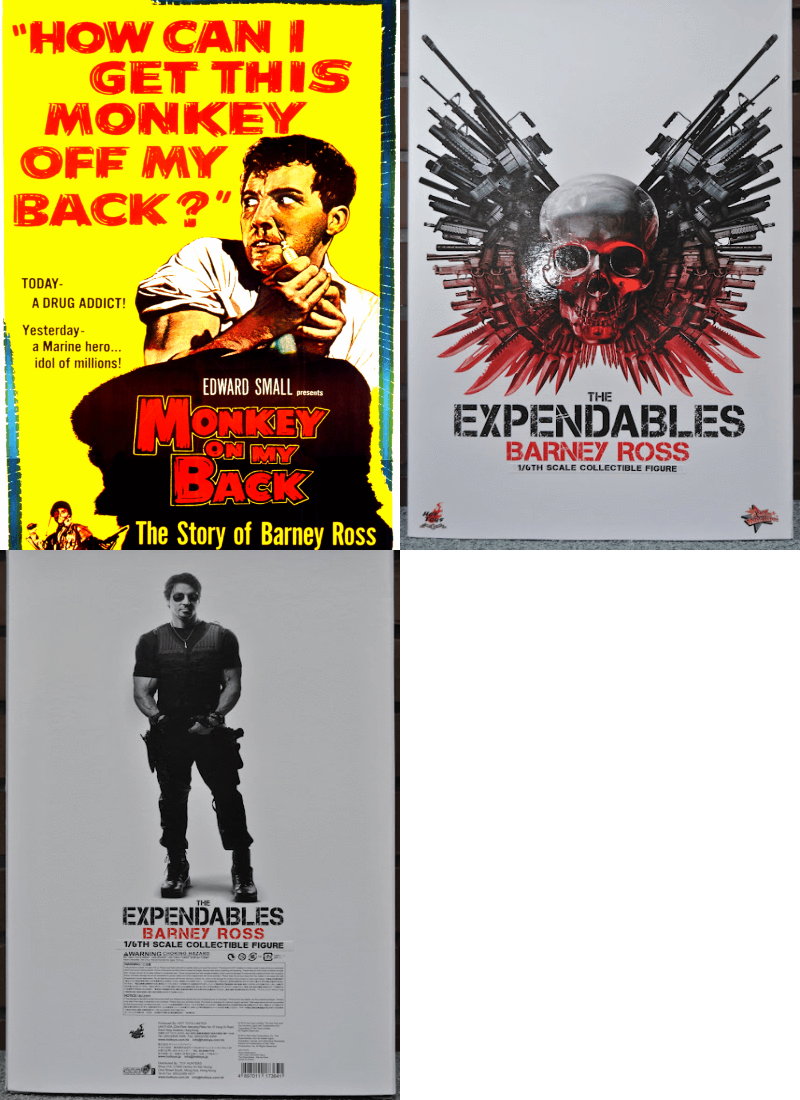
His story drew Hollywood attention. The 1957 autobiographical movie "Monkey on My Back" chronicled his addiction, though Ross approved the script but sued the producers for $5 million over advertising that implied he was still an addict, settling out of court in 1960 for $10,000. The 1947 boxing movie "Body and Soul" also bore so many obvious connections to Ross's life that the studio paid him $60,000 for what amounted to copyright infringement.
In his private life, Ross married twice but had no children. Like many fighters of the era, he loved his drink and was a carousing, chronic gambler, often blowing his purses and finding himself in debt to bookies, loan sharks, and even mobster friends. As mentioned in his autobiography No Man Stands Alone, after all his battles in and out of the ring, he held reuniting with his family and his win over Tony Canzoneri as his greatest accomplishments.
In his later years, Ross enjoyed celebrity status with a few small movie roles and became the proprietor of a successful Chicago lounge bearing his name. He worked several other minor businesses, made frequent casino appearances, and stayed loyal to his ghetto roots, even testifying as a character witness for his childhood friend Jack Ruby at his trial for killing Lee Harvey Oswald.
Ross died on January 17, 1967, at age 57 after a long bout with throat cancer—in a strange twist of fate, just two weeks after Ruby's death in prison while awaiting retrial. Elected to the International Boxing Hall of Fame in 1990, Ross is never forgotten; the fast-reloading mercenary character named Barney Ross, played by Sylvester Stallone in "The Expendables" movies, was chosen to honor the former world champion.
As we reflect on a great year of boxing in 2025 and set our sights on a promising 2026, I hope boxing fans with history in mind don't forget one of the sport’s greatest, Barney Ross, born 108 years ago today—a U.S. military veteran and professional boxer who was a guru of both the offensive and defensive sides of the game, a true master of the "sweet science," and a winner of world titles in three weight divisions.
December 23rd
1883: Dixie Kid was born in Fulton, Missouri
1902: Harry Forbes KO7 Frankie Neil
1903: Jack Blackburn W12 Sam Langford
1909: Barney Ross was born New York, New York
1925: George Godfrey W10 Martin Burke
1929: George Godfrey KO3 Leonard Dixon
1937: Tommy Forte W8 Joe Maffei
1939: Ceferino Garcia KO13 Glenn Lee
1945: Antonio Cervantes was born San Basilio, Columbia
1946: Billy Fox KO2 Reedy Evans
1948: Brown Lee W8 Percy Bassett II
Otis Graham W8 George LaRover
1952: George Benton W10 Charlie Joseph
1955: Henry 'Toothpick' Brown D8 Damazo Collazo
1959: Luis Rodriguez W10 Garnet 'Sugar' Hart
1972: Muhammad Rachman was born Merauke, Indonesia
1981: Bennie Briscoe KO6 Rick Noggle
1985: Khaosai Galaxy KO2 Edgar Monserrat
1993: Yasuei Yakushiji W12 Jung-Il Byun
1997: Satoshi Iida W12 Yokthai Sithoar
1998: Jesus Rojas W12 Satoshi Iida
2008: Daisuke Naito KO11 Shingo Yamaguchi
2010: Hugo Fidel Cazares W12 Hiroyuki Kudaka
2011: Suriyan Satorn KO10 Adrian Hernandez
2019: Ryota Murata TKO5 Steven Butler
Kenshiro Teraji TKO4 Randy Petalcorin
Moruti Mthalane TKO9 Akira Yaegashi
Roman Gonzalez TKO2 Diomel Diocos

 Print
Print