
Naoya Inoue's “Monster” Hand Wraps
Drama, Controversy Or Strategic Psychological Ploy?
(December 29th) Yes, a handwrap controversy arose before Naoya Inoue's fight against Alan Picasso on December 27th, 2025, at The Ring V: Night of the Samurai event in Riyadh.
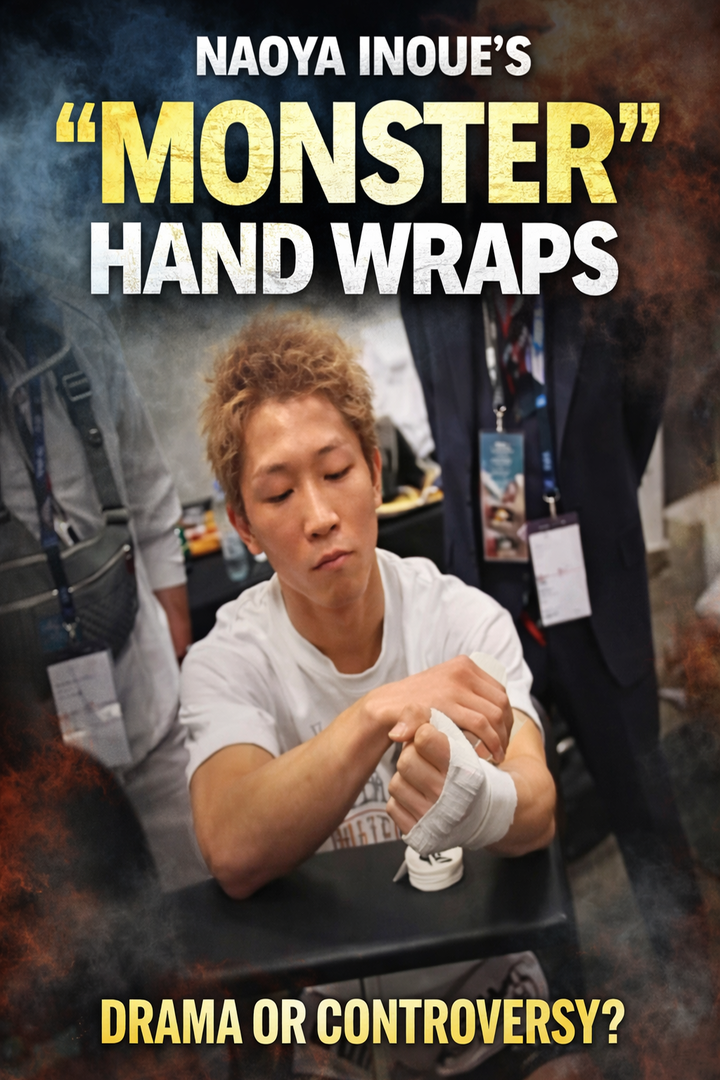
Picasso's team and the commission objected to Inoue's "stacking" technique—applying tape directly to the skin before gauze—which is allowed in Japan but restricted elsewhere due to concerns over creating a harder knuckle surface. Inoue was forced to remove and re-wrap his hands pre-fight, sparking backstage tension similar to a 2023 dispute with Stephen Fulton's team.
Despite the issue, Inoue dominated Picasso via unanimous decision (119-109, 120-108, 117-111), maintaining his 32-0 record and undisputed super bantamweight titles. Social media and reports highlighted cultural differences in wrapping rules between Japanese and Western commissions.
Naoya Inoue, born April 10, 1993, Zama, Kanagawa, Japan is a Japanese professional boxer widely regarded as one of the greatest pound-for-pound fighters of the modern era. Nicknamed “The Monster” Inoue is celebrated for his devastating punching power, elite speed, and rare technical precision.
Inoue turned professional in 2012 following a standout amateur career in which he recorded 75 wins and 48 knockouts. His rise was immediate and historic. In April 2014, just his sixth professional bout, Inoue captured his first world championship by stopping Adrian Hernández in six rounds to claim the WBC light flyweight title, becoming one of the youngest champions in boxing history.
He continued his rapid ascent by winning world titles across four weight classes—light flyweight, super flyweight, bantamweight, and super bantamweight—a feat achieved by only a select few fighters in boxing history. Along the way, Inoue established himself as one of the sport’s most dominant champions.
In 2022, Inoue made history by becoming the undisputed bantamweight champion, unifying all four major world titles. He repeated the achievement in 2023 at super bantamweight, making him one of only three male boxers in the four-belt era to become undisputed champion in two separate weight divisions.
Among his signature victories are two wins over future Hall of Famer Nonito Donaire, a career-defining knockout of Stephen Fulton Jr. to capture the unified super bantamweight titles, and a dominant performance against Marlon Tapales to secure undisputed status at 122 pounds.
Inoue’s excellence has been recognized globally. In June 2022, he became the first Japanese boxer ranked No. 1 pound-for-pound by The Ring magazine, cementing his place among the sport’s elite.
Known for his “fast and furious” fighting style, Inoue combines relentless pressure with surgical precision. His punishing body shots—particularly his famed liver punch—have ended fights instantly, while his perfectly timed straight right hand remains one of boxing’s most feared weapons.
As he continues to defend his undisputed super bantamweight titles, Inoue remains undefeated with a knockout percentage exceeding 80 percent, a rare mark of sustained dominance at the championship level. Having fully conquered two divisions, he has publicly expressed interest in eventually moving up to featherweight in pursuit of a world title in a fifth weight class.
The difference in hand wrapping between Japan and other regions (specifically parts of the United States and the UK) primarily boils down to a technique called "stacking" and the order in which materials are applied to the skin.
While the differences might seem technical, they often spark "loaded glove" controversies in major fights, most notably during the buildup to Naoya Inoue vs. Stephen Fulton in 2023.
1. The Core Difference: Stacking
The primary distinction is a method known as stacking (or layering):
- Japan (and Nevada/Mexico): Regulations generally allow trainers to alternate layers of gauze and tape. For example, they might apply a layer of tape, then gauze, then another layer of tape. This creates a more rigid, cast-like structure that stabilizes the wrist and small bones of the hand.
- Other US States (e.g., California/New York) & UK: Rules often dictate a "one-and-done" approach. You must apply the gauze first, and then the tape goes on top to secure it. You cannot alternate layers or put tape directly against the skin.
2. Tape on Skin
- In Japan: It is legal to apply a layer of athletic tape directly to the skin before the gauze is wrapped. Supporters say this provides maximum stability for heavy hitters.
- In Restricted Areas: Many commissions require a layer of gauze to be placed against the skin first. Putting tape directly on the skin is seen by some as creating a "harder" surface, though most experts agree this is for hand protection rather than increasing punching power.
3. Knuckle Padding
- The Global Standard: Almost all commissions (including Japan) strictly forbid placing tape over the knuckles. The impact surface must only consist of gauze.
- The Dispute: During the Inoue-Fulton controversy, Fulton’s trainer (Wahid Rahim) argued that Inoue's "stacking" method essentially created a "plaster cast" effect. Inoue famously dismissed this, noting that he follows the rules of the local commission (Japan) and has used various methods in Vegas and the UK with the same knockout results.
Not boxings first handwrap debate or scandal, you could go back to one of the oldest and most debated scandals in the sport. The legend having Jack Dempsey vs. Jess Willard – 1919. Dempsey, a much smaller man, destroyed the giant Jess Willard, reportedly breaking his jaw, ribs, and cheekbones. Rumors persisted for decades that Dempsey had hidden a railroad spike in his palm or used plaster of Paris. Most modern historians and film analysts have debunked this, noting that Dempsey's "loaded" hands would have likely broken under the force of his own punches if they were hardened with plaster. However, it remains a foundational "bad wrap" legend.
Clearly the most tragic, Luis Resto vs. Billy Collins Jr. -1983. This is the darkest chapter in boxing history. Luis Resto, an underdog, battered the undefeated Billy Collins Jr. for ten rounds, leaving Collins with permanent vision damage. After the fight, Collins' father shook Resto’s hand and realized the gloves felt "thin." An investigation found that Resto’s trainer, Panama Lewis, had removed an ounce of padding from the gloves and soaked the handwraps in Plaster of Paris, turning Resto's fists into rocks. Resto and Lewis were convicted of assault and served prison time. Collins, unable to fight again due to his injuries, tragically took his own life a year later.
The there was the “Technical Dispute” Felix "Tito" Trinidad vs. Bernard Hopkins – 2001. The most direct parallel to Naoya Inoue's situation because it involved stacking, before the fight, Naazim Richardson noticed that Trinidad’s team was alternating layers of tape and gauze. While this was legal in some regions, it was strictly illegal in New York, where the fight was held.
After a tense standoff in the dressing room that delayed the walkouts, Trinidad was forced to unwrap and re-wrap his hands using the gauze-then-tape method. Without his usual support, Trinidad appeared to lose some of his signature "thudding" power and was eventually stopped by Hopkins.
Then in modern infamy we have Antonio Margarito vs. Shane Mosley – 2009. While the Inoue controversy often draws comparisons to this, the two are fundamentally different. Minutes before the fight, Mosley’s trainer (Naazim Richardson) (again the "wraps detective") noticed a white, chalky substance falling out of Margarito’s wraps. Officials discovered a hidden "insert"—a pad treated with sulfur and calcium that would harden into plaster once moistened by sweat.
Margarito was forced to re-wrap his hands, lost the fight by TKO, and was subsequently banned from boxing for a year. This incident cast a shadow over his previous "Monster-like" victory over Miguel Cotto, whom many believe he fought with loaded wraps.
With actual proven violations being rare we have seen this procedure examined many times – Julio César Chávez vs. Meldrick Taylor - 1990, Taylor’s team later raised concerns about wrap thickness and hardness, the claims were never upheld, yet the discussion entered boxing folklore due to the fight’s brutal ending. Complaints made towards Floyd Mayweather Jr. pre-fight versus Manny Pacquiao 2000 and Marcos Maidana 2010, Brandon Rios accusing Manny Pacquiao 2013, all without formal penalties shows how dominant punchers often face scrutiny regardless of compliance and illustrates how handwrap disputes are sometimes simply strategic or psychological.
Key differences highlight the events' severity and intent: Inoue's issues revolve around procedural and jurisdictional rule variations—essentially a clash of boxing cultures—without evidence of foreign substances or deliberate harm, allowing quick resolutions and no penalties. Margarito's, however, was a clear case of tampering that posed real safety risks, tarnishing his career, prompting bans, and fueling debates over whether it occurred in multiple fights, though only proven once. Both underscore the importance of wrap inspections, but Inoue's feels more like a technicality, while Margarito's evokes infamous cheaters like Luis Resto, whose 1983 plaster-laden gloves against Billy Collins Jr. caused permanent injury.
All that said: Naoya Inoue’s career stands as a defining chapter in modern boxing—one built on historic achievements, elite skill, and a relentless pursuit of greatness. You make the call...

 Print
Print