
The International Boxing Federation
(IBF) Strips Janibek Alimkhanuly!
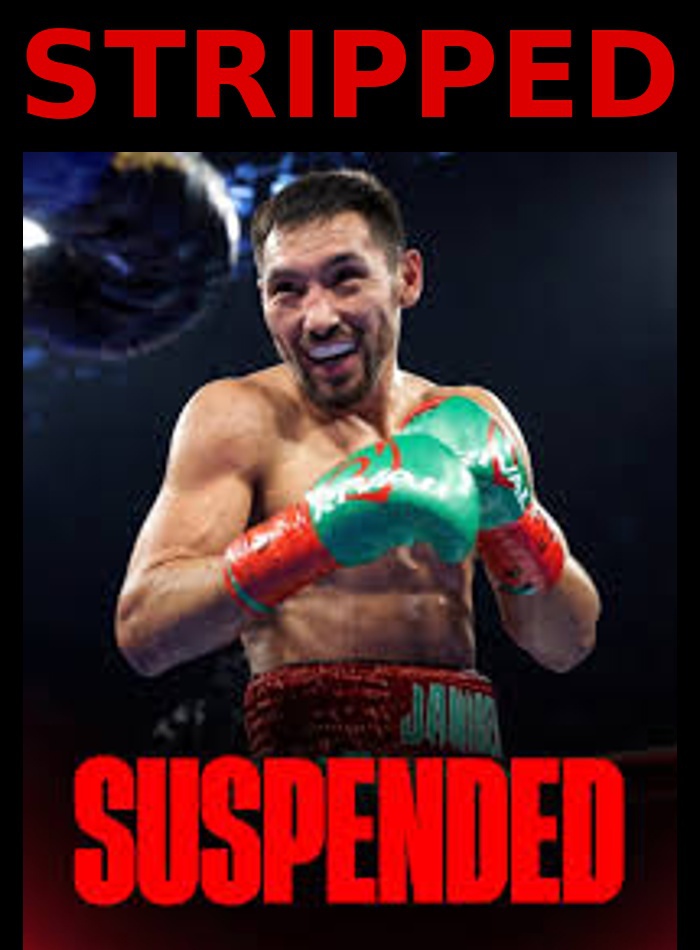
(March 11th) The International Boxing Federation (IBF) has stripped Janibek “Qazaq Style” Alimkhanuly of its middleweight world title and declared the championship vacant, following his positive test for the banned substance meldonium and a resulting suspension that makes him ineligible to meet his mandatory title obligations.
In May 2025, Alimkhanuly, received emergency medical treatment in Kazakhstan for severe neurological symptoms later diagnosed as a transient ischemic attack (TIA), during which he was prescribed Ripronat, a medication legal domestically that contains meldonium. A VADA-administered random drug test in mid‑November 2025 subsequently detected meldonium in his system, and both the A and B samples returned adverse findings.
On December 2, 2025, Alimkhanuly was provisionally suspended after the positive result became known, leading to his removal from a planned December 6 middleweight title unification bout with WBA champion Erislandy Lara in San Antonio. The Kazakhstan Professional Boxing Federation (KPBF) later reviewed the case, finding that the drug entered his system via prescribed Ripronat after the TIA and determining he was negligent “to a minimal degree.”
The KPBF imposed a suspension on Alimkhanuly retroactive to December 2, 2025, initially set at six months and requiring him to undergo random testing before returning. Separately, the WBO World Championship Committee handed down a one‑year suspension from all boxing and exhibition events, also effective retroactively from December 2, 2025, but allowed him to retain its middleweight title under strict testing conditions.
Under IBF Rule 18, any boxer serving a suspension for an anti‑doping violation is barred from being ranked or taking part in IBF‑sanctioned contests for a period of one year from the start of the suspension. Applied to Alimkhanuly, this rules-based ineligibility runs through December 2, 2026, extending beyond his home commission’s shorter competitive ban and effectively freezing him out of IBF activity for a full year.
The IBF had scheduled Alimkhanuly’s mandatory defense of its middleweight title to take place on or before July 4, 2026, with formal notice of that obligation due to be sent around May 4, 2026. Because the one‑year ineligibility window under IBF Rule 18 covers the entire period up to December 2, 2026, he is unable—both physically and legally—to fulfill that mandatory defense within the required timeframe.
IBF Championships Committee chairman George Martinez noted in the ruling circulated to the Board that Alimkhanuly “is unable to fulfill his mandatory defense obligation on July 4, 2026,” concluding that the middleweight title “should be vacated immediately.” Following a teleconference review, a majority of the IBF Board voted that, in light of the anti‑doping suspension and missed mandatory deadline, the IBF Middleweight Title would be declared vacant with immediate effect.
While the IBF applied its rule framework to strip Alimkhanuly and remove him from its rankings for the full one‑year ineligibility period, the WBO opted for a different approach. The WBO’s one‑year suspension, retroactive to December 2, 2025, sidelined him from all WBO‑sanctioned activity but did not include vacating its middleweight belt, instead tying his continued recognition as champion to year‑round random testing through a WADA‑certified program.
With the IBF Middleweight Title now vacant, the sanctioning body is expected to move quickly to keep the division active. Asti, Italy’s, #2-ranked, Etinosa “El Chapo” Oliha currently unbeaten at 22‑0 with 10 knockouts and Sheffield, UK’s #3-ranked Shakiel “Dr. Steel” Thompson, 15‑0 with 11 knockouts, are among the top‑ranked contenders and are widely anticipated to be ordered to meet for the vacant championship.
In addition, following the collapse of the previously scheduled unification clash with Erislandy Lara, the IBF has left open the possibility of matching its leading available contender with the reigning WBA middleweight champion if negotiations for an immediate title fight can be successfully concluded. Together, these moves are designed to re‑energize the 160‑pound landscape while the 32 year old, Oxnard, California, based Kazakhstan 2016 Olympian, Alimkhanuly, 17-0, 12Ko’s serves out his suspension and attempts to rebuild his standing in the sport.
The International Boxing Federation (IBF) is one of boxing’s four major world sanctioning bodies, recognized alongside the WBA, WBC, and WBO as a primary authority for professional world titles.
The IBF traces its roots to the United States Boxing Association (USBA), a national body formed in the late 1970s to organize and regulate American title fights. In 1983, USBA president Robert W. “Bobby” Lee Sr., having failed in a bid to become president of the WBA, led a move to expand the USBA into a world‑level organization.
That expansion created the USBA‑International (USBA‑I), effectively the first iteration of the IBF as a global sanctioning body. In 1984, the group formally adopted the name International Boxing Federation/United States Boxing Association (IBF/USBA), reflecting both its world-championship ambitions and its U.S. regional structure.
In its early years, the IBF boosted its credibility by recognizing already established champions—such as Larry Holmes, Marvin Hagler, Aaron Pryor, and Donald Curry—as IBF titleholders in their divisions. Holmes’ decision to accept IBF recognition as heavyweight champion, even relinquishing his WBC belt in the process, gave the new body immediate visibility.
The IBF quickly grew into a full-fledged world sanctioning organization, adding champions across weight classes and becoming widely accepted by promoters, television networks, and commissions. By the late 1980s, it was firmly entrenched as the “third” major body, and later as one of the four dominant organizations in modern championship boxing.
The federation’s reputation suffered a major blow in the late 1990s when U.S. federal authorities charged founder Robert W. Lee Sr. and others with racketeering and related offenses involving the sale of rankings and other corrupt practices. After a lengthy investigation and legal process, Lee was convicted, and the IBF was placed under federal monitoring into the mid‑2000s.
During this period, interim leaders worked to overhaul governance and restore credibility, emphasizing transparency in rankings and title decisions. Hiawatha Knight, a long‑time official and safety advocate, became the first woman to lead a global boxing sanctioning body when she assumed the IBF presidency in the wake of the scandal.
Today, the IBF is headquartered in New Jersey and operates a dual system of world titles and regional belts under the USBA banner. It is best known for relatively strict enforcement of mandatory defenses and clear ranking procedures, often ordering top contenders to face each other rather than allowing long delays.
The organization sanctions world championship bouts in all traditional professional weight classes for men and, since 2010, has also maintained rankings and titles for women, crowning Daniella Smith as its first female world champion. As of the late 2010s and 2020s, Daryl (Daryl/Darryl) J. Peoples has served as IBF president, overseeing continued efforts to emphasize rule-based title management and standardized regulations across its global membership.
The IBF’s red-and-gold world championship belt is a staple in major unification fights, and its titles frequently feature in multi‑belt showdowns broadcast worldwide. Its combination of mandatory challenger enforcement and relatively transparent rankings has earned it a reputation among many observers as one of the more rule‑driven organizations in a fragmented sanctioning landscape.

 Print
Print