
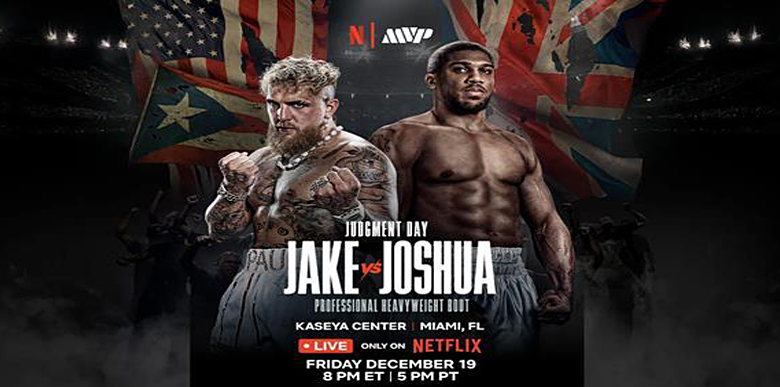
Jake Paul vs Anthony Joshua “Judgment Day”:
A Structural Threat To Professional Boxing?
(click here)
Phil Kane
(December 20th) The Jake Paul–Anthony Joshua “Judgment Day” bout represented far more than a controversial matchup. It exposed fundamental fractures in boxing's competitive integrity, safety protocols, and meritocratic foundations. While the event generated massive financial returns—with combined backend money and sponsorships suggesting the overall value of the deal could reach $267 million—the fight’s total guaranteed purse of about $184 million was split 50/50, roughly $92 million for each fighter before taxes and expenses. The fight's structural implications have prompted widespread condemnation from boxing professionals, regulators, and analysts, who view it as emblematic of the sport's drift toward spectacle over substance.
The disparity between the two fighters—a dangerous physical and skill mismatch—was staggering by any professional standard. Joshua, a former two-time unified heavyweight champion and Olympic gold medalist, entered the ring at 243.4 pounds on a 6'6" frame. Paul weighed 216.6 pounds at 6'1"—a 27-pound weight differential and five-inch height disadvantage that created a six-inch reach gap. Joshua's résumé includes victories over elite heavyweights like Wladimir Klitschko, Alexander Povetkin, Andy Ruiz Jr., and Joseph Parker, plus 25 career knockouts from 28 victories.
In stark contrast, Paul's professional record entering the bout stood at 11-1, with his sole defeat against Tommy Fury at cruiserweight. He had never faced a ranked heavyweight or a former world champion in their prime and lacked the amateur pedigree that typically underpins elite professional careers.
The physical consequences were severe and predictable. Despite his so-called cat-and-mouse fight plan, the self-proclaimed “Disruptor of Boxing” was knocked down twice—in round five and round six. With Paul reportedly sustaining a double-broken jaw, the fight was stopped in the sixth round.
Former world champion Richie Woodhall described the matchup as "really dangerous," noting that even established full-time professionals giving up that much weight against Joshua could be "seriously hurt." The medical outcome validated pre-fight warnings that one clean Joshua right hand could cause catastrophic damage to a far less experienced opponent.
In the only pro sport where competitors pick and choose opponents, professional boxing continues to wrestle with criticism over its fractured, often inconsistent ranking system, governed by sanctioning bodies such as the WBC, WBA, IBF, and WBO. In theory, championship opportunities are earned through sanctioned bouts, eliminators, and mandatory challenges against progressively tougher opposition. Anthony Joshua rose through that traditional route, building credentials via years of amateur success and rigorous professional competition.
Jake Paul’s recent leapfrogging defied that structure entirely. Despite never appearing in any major organization’s top rankings, he secured a bout with a WBC top-three heavyweight, bypassing dozens of established contenders who have spent years navigating the system. Paul himself described the matchup as an intentional shortcut to title contention, arguing that a win over Joshua should silence critics and validate his claim to an immediate world title shot.
Remember when the competition itself was the entertainment? This fight was structured as an eight-round, ten-ounce-glove, made-for-streaming event with bespoke stipulations, including a 245-pound cap for Joshua and a late change to a much larger 22-foot ring—designed explicitly for entertainment and marketability rather than to establish legitimate heavyweight hierarchy. Critics argue this arrangement sends a destructive message: that celebrity and social media reach can replace years of competitive development and ranking progression.
Boxing commissions historically block extreme mismatches due to injury risk, particularly in the heavyweight division, where concussion and fatality rates are highest. Despite widespread safety protocol violations and regulatory concerns, the Florida Athletic Commission sanctioned the Paul–Joshua bout—even as professionals warned it could result in serious injury or demand investigation if Paul escaped significant harm.
Association of Boxing Commissions President Michael Mazzulli has stated that when rules or matchups are altered to accommodate celebrity competitors, the designation "professional boxer" loses meaningful definition. The Paul–Joshua fight exemplified this; critics noted Paul spent much of the contest in survival mode, employing frequent clinching and a questionable low-blow claim in the fourth round to gain recovery time. UFC President Dana White publicly condemned the bout as a "fucking bad idea," reflecting broader consensus within combat sports leadership that it prioritized revenue over participant safety and competitive integrity.
The overwhelming skill disparity—Joshua's 28-4 record with 25 knockouts against Paul's 11-1—fueled speculation that the fight was scripted or rigged merely to let Paul survive several rounds. The live audience at Miami’s Kaseya Center repeatedly booed through the early rounds over the lack of authentic engagement, while social media debates centered on whether Joshua was deliberately restraining himself.
Analysts of influencer boxing view the Paul–Joshua bout as the clearest example of eroding professional standards and sporting credibility, warning that blurring entertainment and elite competition undermines the legitimacy real fighters spend careers building. When sanctioning bodies, broadcasters, and promoters prioritize record purses over competitive integrity, it deepens public belief that boxing now operates more as commercial theater than true sport. The event was labeled a “sham,” “farce,” “clown show,” and “budget sporting spectacle” by observers from legacy media and boxing experts to active fighters—many arguing it inflicted more reputational harm than Paul’s prior exhibition with the 58-year-old Mike Tyson, as this involved an active, world-class contender.
The Paul–Joshua event exemplified the opportunity cost to legitimate contenders, consuming prime broadcast dates, promotional budgets, and media attention that could have supported genuine heavyweight matchups. Instead of Joshua facing ranked challengers like Daniel Dubois—who had recently defeated him—or pursuing mandatory opponents, the division stagnated as resources funneled toward celebrity crossover content.
Promoter Lou DiBella argued that the “circus” nature of such events siphons sponsorship and exposure from rising professionals lacking Paul’s 20-million-subscriber social media platform. Each mega-crossover spectacle represents lost career momentum for ranked fighters relying on the traditional ladder to earn visibility, credibility, and fair purses. Joshua reportedly earned £80 million for a non-title bout against an inexperienced opponent, raising ethical questions about whether financial incentives should outweigh competitive duty to the sport’s merit-based framework.
The precedent set by Paul–Joshua signals long-term damage to boxing’s cultural and athletic pipeline, with consequences reaching far beyond one spectacle. Aspiring fighters may come to believe social media fame outweighs the discipline of amateur development and gradual professional progression—eroding grassroots foundations, amateur systems, and long-term athlete development that sustain competitive integrity.
Historically, crossover experiments like Muhammad Ali versus Antonio Inoki were positioned as exhibitions marketed as entertainment, not legitimate contests. Earlier examples include John L. Sullivan touring with stage-like fights in the late 1800s; Jack Dempsey battling wrestlers like Cowboy Luttrell in the 1930s–1940s; 67-year-old Jack Johnson sparring Joe Jeannette in 1945; George Foreman fighting five opponents in 15 minutes in 1975; Ray Mercer versus Tim Sylvia in 2009; and James Toney challenging Randy Couture in a sanctioned MMA bout at UFC 118 in 2010. None counted toward official boxing records.
That narrative shifted on August 26, 2017, with Floyd Mayweather’s “The Money Fight” against Conor McGregor, cementing his 50-0 record in a sanctioned crossover—surpassing Rocky Marciano’s heavyweight mark of 49-0. Other unbeaten boxers like Jimmy Barry (61-0-10), Sven Ottke (34-0-6), Jack McAuliffe (30-0), Ricardo López (51-0-1), Joe Calzaghe (46-0), Julio César Chávez (87-0), Willie Pep (62-0), Luis Campas (56-0), and Nino La Rocca (56-0) simply accumulated 50+ wins without retiring on the milestone. Promoting Paul versus Joshua as an official pro bout—amid boxing’s foggy history of special belts, 12-round title fights, new weight divisions, 24-hour weigh-ins, and women’s three-minute rounds—further blurs distinctions between authentic sport and spectacle.
For over a century, boxing titles have symbolized continuous competitive excellence. Joshua’s résumé, built through credentialed world-class victories, embodies that tradition. Facing a social-media celebrity brings no athletic merit to that legacy; it diminishes championship achievement and feeds perceptions that commercial value outranks sporting worth.
From a strictly sporting standpoint, the Jake Paul–Anthony Joshua event advanced no legitimate competitive, safety, or institutional interest in professional boxing. It disregarded sanctioned rankings, weakened safety standards, devalued championship lineage, and hastened the sport’s slide from regulated competition toward attention-driven spectacle.
Though the event produced exceptional revenue and exposure, it did so at the expense of meritocratic structure, safety oversight, and authenticity separating true sport from commercial entertainment. The glaring skill gap, regulatory leniency, and sidelining of deserving contenders set a perilous precedent—one that, if normalized, risks eroding boxing’s credibility as a disciplined profession.
From a commission and legal perspective, promoters pursue fights like Paul versus Joshua because boxing’s regulatory structure lets commercial incentives outweigh sporting integrity with minimal resistance. Commissions focus on sanctioning safety, licensing, and contractual compliance—not rankings, merit pathways, or ecosystem health. As long as medicals clear, purses bond, insurance meets requirements, and fighters consent, they lack authority to deny bouts on competitive grounds alone—creating a permissive environment for spectacles unthinkable in centralized leagues.
Financially, these fights concentrate revenue—PPV sales, broadcast deals, site fees, sponsorships—often exceeding several title bouts, with no requirement to reinvest in development. Promoters’ fiduciary duty favors business interests over sport health, so short-term monetization overrides long-term considerations.
Popularity as a monetizable asset has shifted the balance: contracts emphasize social media reach and brand activation over legitimacy. Rankings carry no legal weight; sanctioning bodies collect fees but lack enforcement to prevent bypasses. This lets promoters hollow out meritocratic signaling legally while sending corrosive cultural messages.
Risk allocation favors promoters: fighters bear physical danger via bout agreements waiving liability beyond negligence. Broader risks—lineage erosion, amateur credibility loss, distorted incentives—are externalities absorbed by the ecosystem, with no penalties for weakening the talent pipeline. Casual audiences, easier to monetize and less critical of matchmaking, require no contextual education from promoters.
When compared to past crossovers, this represents escalation: earlier novelties like Ali–Inoki stayed outside competitive lineage; Mayweather–McGregor was an elite exception under modified rules. Modern influencer events normalize minimal-pedigree fighters as top-contender equivalents, competing directly with legitimate bouts for resources and influencing young fighters’ incentives.
Promoters push such fights not from misunderstanding but because the framework rewards attention over merit—monetizing fame rapidly, bypassing rankings consequence-free, and externalizing damage while staying compliant. Boxing survives on structure and continuity; spectacle on attention. Until commissions, sanctioning bodies, or markets alter that calculus, promoters will prioritize short-term profit over long-term integrity.
About Jake Paul
The American pride of Puerto Rico, Jake “El Gallo de Dorado” Paul has shown tremendous growth as a boxer on his path to becoming a world champion, and now will look to prove he has what it takes against one of the most feared punchers in boxing and greatest pound-for-pound heavyweights in the world, Anthony Joshua. In just five years since turning pro, Paul has made his impact in the ring, earning high-profile victories over names like Tyron Woodley, Anderson Silva, and Nate Diaz. His viral knockouts and headline-grabbing performances have breathed new life into boxing, drawing millions of fans and setting records. In November 2024, Jake Paul defeated the Baddest Man on the Planet, Mike Tyson in a heavyweight bout in the first-ever live professional sporting event on Netflix. Paul vs. Tyson shattered records, becoming the most-streamed sporting event ever with 108 million live viewers globally. Paul most recently returned to the ring in June 2025 to face former world champion Julio Cesar Chavez Jr., earning a unanimous decision victory and entering the WBA cruiserweight rankings at #14 with the win. Paul has collected multiple accolades for his commitment to the sport of boxing, including ESPNRingside’s 2021 Knockout of the Year, Sports Illustrated’s 2021 Breakout Boxer of the Year, ESPNRingside’s 2022 Viral Moment of the Year, and was the cover of Sports Illustrated’s “The 50 Most Influential Figures in Sports” issue, awarded specifically for his groundbreaking work to revolutionize the sport through equitable pay, providing a platform for young fighters, and his support of female boxers. Paul also partnered with USA Boxing ahead of the 2024 Paris Olympics, continuing his mission to elevate the sport and its future champions.
About Anthony Joshua
Anthony “AJ” Joshua claimed Olympic gold for Team Great Britain at London 2012 before becoming one of the biggest heavyweight stars in the world. In April 2016, he destroyed then-IBF titleholder Charles Martin to win his first world title, successfully defending it twice before defeating legend Wladimir Klitschko in an unforgettable battle in front of 90,000 at England’s national stadium in April 2017 to unify the division and earn the WBA title. He unified the division again in March 2018 by defeating Joseph Parker to become the WBO, IBF and WBA world champion, successfully defending the belts against Alexander Povetkin at Wembley Stadium in September 2018. In his American debut at Madison Square Garden, he lost his unbeaten record to Andy Ruiz Jr, but avenged the loss in Saudi Arabia in December 2019 to become a two-time unified WBO, IBF, and WBA heavyweight champion. The now-36-year-old followed that up with a KO victory over mandatory challenger Kubrat Pulev at Wembley Arena a year later before testing himself on two occasions against pound-for-pound powerhouse Oleksandr Usyk. Still hungry, Joshua moved to Dallas, Texas to work under new trainer Derrick James before returning to the UK to fight Jermaine Franklin at the O2 in April 2023, earning his 25th career victory with a wide points decision in his first fight back at the dome since 2016. AJ then fought Robert Helenius on short notice, earning a devastating knockout of the year contender in the seventh round, then landed a headline slot in Saudi Arabia in December 2023 against Otto Wallin, who retired on his stool at the end of the fifth round. In March 2024, Joshua delivered a devastating second-round Knockout of the Year against MMA star Francis Ngannou. In pursuit of becoming a three-time heavyweight world champion, Joshua most recently took on then-IBF title holder, fellow Brit and former sparring partner Daniel Dubois in front of 96,000 fans at Wembley Stadium in September 2024.
About MVP
MVP was founded by Jake Paul and Nakisa Bidarian in 2021. With the mission to provide more creative control to fighters, MVP works to identify, grow, and maximize return for its own events and talent partners. One year into its inception, MVP was nominated as one of the prestigious Sports Breakthroughs of the Year in 2022 by Sports Business Journal. MVP has produced Jake Paul’s last seven global pay-per-view events, including the recent Paul vs. Chavez Jr. match. The promotion company also signed one of the most decorated Hispanic athletes of all time, Amanda Serrano in its first year. Serrano and MVP made history in April of 2022 when Serrano went head to head with Katie Taylor, marking the first female fight to headline at Madison Square Garden, earning a nomination for Event of The Year by Sports Business Journal. MVP made history again in November 2024 with Jake Paul vs. Mike Tyson and Katie Taylor vs. Amanda Serrano 2, the first-ever live professional sports event on Netflix. MVP’s Paul vs. Tyson streamed live globally on Netflix and shattered records, becoming the most-streamed sporting event ever with 108 million live viewers globally. MVP followed that up by Katie Taylor vs. Amanda Serrano 3 in July 2024 the first all women’s boxing card to be featured on Netflix. Co-founder Nakisa Bidarian was an executive producer of Paul vs. Tyson and the historic Triller Presents Mike Tyson v. Roy Jones Jr., which was the 8th most bought pay-per-view event in history.
About Netflix
Netflix is one of the world's leading entertainment services, with over 300 million paid memberships in over 190 countries enjoying TV series, films, live events and games across a wide variety of genres and languages. Members can play, pause, and resume watching as much as they want, anytime, anywhere, and can change their plans at any time.

 Print
Print